The question of how many marketing tasks (and, therefore, marketing jobs) can and should be automated has been debated for years. There are many possible answers.
Some believe that marketing automation will lead to significant job loss. Others argue that, at best, automation will allow large organizations to manage their marketing efforts as efficiently as smaller ones, and create new roles for those who oversee the increasingly complex technology.
But is the biggest threat that AI is making marketing less interesting rather than eliminating the need for it?
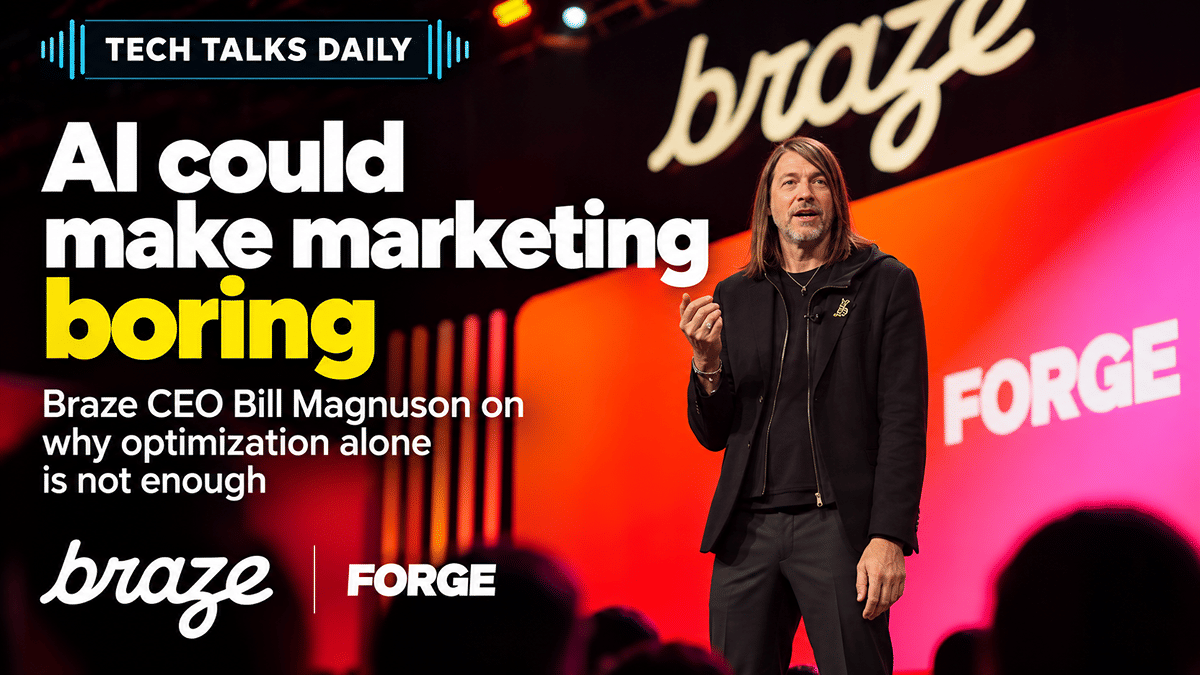
Braze CEO Bill Magnuson made that argument with unusual directness during the opening keynote at Forge 2026 in Las Vegas. His concern was not that machines would remove humans from marketing, but that companies using the same models, the same tools, the same data, and increasingly the same optimization techniques could gradually converge on the same ideas.
Magnuson described a future in which "everything is optimized, nothing breaks through, and it's all just fucking boring."
Generative AI is getting very good at creating content that is believable, professional-looking, and looks like what has come before. Provide a model with a campaign brief, a press release, a promotional e-mail, a blog article or a product description, and it will likely generate some acceptable material in just a few seconds.
The issue here is that serviceable is rapidly becoming cheaper, while being distinctive remains challenging. The marketing sector has been touting "better" personalization for years as a solution. Businesses will better understand their customers through more data. Automation will enable businesses to act at the appropriate time. Every interaction will ultimately be individually optimized with the help of AI, and all those things are starting to become realities.
When efficiency becomes sameness
The current conversation around AI return on investment can get fuzzy when businesses demand measurable outcomes from costly technology purchases. So they begin measuring hours saved, tasks automated, campaigns created, and content developed. These are very valuable metrics for measuring business efficiency; however, these are only part of the overall picture.
AI is dramatically reducing the cost of playing it safe. A mediocre campaign once required people to write, design, configure, approve, distribute, and measure it. Producing forgettable work still consumed resources, which naturally limited volume.
Generative and agentic systems are beginning to remove much of that friction. Organizations will soon be able to generate hundreds or thousands of variations, test them continuously, and allow algorithms to optimize performance automatically.
On paper, this sounds like an obvious improvement. In practice, a basic distinction exists between optimizing an idea and having a good idea. A machine can determine which of 500 subject lines performs best, but it cannot guarantee that any of them deserved to exist in the first place.
For companies investing heavily in agentic systems, this raises an uncomfortable operational question. What is the value of AI that can act at machine speed if it removes brand distinction?
Another cultural element is at play. Businesses have layered creative workers under layers of administration (reporting, approval, channel management, campaign operations, etc.) for years. AI will automate some of this work; however, simply giving people back the time they saved will not increase creativity. Leaders must decide how employees use the free time they now have.
A business that misunderstands AI's potential could cut its marketing operations by 50% and then fill the resulting open time with twice as many deliverables. Conversely, a business that uses AI to automate administrative tasks and free up time for customer research, experimenting with new ideas, developing original thought, and making thoughtful decisions may discover something much more valuable.
When average becomes almost free
An irony sits at the center of the current AI boom. Artificial intelligence is making it easier than ever to produce work that looks polished and professional, which could make truly distinctive work more valuable, not less.
When creating vast quantities of content stops being impressive, personalization becomes infrastructure. The real advantage then moves toward judgment, context, experience, and the willingness to reject the obvious answer. It may also move toward something much harder to automate, like taste.
None of these things negate AI. Machines can reduce repetitive labor, evaluate numerous alternatives, recognize patterns, and perform tasks rapidly. These abilities will give employees something that has grown exceedingly rare in today's organizations: time to think through the work they do.
The real issue facing organizations is what they plan to do with that time. Organizations that use AI to increase production may be surprised to find themselves with exceptionally productive systems for creating average-quality products at massive scale. Organizations using AI to help workers explore ideas differently, understand clients, test new ways of working, and produce something worth remembering may have an advantage their competitors cannot effectively replicate through automation.
If Magnuson is right, the biggest threat from AI in marketing may have little to do with machines taking human jobs. The greater risk is that humans hand over so much judgment to machines that everything begins to look perfectly optimized and remarkably similar.
Efficiency has always been valuable. In an AI economy, originality may become expensive enough to matter even more.