
How many downloads does your podcast get? It is one of the most common questions I hear from sponsors, PR teams, and companies considering working with Tech Talks Network. I understand why it gets asked: downloads are familiar, measurable, and easy to compare. But I have increasingly come to believe they tell only part of the story when evaluating the value of a modern business podcast.
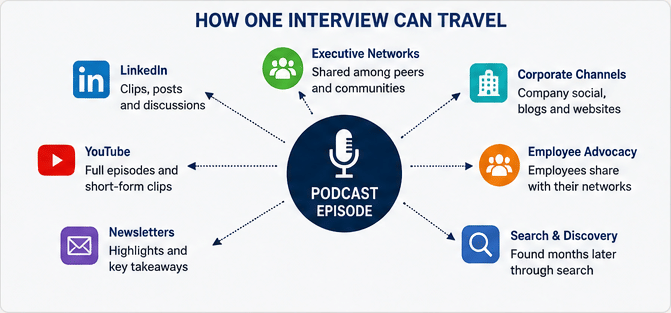
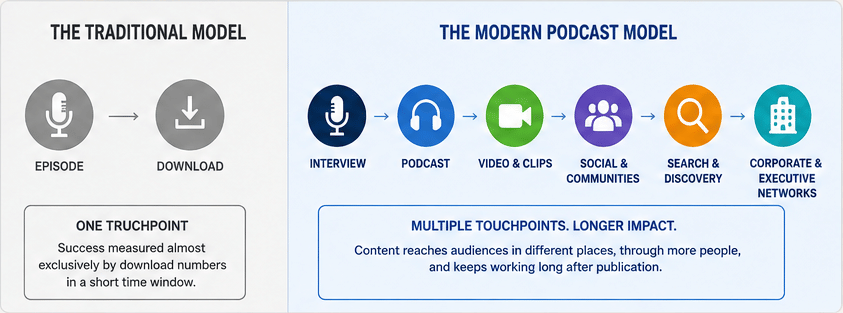
Podcasting has changed dramatically from the days when an episode was published, downloaded, and then effectively disappeared into an archive. Today, a single interview can move across LinkedIn, YouTube, newsletters, company websites, executive social channels, employee advocacy networks, search engines and internal communications.
The audio download remains important, but it is now one touchpoint among many, which means the better question for sponsors is not simply how many people downloaded an episode, but how far that conversation can travel.
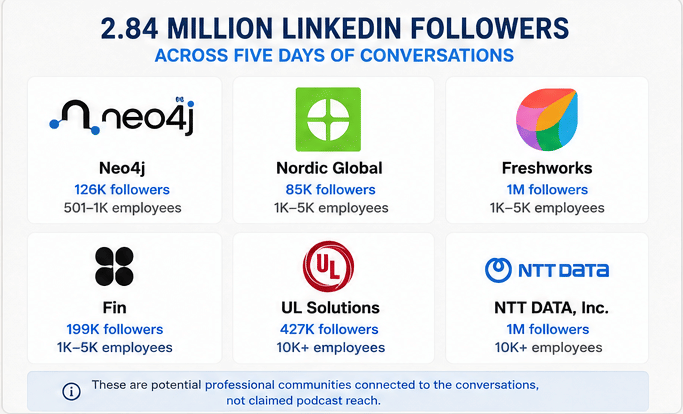
For example, in a recent five-day publishing period on Tech Talks Network, I published interviews involving Neo4j, Nordic Global, Freshworks, Fin, UL Solutions, and NTT DATA. Those companies collectively have around 2.84 million followers on LinkedIn alone.
To be clear, I am not suggesting that 2.84 million people listened to those interviews or even that every one of those followers saw the content, because that would be misleading. What the number does demonstrate, however, is the scale of the professional communities connected to the conversations taking place on the network.
Every interview introduces another organization, another executive, another set of colleagues, customers, partners, and followers, and another potential route through which the content can be discovered and shared. This distinction matters because podcasting is no longer only about building an audience. It is also about building a network around that audience.
When I publish an interview with a senior business leader, the episode quickly reaches my existing audience. But the guest can share it, the company can amplify it, employees can discuss it, and customers might reference it. Episodes can also be clipped for LinkedIn, watched on YouTube, and found through search months later.
Ultimately, one conversation can create several layers of reach that will never appear in a traditional podcast download report. A thousand listeners working in technology leadership, cybersecurity, AI, enterprise software, or digital transformation can be far more valuable to the right sponsor than tens of thousands of people with little connection to the topic.
Audience size matters, but so do who is listening, what role they play, which companies they work for, and whether the content aligns with the problems they are trying to solve. This is also why I think sponsors should look beyond simple cost-per-thousand calculations when assessing business podcasts.
Authority is another part of the equation that download figures cannot capture particularly well. When senior executives from major organizations repeatedly agree to spend time discussing the issues affecting their industries, it builds trust and credibility around the platform itself. Companies are effectively placing their leaders into a conversation because they believe the audience, host, and editorial environment are relevant to them.
This matters to sponsors because association has value.
A sponsor is not simply appearing before several anonymous listeners. They are placing their brand alongside ongoing conversations involving CIOs, CTOs, CEOs, founders, researchers, and senior technology leaders from organizations around the world.
In a B2B environment, that context can be as important as audience size because it affects how the sponsor is perceived and who sees them alongside the content. There is also the issue of amplification.
An episode published today may begin as a long-form interview, but it can quickly become several pieces of content. A strong answer can become a short video clip. That clip can become a LinkedIn post. The conversation can appear in a newsletter, on YouTube, or in search results, and the guest or their company can share it with an entirely different audience from the one already following the podcast.
This is one of the biggest reasons I believe podcasting should be viewed as a distribution network rather than a single media format.
The audio feed is the starting point, not the finishing line.
Longevity also deserves more attention than it usually receives.
Traditional podcast reporting often focuses on the first 30 days because it creates a convenient measurement period. But I would question the value of doing so.
Interviews about AI adoption, cybersecurity, enterprise infrastructure, customer experience, or digital transformation can keep attracting listeners and viewers long after publication. Especially when guests answer questions people keep searching for. This creates a different type of value from a short-lived advertising impression that many do not see.
It also changes the conversation about sponsorship. If a company wants the largest possible number of impressions, plenty of advertising channels can deliver that efficiently. However, if the objective is to become associated with informed conversations about enterprise technology, reach relevant professional communities, appear alongside respected executives and create repeated opportunities for discovery, then judging a podcast purely by download numbers becomes far too narrow.
This is where I think Tech Talks Network differs from the traditional idea of a podcast. After thousands of interviews with technology leaders, founders, executives, and practitioners, the value isn't only in the audience built over time. It is also in the network of people, companies and communities that those conversations connect.
Downloads tell us that somebody pressed play, but they do not tell us whether a CEO shared the interview, whether an employee discovered it on LinkedIn, or whether a customer watched the video three months later. For example, I have heard several stories of prospects that found an episode through Google and the conversation became the starting point for a new business relationship.
So when somebody asks me how many downloads Tech Talks Network gets, I will always answer because sponsors deserve transparency, and downloads remain an important measure of audience size. I will also ask what they are actually hoping to achieve.
If the objective is pure scale, downloads may be the main number they need. If the objective is relevance, credibility, executive association, professional reach, and long-term discovery, then there is a much bigger story to consider.

The value of a podcast is no longer limited to the number of people who pressed play. It is also about who joined the conversation, which communities were connected, and how far that conversation continued to travel after the episode was published.
For sponsors looking at business technology audiences, that is where the most interesting value is increasingly being created.