
Most conversations about enterprise artificial intelligence (AI) begin with the words speed and scale. Executives are promised faster analysis, broader reach, and systems that crunch through data at previously unimaginable volumes.
However, we seldom hear trust, tone, and culture in an AI sales pitch. Yet, these are the subtler ingredients that decide whether people will actually use AI tools in their daily work.
Techopedia spoke with Inflection AI's Shruti Prakash and Amit Manjhi to gain a deeper understanding of the business value of contextual intelligence.
Key Takeaways
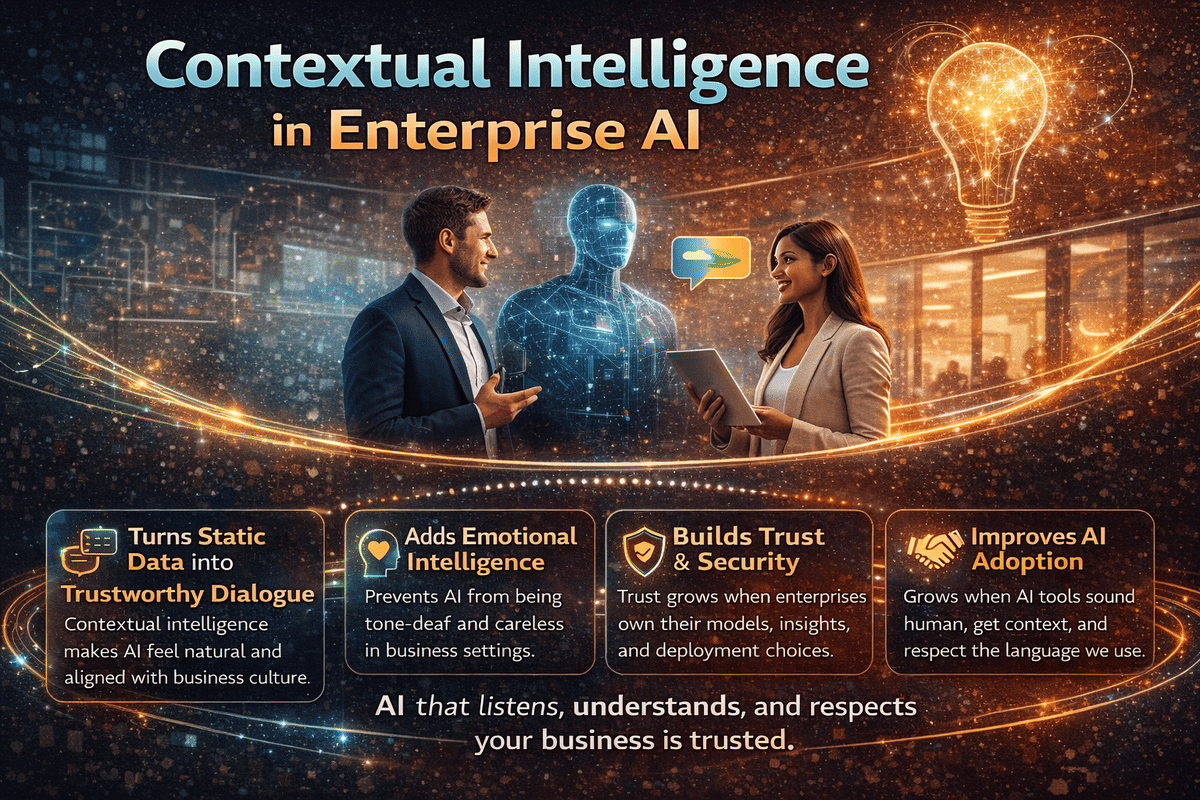
Contextual intelligence turns static data into conversational, context-rich dialogue that leaders can trust.
Emotional intelligence prevents AI from being tone-deaf in business settings.
Contextual intelligence improves adoption by making AI feel natural and culturally aligned.
Trust grows when enterprises own their models, insights, and deployment choices.
Why Contextual Intelligence Matters in AI
Contextual intelligence is the combination of raw analytical power with a nuance of emotional awareness. Rather than just showing what happened in the data, it listens to how a user asked the question. It is then able to interpret the intentions behind the request and respond in a way that feels accurate and almost human.
Rather than treating data as a static resource, contextual intelligence is conversational and mirrors the way humans naturally discuss problems, patterns, and possibilities.
Shruti Prakash, Head of Product for Data at Inflection AI, explained why this is so important:
"Data as a number does not tell you much. The story behind the data is what makes data powerful. Most of these stories are written in natural language. It is based on discussions that happen within meeting rooms, where one person will say, 'Oh, I wonder why that happened.' And instead of going through writing tons and tons of code lines to generate the answer to the question."
Instead of static dashboards, contextual intelligence enables a back-and-forth. The system probes for reasons, tests hypotheses, and adapts to new angles. It is less like looking at a spreadsheet and more like having a junior analyst who already knows the culture and history of your business.
That adaptability makes a difference when speed is of the essence.
A merchandising manager does not have weeks to commission a new report if the lifetime value is dropping. A CX lead cannot afford to miss churn risks until quarter-end. They need systems that help them spot patterns early, in the language they already use.
That grounding is what Shruti describes as contextual intelligence, or CI. It is the marriage of EQ and IQ, where data is not only correct but also meaningful.
People often say that talking to @pi feels just like texting a friend—a friend who has real-time access to the internet and infinite knowledge.
— Inflection AI (@inflectionAI) March 1, 2024
Well, now you can text Pi via iMessage.
No green bubbles here!https://t.co/UDEjxZXj0b pic.twitter.com/6xrxXMCXql
Trust, Security & Ownership
Intelligence without trust has no place in the enterprise. One of the most pressing concerns for business leaders remains data security and ownership.
Amit Manjhi, Head of Data at Inflection AI, explained:
"We designed the system so that the enterprises own the models, they own the insights. If they do not want to send their data, like they want it either on-prem or VPC, right? All of that is possible…And so the data is not leaving their premises."
This flexibility extends to deployment. Inflection AI tools can run on-premise, in a virtual private cloud, or in hybrid environments. That control matters, particularly for regulated industries where compliance is non-negotiable.
As Shruti Prakash put it:
"The power lies in what we offer. It's the advantage in having that ownership, having a model that is tuned to you and you alone, that gives the trust that it's never leaving your premises if that is what is chosen, that it is talking the language and is emotionally intelligent about the state of business at the time."
Trust also comes from relevance. Generic answers quickly erode confidence. Bespoke models tuned to an organization's own vernacular feel natural. They reduce the friction that often causes employees to abandon AI tools after the first trial.
Human-Centric AI
For all the technical architecture, the philosophy is consistent. AI should empower humans, not displace them. Prakash illustrated this with a simple example:
"If I give you the number 10, what does it mean? It could be anything. But when I tell you it's 10%, now it has a little context around it. If I then put it as minus 10%, if it's my debt, a negative 10% is excellent. If it's my revenue, a negative 10% is bad. So, I color-code it in red. And now the human understands how to interpret it."
Context transforms numbers into meaning. Without it, data risks becoming noise. With it, employees trust the system, adopt it more fully, and ultimately make better decisions. That ethos shapes the company's longer-term vision.
Shruti Prakash echoed that sentiment. "We strongly believe in trust, transparency, security, and data ownership. You own your data. Data has to be with you, secured, and you have to trust all the solutions that are built on top of it."
A Different Path for Enterprise AI
In a world where headlines are dominated by the race to AGI, Shruti Prakash and Amit Manjhi are choosing a different path. They are not interested in chasing a speculative future. Their focus is on what matters today: making data useful for the people who rely on it.
Amit is focused on delivering ROI rather than getting distracted by the next big thing. He said:
"We are not chasing AGI. The path we are taking is similar to that of enterprises. They care about their problems today. They want to make, empower their workforce to get things done."
Inflection AI positioned itself as a distinctive player in the foundation model space by developing Pi, a personal AI companion specifically optimized for supportive, empathetic, and compassionate interactions rather than competing directly on raw performance metrics. This…
— Joe (@JoeMaristela) September 1, 2025
The Bottom Line
Prakash and Manjhi's philosophy may prove more durable than moonshots. By building systems that combine the sharpness of IQ with the empathy of EQ, Inflection AI is carving out a space where contextual intelligence is hitting the headlines for all the right reasons.
It's a vision for a future where AI tools not only process information, but do so in ways that reflect the culture, language, and values of the organizations they serve. That's the kind of ROI that we can all celebrate.
FAQs
What is contextual intelligence?
A type of AI that uses a combination of data analysis and emotional awareness gained from previous conversations to provide better answers and human-aligned insights.
How does contextual intelligence improve business decision-making?
Contextual intelligence adds context to corporate data, delivering actionable and trustworthy insights that accelerate and enhance business decision-making.
Why is emotional intelligence important in AI systems?
Although AI lacks feelings, context and empathy derived from data enable it to respond in ways that people find appropriate, relatable, and trustworthy.