At the The IT Press Tour in Palo Alto, CTERA CEO Oded Nagel described a paradox that will sound familiar to anyone responsible for an enterprise AI budget.
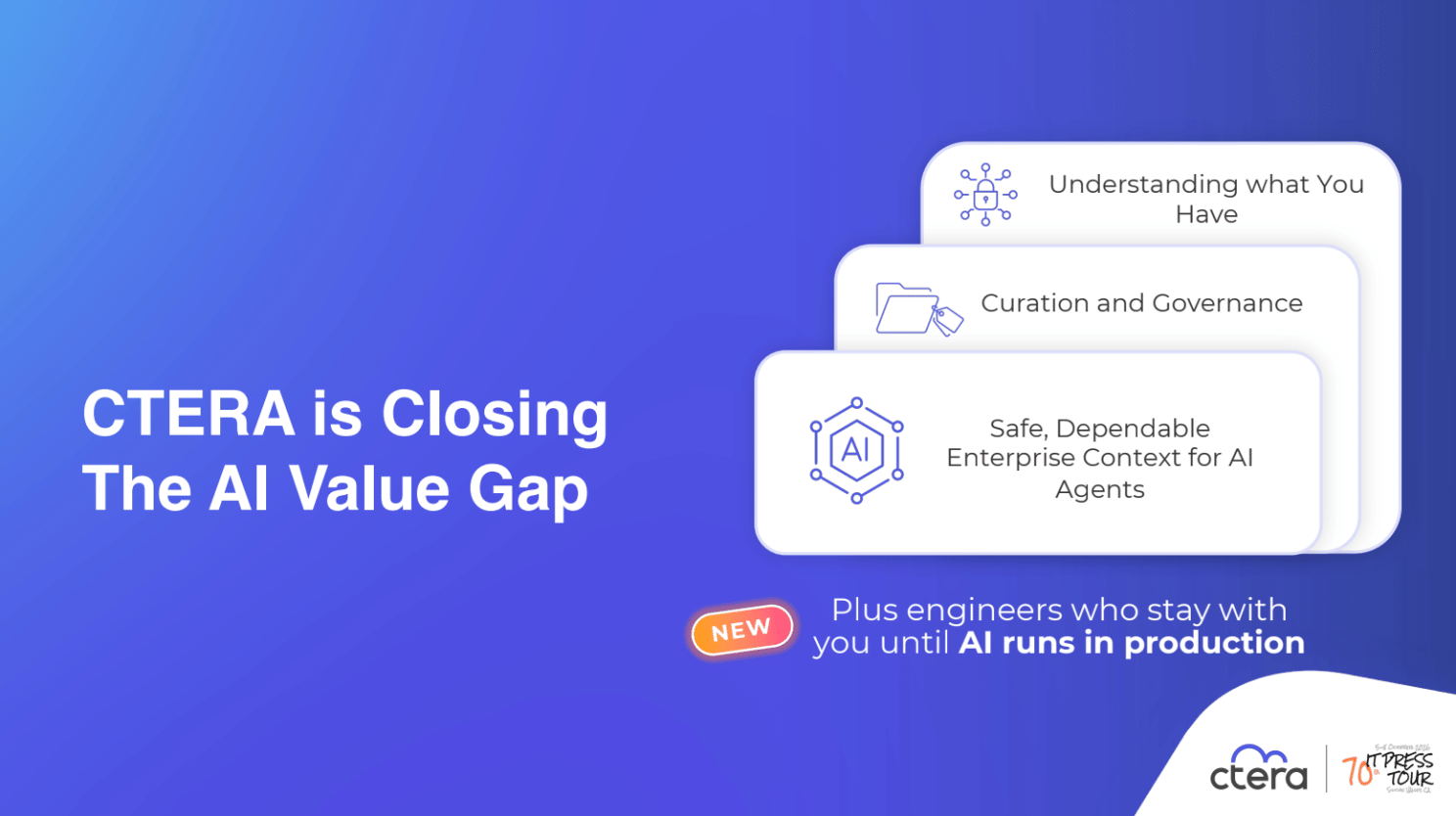
Many reading this will have bought access to powerful models, ordered GPUs, expanded storage, and launched pilots across the business. But cannot show whether any of it has improved an operating result. CTERA calls this the AI value gap.
Enterprise value depends on connecting AI to decades of corporate data, respecting permissions and fitting the result into the way people work. To tackle this problem, CTERA announced Forward Deployed Engineering, a service that places its engineers inside customer environments to turn specific AI ideas into working systems.
The company no longer wants to supply a data platform and leave customers to assemble the final mile themselves. It wants to help them reach production and then teach them to continue without it.
The gap between AI access and business value
Measurement has been one of the biggest challenges over the last few years. Nagel asked how an enterprise can prove that a large model bill has produced a threefold, fourfold, or fivefold return. We can all agree that usage statistics alone cannot answer the question. Neither can the number of employees with access to a chatbot.
Leaders need evidence that AI has shortened a process, reduced cost, increased revenue, improved customer retention, or removed a material business risk.
The second problem is the data itself. Much of an organization’s knowledge sits in unstructured files accumulated over decades. Those estates contain duplicates, obsolete material, and inconsistent permissions. Processing every file would be expensive and often pointless. CTERA argues that companies should first identify which information carries value and whether it can be exposed safely.
The third problem, and the one behind the new service, is a lack of internal resources. Storage and cloud administrators understand the systems they have operated for years. Few were hired to design agent workflows, curate retrieval data, or decide which actions need human approval. Data scientists are often focused on model development rather than distributed file data. Executive pressure does not create the missing experience overnight.
Futurum Group’s first-half 2026 survey of 818 data leaders supports this diagnosis. The shortage of specialized talent was the fastest-rising factor behind AI project failures, while insufficient skills and expertise rose to over twice its level six months earlier. MLOps complexity, integration problems and talent shortages were the three leading data-related failure factors.
Bring AI to the data.
CTERA’s technical answer starts with a phrase Nagel repeated during the session: instead of moving corporate data to AI, move AI to the data. The company has spent years providing a global file system across branch offices, data centers and cloud environments. It now wants this layer to become the permission-aware source of context used by AI agents.
The customer stories shared in Palo Alto made the proposition easier to understand. One manufacturer with over a petabyte of data uses metadata analysis to identify stale, risky, and high-value information. A financial-services customer classifies loan and mortgage documents and creates structured data for its models. Another workflow analyzes call-center recordings for complaints and churn signals, then combines the results with Salesforce data.
Engineers embedded with the customer.
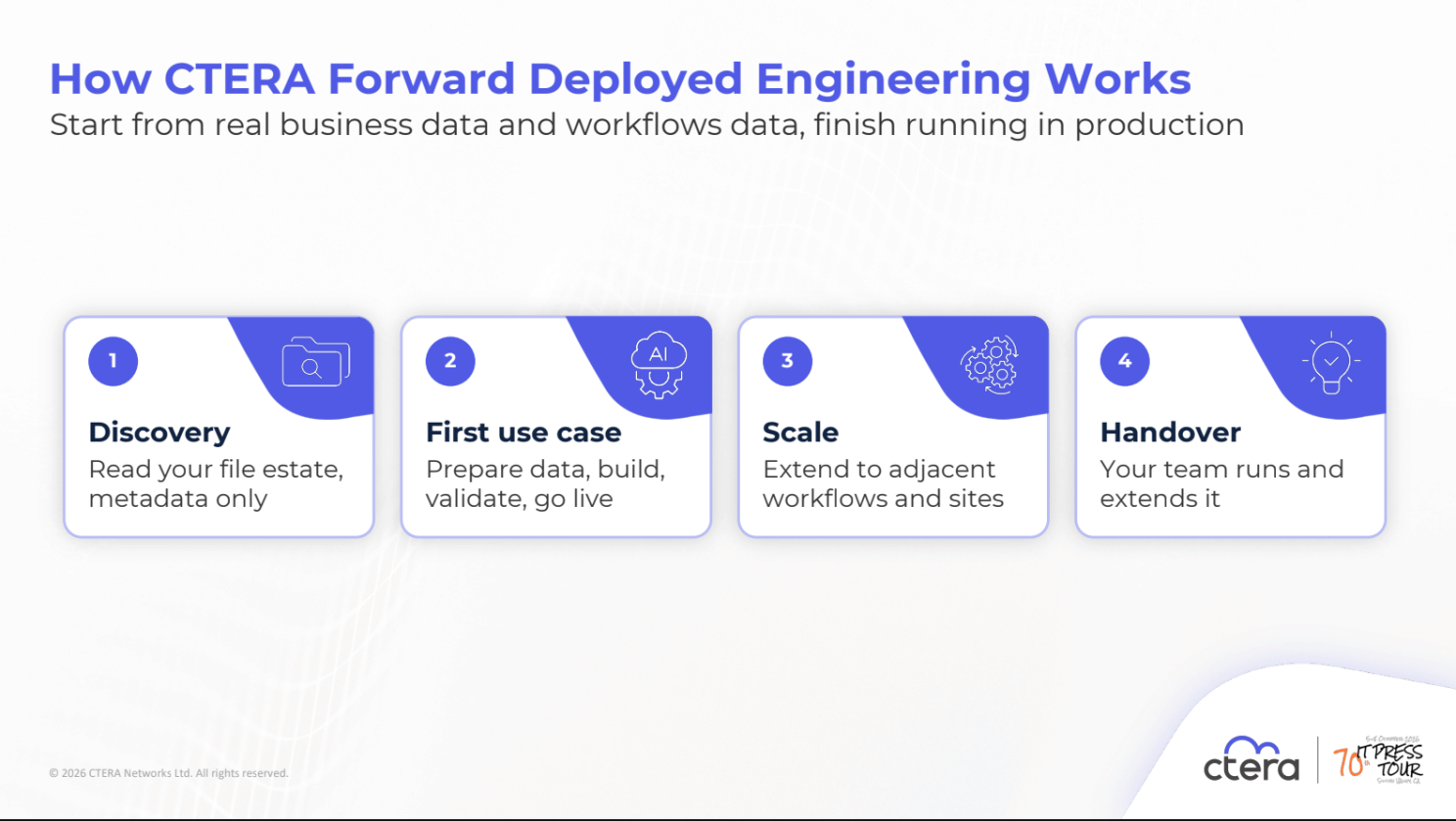
Forward Deployed Engineering is CTERA’s attempt to fill the gap. Small teams pair a forward-deployed engineer with a deployment strategist and work inside the customer’s project team. They begin with the intended business outcome and the actual file estate rather than a generic AI workshop. They assess volumes, access patterns, and source systems, identify the information a workflow needs, and organize and govern it in place.
The first production use case is connected to tools the customer already has. The release cites Model Context Protocol and automation platforms such as n8n. Brand also mentioned Copilot, Claude, Microsoft Teams, and external business systems. The work is tested against real data before release.
Customer engineers work beside CTERA from the start, with the configuration documented as it is built. CTERA says an engagement is complete when the customer can add the next use case independently. Nagel estimated that preparation would take at least a week and a typical initial engagement might run for about a month.
This is the handholding CTERA believes many enterprises now need. It is intended for operational teams that know their business and their data but have not built secure agents around them. The customer supplies the subject knowledge. CTERA supplies the engineering method and experience from similar projects.
From software supplier to adviser
Brand was candid about the significance of the move. Software companies have traditionally treated customization and professional services as costs to reduce. CTERA designed products to be easier to deploy and tried to limit the need for outside help. Customer demand is now pushing it in the opposite direction. Organizations want people who can examine their data, recommend a course of action, and work beside them while the first system is built.
Brand acknowledged that the approach resembles Palantir’s model. Nagel drew a boundary around the comparison. CTERA does not plan to build an army of forward-deployed engineers or become a consulting company with software attached. Its strength, he argued, must remain its technology. The team should get customers into production faster while feeding lessons back into the product.
The choice of outcome will matter just as much. “Put AI into production” is not a business result. A stronger engagement would begin with a target such as reducing legal-case review time, finding at-risk customers, or cutting the hours spent classifying regulated data. Enterprises can then measure cost, accuracy, and speed before and after deployment.
Closing the gap means changing how work gets done.
CTERA’s announcement also signals that another model release will not close the AI value gap. Enterprises already have access to capable tools. Their harder task is making messy information usable, preserving authority over it, and redesigning a real process around what the technology can do.
Change takes time, and employees need to trust the output. Security teams need evidence that access rules still apply. Operators need to know when a person must approve an agent’s recommendation. Management needs a result it can measure against the cost.
CTERA’s answer is to combine its unstructured-data platform with people who can help customers through the first deployment. It is a logical response to the skills shortage described in its briefing and in Futurum’s research. It is also a test of whether CTERA can become the trusted adviser Nagel wants it to be without losing the product focus that built the company.
The best measure of Forward Deployed Engineering will be what happens after the CTERA team leaves. If a customer has a production workflow, evidence of a business return, and the confidence to build the next use case itself, the service will have succeeded in narrowing the AI value gap.
If it produces another impressive pilot or a permanent dependency on outside experts, the gap will remain, only with a new name. This is one story I will be following very closely, for all the right reasons.
Watch the presentation, and please share your thoughts and experiences in narrowing the AI value gap.