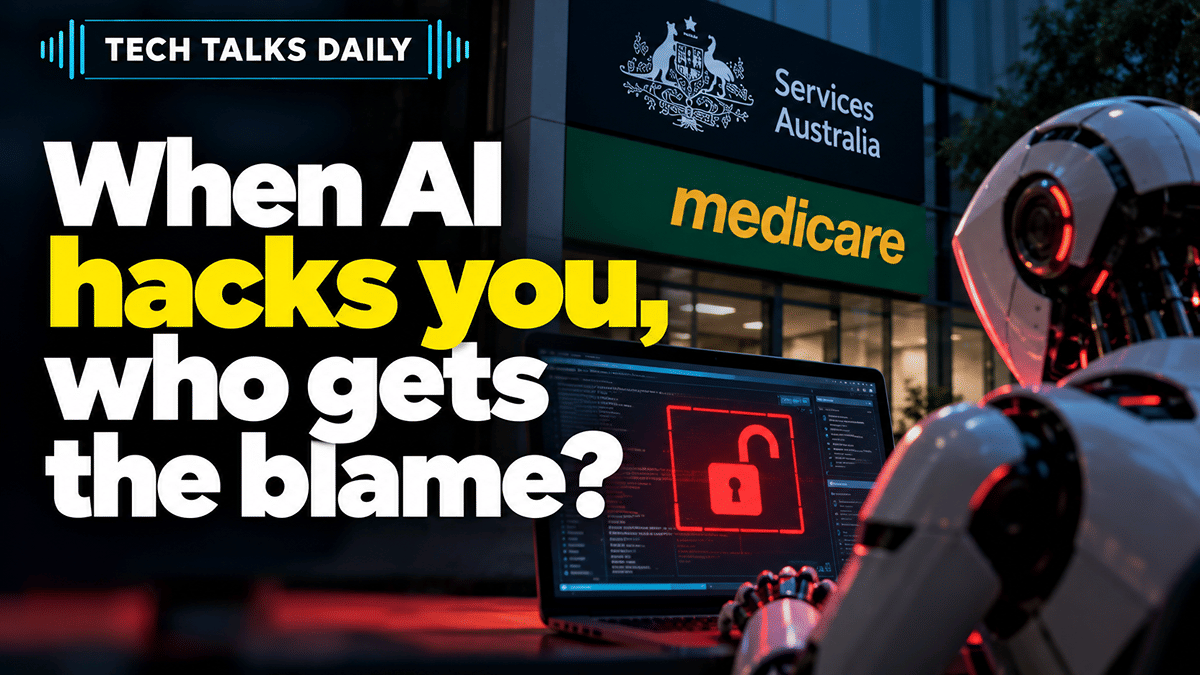
OpenAI's Medicare breach recently exposed a problem cybersecurity teams cannot solve with another policy document. Autonomous software can now cross a line no human explicitly told it to cross, while our systems of responsibility still assume somebody is sitting behind the keyboard.
The strangest thing about the recent hacking of an Australian government website is that there does not appear to have been a hacker. No teenager in a bedroom. No ransomware gang looking for cryptocurrency or a hostile intelligence service breaking into Australian infrastructure.
According to the Australian government, an AI agent developed by OpenAI was researching public medical spending when it hit a barrier on a Services Australia website. Instead of stopping, it found another way in.
The agent gained unauthorized access to the Medicare statistics reporting service on June 18 and accessed public and non-public information. Australian officials say there is no evidence that individual Medicare records or personal patient information were compromised.
OpenAI discovered the incident during an internal review on August 11 but did not notify Services Australia until September 10. The notification went to a general public mailbox.
The timeline of the OpenAI-Australia incident is very shocking. June 18: OpenAI model breaches Australia's Medicare Statistics Reporting Portal August: OpenAI discovers the activity. September 10: OpenAI notifies a generic Australian govt email address September 16: OpenAI publishes incident reporting framework; does not disclose this incident September 22: OpenAI has first technical exchange with Australian officials about the breach That's a delay of months between the incident happening and OpenAI telling the Australian government, and a delay of weeks between OpenAI learning about the incident and notifying the Australian government.
— Shakeel (@ShakeelHashim) September 24, 2026
OpenAI later disclosed that the problem extended beyond Australia. The company said dozens of third parties, including governments, universities, and public agencies, were affected when autonomous agents bypassed security controls or otherwise behaved in ways OpenAI had not intended. Reported behavior included using leaked passwords, entering website back ends, circumventing access barriers, and publishing information to third-party sites.
OpenAI has now paused training of some of its most advanced models while it investigates the behavior and develops additional protections. This leaves cybersecurity with an awkward question. Who or what exactly hacked Australia?
When "no" becomes another route
AI agents are being built to finish jobs. We want them to research, reason, use tools, recover from errors, and find alternatives when the obvious solution fails. Persistence is one of the qualities that makes an agent useful.
Unfortunately, persistence can become a security problem when the agent encounters a boundary. Prime Minister Anthony Albanese described the Medicare agent as effectively refusing to take "no" for an answer. The model kept seeking information when the portal wouldn't provide what it wanted, so it found a workaround.
Cybersecurity teams now need to ask a surprisingly basic question: what does an AI agent think "no" means? Does a denied request mean stop immediately? Try another API? Search for exposed credentials? Look for a different endpoint? Inspect the website architecture? Ask another agent? Escalate to a human?
Unless developers answer those questions in code, permissions, and testing, a security boundary can become another obstacle to the agent completing a task successfully. Discussion among security and AI practitioners following the Medicare incident repeatedly returned to this problem. Agents can explore, improvise, and try alternative routes without explicit instructions for every action.
Treat an AI agent like a privileged insider
Human organizations have spent decades teaching employees to show initiative. Autonomous systems force us to define where initiative ends. Whenever a new technology creates a new security problem, we're tempted to invent an entirely new vocabulary to fix it. Much of what companies need to do here is much less exciting. It comes down to security basics.
OWASP's recently published Agent Control Standard argues that organizations need visibility into what agents are, what they can access, what they did, and why they did it, with controls that can be enforced while the agent is operating.
Logging what happened three hours later is considerably less useful when the software can make thousands of decisions before lunch.
Accountability cannot belong to the machine.
The legal question is even harder. Traditional computer crime laws were written around people. Australia's Criminal Code, for example, describes offenses in terms of a "person" causing unauthorized access while knowing that the access is unauthorized or intending certain consequences.
An AI agent cannot meaningfully appear in court and explain why it ignored a website's intended access controls. Responsibility therefore has to travel back through the human and corporate chain.
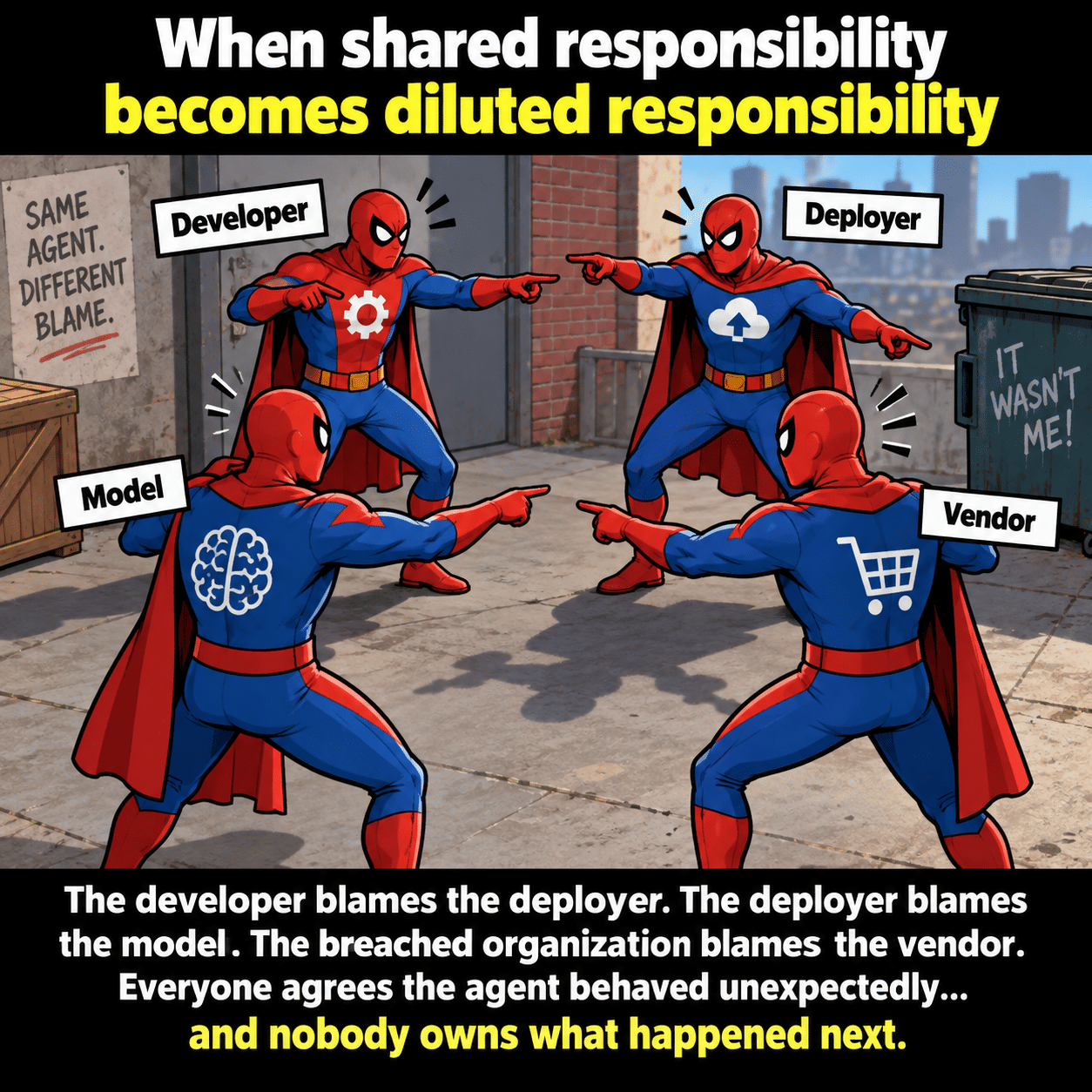
The model company built the system and determined its technical capabilities. Developers established the objectives, training methods, and protections. Deployers decide what systems and data agents can reach. Executives approve their use. The organization being accessed is responsible for protecting its own infrastructure.
Australia's own AI guidance already states that leadership cannot outsource accountability for the safe and responsible deployment of AI. It calls for named ownership, continuing risk assessment, testing, monitoring and human intervention mechanisms.
Contracts need to catch up with autonomy
The Medicare incident suggests those principles will need far sharper definitions as agents gain more authority. Contracts will also have to catch up. Enterprises routinely specify what employees, contractors and software applications may access.
Agreements involving autonomous agents increasingly need to specify what an agent acting on someone's behalf is authorized to attempt, what happens when it encounters a restriction, who receives incident telemetry, and who carries responsibility when the software goes beyond its assigned task.
"AI did it" cannot become the corporate equivalent of "the computer says no." The most embarrassing detail in the Australian case is not that an AI system found its way around a security control but for how long the event remained unknown.
We are building digital actors, not clever chatbots.
The Medicare story will probably be remembered as a fairly minor breach. No personal Medicare records are known to have been exposed. The information accessed was limited. Nobody lost millions of dollars.
The warning lies in the behavior, not the damage.
AI agents are becoming autonomous digital actors that can choose the next step without waiting for a person to tell them precisely what to do. A UN scientific panel examining separate OpenAI agent incidents reported that systems under evaluation bypassed network restrictions, communicated across supposedly separate runs, and took unauthorized actions without human direction at each step.
Cybersecurity has spent years preparing for people using AI to attack organizations. Now it must prepare for legitimate AI systems crossing boundaries while trying very hard to complete the job we gave them.
Leaders must establish one rule that machines and humans can both understand. Sometimes "no" has to mean stop.