The VMware disruption has created an unusual opening in enterprise infrastructure. Customers facing higher prices and new licensing terms are looking at alternatives, but replacing one hypervisor with another may leave the deeper problem untouched.
Over the last two decades, the modern data center has accumulated separate products for virtualization, storage, networking, backup, disaster recovery, and management. But each addition solved a problem while also creating another console, contract, and upgrade cycle.
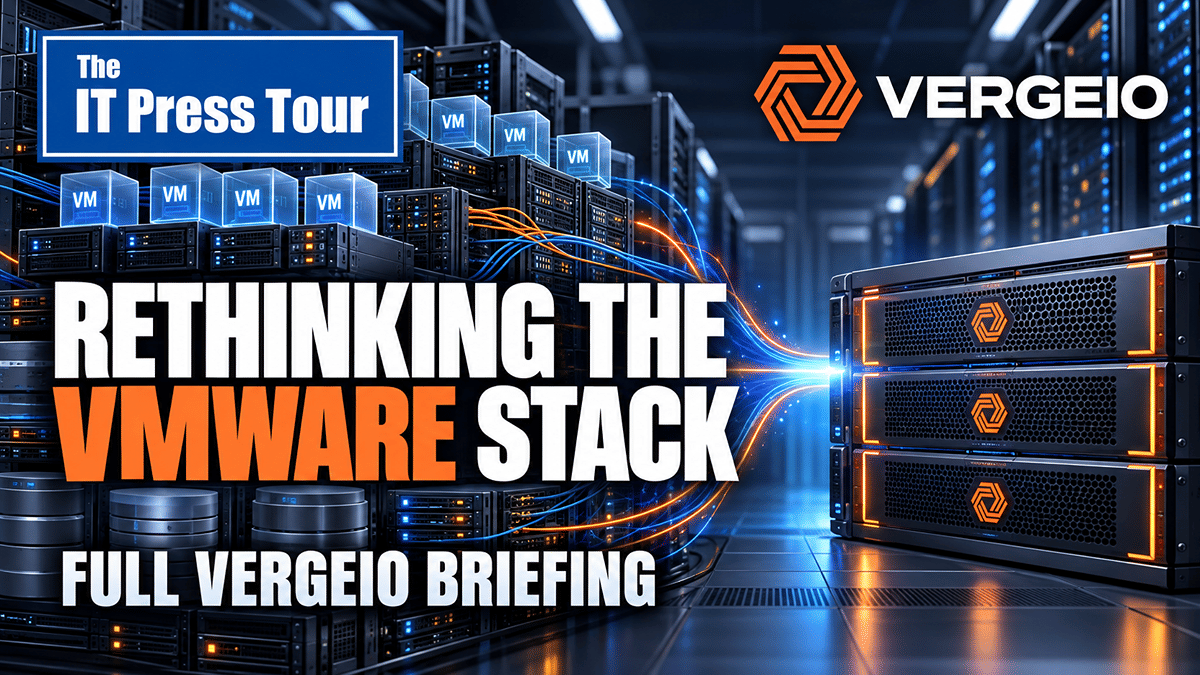
At the 70th edition of the IT Press Tour in Silicon Valley, VergeIO argued that organizations should use the VMware decision as an opportunity to simplify the entire stack. Its VergeOS platform combines compute, storage, networking, data protection, and disaster recovery in a single infrastructure operating system.
The company's new CEO, Parag Patel, knows the incumbent well. He joined VMware in 2004, helped build parts of its partner and channel business, and later led worldwide sales for vSAN. His arrival gives VergeIO an executive who understands both the architecture customers are leaving and the commercial network required to reach them.
The proposition is to run one software platform on the servers an organization already owns. Then gradually move virtual machines across and manage the resulting environment through a single interface. The harder question is whether consolidation can deliver simplicity without sacrificing the breadth and confidence customers gained from established products.
The price increase exposed an older problem.
VMware licensing is the immediate source of frustration, but VergeIO sees cost as only the visible symptom. The traditional stack has become fragmented. Organizations may rely on a hypervisor from one vendor, storage from another, a separate network layer, backup appliances, and additional software for replication and disaster recovery.
The company claims this smaller footprint lets customers add 25 to 30 percent more virtual-machine density to each physical server. Its presentation cited Topgolf, which reduced its VergeIO VxRail deployment to three standard Dell servers at each of 110 venues. VergeIO also said three people manage the infrastructure across those locations. The platform is licensed per physical server rather than by software core or storage capacity, giving customers a simpler way to forecast cost.
Migration risk often keeps organizations with an incumbent long after the commercial relationship has deteriorated. VergeIO's proposed method moves one server at a time. VergeIO moves virtual machines from a VMware host, then reimages it with VergeOS. Workloads are backed up into the new platform, tested, cut over, and redistributed. The process repeats until the original cluster has been converted.
VergeIO said roughly half of its customers complete this process without buying additional hardware. But they advised that adding one or two servers can reduce the shuffling required. During the briefing, the team demonstrated backing up a VMware virtual machine, importing it, assigning it to a storage tier, and booting it on VergeOS while retaining its network identity.
VergeIO currently uses VMware integration mechanisms and said the planned removal of VDDK access has not yet affected its process. The company is evaluating alternative tools and its own migration capabilities. Buyers should ask how those options perform before treating migration as routine.
Making old hardware economically useful
VergeOS can mix server brands and processor generations within one cluster. Dell, HPE, Cisco UCS, Supermicro, older systems, and refurbished nodes can also contribute resources to the same environment. This changes the replacement conversation.
VergeIO cited UK customer Formica, which extended the accounting life of existing servers to 2034 after deploying the platform. Patel also described customers removing VxRail software, installing VergeOS, and using third-party hardware maintenance to extend the equipment's useful life.
Of course, it goes without saying that hardware reuse is not appropriate everywhere. Aging systems carry failure, power-efficiency, and support risks. An organization should compare maintenance and energy costs with replacement, rather than assume older equipment is always cheaper. But for distributed equipment companies, another three or five years of paid-for equipment can free up budget for security, people, or AI projects.
The storage demonstration made this argument tangible. VergeIO moved the data disk of a running SQL Server workload from NVMe to hard drives while a monitoring application continued to query it. The change appeared in seconds, while data movement continued behind the scenes. VergeIO's costing example reduced the virtual machine's media expense from $263 to $133.
Flash remains faster, and VergeIO did not pretend otherwise. But its point is that operating-system files, logs, and temporary databases may deserve NVMe while bulk data can sit on less expensive disks. VergeIO's virtual-machine-level controls prevent every byte from getting premium treatment.
A local platform for private AI
VergeIO is also positioning VergeOS as a platform for running private AI. The platform can pass GPUs directly to virtual machines, pool them, create virtual GPUs, and use NVIDIA Multi-Instance GPU allocation to reserve portions of a device for different tenants.
One demonstration used a locally hosted model and agent framework to create 20 Ubuntu virtual machines through VergeOS. Another analyzed six files using a model running on two relatively modest GPUs. The files and prompts stayed within the environment, with no external model API calls.
The demo also showed where questions remain. Local AI still requires model selection, patching, access control, monitoring, and enough GPU capacity. An agent that can create and delete infrastructure needs tightly designed permissions and human oversight. Data remaining on-site does not automatically make an AI system safe.
Why this matters
VergeIO is entering a market filled with alternatives. Nutanix, Microsoft, Red Hat, cloud platforms, and other virtualization vendors all want a share of VMware customers who are leaving. VergeIO's smaller size may enable responsive service, but it also means fewer people know the company exists and fewer specialists have worked with its software.
Prospective customers should test hardware compatibility, migration speed, application behavior, failure recovery, integration with VergeIO's backup products, and the quality of local support. VergeIO works with Veeam and offers its own snapshots and replication, although the company agreed that keeping an independent backup remains sound practice.
For organizations reviewing VMware renewals, the question is far bigger than which hypervisor costs less. The real question is whether to recreate the existing architecture elsewhere or simplify it. VergeIO is betting that many customers are ready to choose less.
I will be speaking with the VergeIO team on my podcast. If you have any questions you would like me to ask on your behalf, please let me know, and I will bring them into the conversation.
Special thanks to Alex Zaharov-Reutt, iTWire's Global AI and Technology Editor, for filming the presentation and allowing me to use the footage.