
For as long as I can remember, I've followed one simple rule when setting up technology. If it has an Ethernet port, use it. But I recently learned that I needed to update my mindset as well as my hardware when doing a speed test on my Samsung TV.
Traditionally, a wired connection has always been the gold standard. Faster, more reliable, lower latency, and less prone to interference. It's advice I've given friends, family, and readers for years. So imagine my surprise when I discovered that unplugging the Ethernet cable from my Samsung TV and switching to Wi-Fi actually made it faster.
At first, I assumed something was wrong with my network. I have 2 gigabit broadband, a Wi-Fi 7 router, and Cat 6 cabling throughout the house. Yet every speed test on my TV stubbornly refused to go much above 95 Mbps. After a bit of digging, I discovered the problem wasn't my internet connection. It was the TV.
The 100 Mbps Surprise
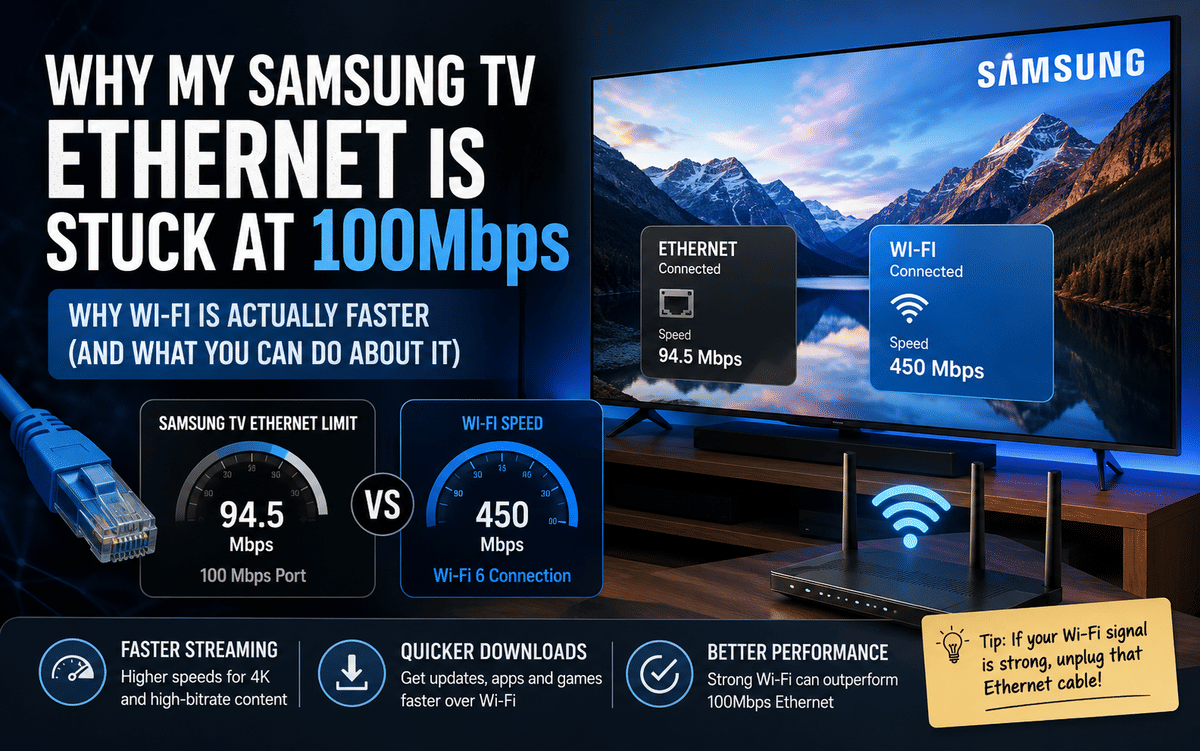
Many Samsung TVs use a Fast Ethernet port rather than Gigabit Ethernet. That means the physical network connection is limited to 100 Mbps, with real-world speeds typically topping out at around 94 to 95 Mbps.
The strange part is that the TV's Wi-Fi is often capable of several hundred megabits per second. Yes, you read that correctly. On many Samsung TVs, the wireless connection is actually faster than the wired one. As someone who has spent years telling people to hardwire everything, that felt completely backward.
Why Would Samsung Do This?
Once the initial frustration wore off, I could understand the reasoning. Streaming services don't need anywhere near a gigabit connection. Netflix recommends around 15 Mbps for 4K streaming. Disney+, Prime Video, and YouTube all operate comfortably below 100 Mbps for most content.
From Samsung's perspective, a Gigabit Ethernet controller would add cost while offering little benefit to most customers. Most people would never notice.
The moment you move beyond streaming services, that 100 Mbps limit can become much more noticeable. If you're streaming high-bitrate 4K Blu-ray remuxes from Plex or Jellyfin, copying large files across your home network, or simply paying for gigabit broadband and expecting your devices to use it, the Ethernet port becomes the bottleneck.
Ironically, connecting the TV to a strong Wi-Fi 5 or Wi-Fi 6 network may deliver two, three, or even five times the speed of the wired connection. That's probably the first time I've ever recommended Wi-Fi over Ethernet.
What About the PS5 and Xbox?
Thankfully, this limitation doesn't apply everywhere. The PlayStation 5 and Xbox Series X and Series S all include Gigabit Ethernet ports so that they can take advantage of much faster wired connections.
So while your TV might be stuck at around 95 Mbps over Ethernet, your game console sitting right beside it could happily use the full capacity of your network.
Why Is My Samsung TV Hard Wired but Still Slow?
If you've searched for:
Why is my Samsung TV Ethernet so slow?
Why won't my Samsung TV go above 100 Mbps?
Is Samsung Ethernet limited to 100 Mbps?
Is Wi-Fi faster than Ethernet on a Samsung TV?
The answer may be the hardware inside the TV. There's nothing wrong with your router or your broadband. In many cases, the Ethernet port itself is the limiting factor. But the most important number isn't necessarily the highest number you see on a speed test, it's how stable that connection remains.
If my Samsung TV gets 300 or 400 Mbps over Wi-Fi but regularly drops packets, fluctuates in speed, or occasionally loses its connection, I'll take a rock-solid 90 to 95 Mbps Ethernet connection every time. That's already far more bandwidth than Netflix, Disney+, Prime Video, or most other streaming services require for 4K. So don't unplug your Ethernet cable simply because you've discovered your Wi-Fi can produce a bigger number.
Try both. If your Wi-Fi is strong and consistently stable, you may get the best of both worlds with considerably faster speeds. But if your wireless connection is unreliable, stick with Ethernet. For streaming, stability beats speed every time.