

What is the office actually for?
It's a question that many organizations are still wrestling with as they balance flexibility, collaboration, employee expectations, and business performance. At Cisco Live, I sat down with Christian Bigsby, Senior Vice President of Workplaces at Cisco, to discuss how the role of the workplace is changing and why measuring success by attendance alone may no longer make sense.
Christian shares how Cisco has rethought the relationship between people, place, and technology, bringing together teams that traditionally operated separately to create a more connected workplace experience. Rather than focusing on how many employees are in the office, the conversation centers on the outcomes that become possible when people come together with purpose.
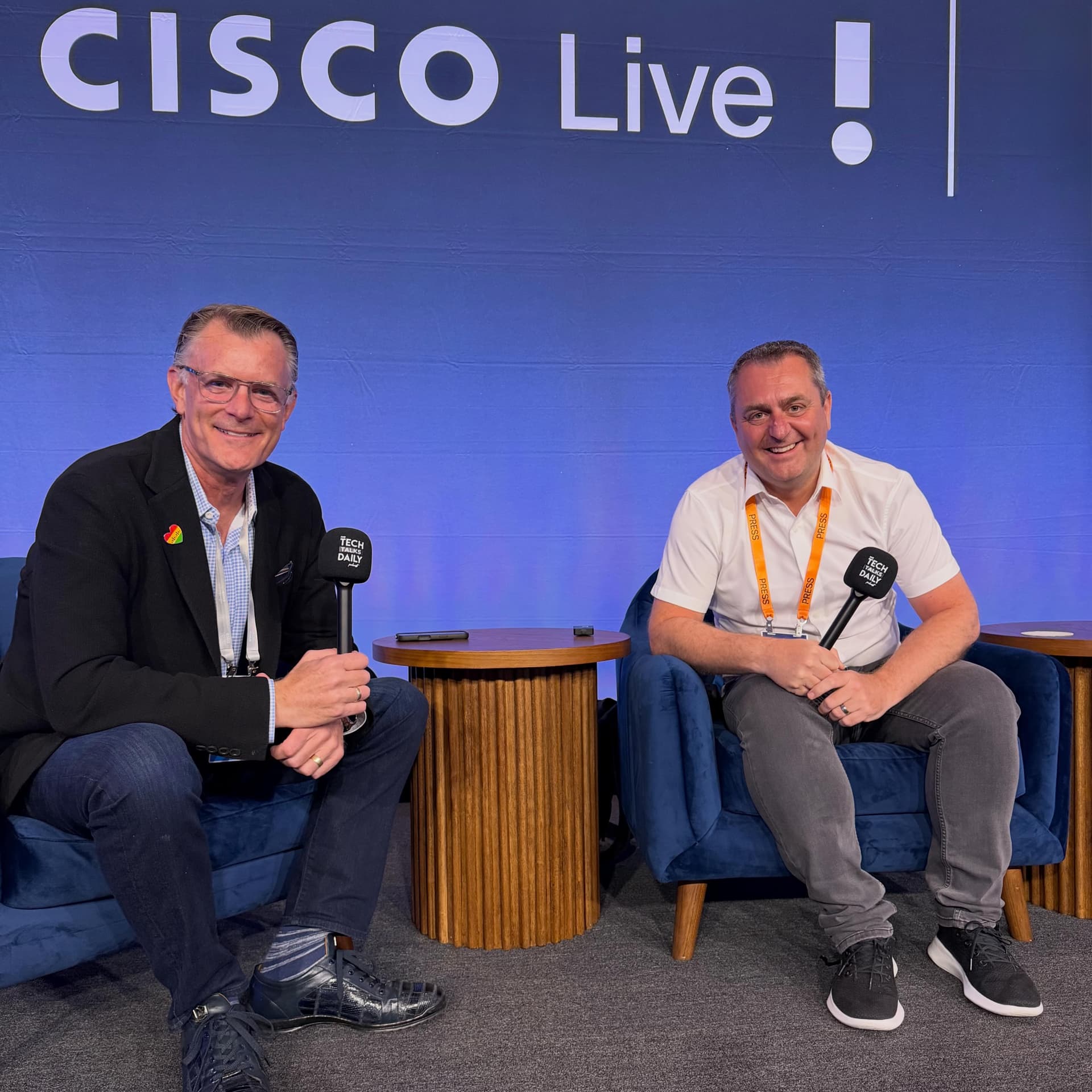
We explore how hybrid work has reshaped workplace strategy, why employee experience has become a business priority, and how organizations can create environments that support collaboration, innovation, learning, and culture. Christian also explains why flexibility should not be viewed as a perk but as an important part of helping employees do their best work.
The conversation also looks at the growing role of AI in workplace operations. From forecasting occupancy and improving space utilization to helping organizations make smarter decisions about resources and services, AI is helping workplace leaders respond to a level of variability that traditional operating models were never designed to handle.
Along the way, Christian offers thoughtful insights on leadership, trust, organizational culture, and why the future workplace may have more in common with a dynamic service than a fixed location.
If you've ever wondered whether the future of work is about where people work, how they work, or why they come together in the first place, this conversation offers plenty to think about.
What do you believe makes a workplace valuable in 2026: attendance, experience, outcomes, or something else entirely?
Useful Links
Connect with Christian Bigsby
Learn more about Cisco Live
Please check the partners of the Tech Tech Talks Network
Learn more about the NordLayer Browser
[00:00:00] - [Speaker 0]
Hybrid work has changed everything about how teams operate. People are now working from different locations on different devices and often outside traditional networks. But the one constant here, no matter where people are working, is the browser. This is where collaboration happens. That's where the data moves, and increasingly, that's where the risk lives.
[00:00:21] - [Speaker 0]
Now NordLayer's business browser is designed for this new reality. It allows teams to work securely from anywhere, even on personal devices, all while giving organizations better control over access, data movement, and browser activity. And it even supports modern ways of working without forcing old security models onto them. And it is that balance between flexibility and control that is where a lot of companies are still struggling. So if anything that I mentioned there resonates with you, if it sounds familiar, please, I encourage you to take a closer look at nordlayer.com/browser.
[00:01:00] - [Speaker 0]
But now on with today's show. What if we've been measuring workplace success all wrong? For years, organizations focused on occupancy rates, badge swipes, attendance metrics. But what if the true value of a workplace isn't about how many people show up? I mean, we've seen enough examples of presenteeism, where people are just sat watching YouTube quietly in the office.
[00:01:26] - [Speaker 0]
But I think what we should be looking at is what becomes possible when the right people come together with a sense of purpose. So today, I sat down with Christian Bixby, senior vice president of workplaces at Cisco. And together, we sat down to discuss how the company is rethinking everything from office design, workplace culture, and AI powered operations, and the future of hybrid work and what that looks like and the business value of all that too. So we'll explore why attendance isn't a automatic proxy for productivity and talk about how AI is helping more intelligent workplaces and why the most successful offices of the future might look more adaptable destinations than traditional corporate spaces. But enough scene saying from me.
[00:02:19] - [Speaker 0]
Let's get Christian onto the podcast now. So thank you for joining me here at Cisco Live. Can you tell everyone listening a little about who you are and what you do?
[00:02:30] - [Speaker 1]
I sure will. So my name is Christian Bixby. I am the leader of our workplace resources team at Cisco, which is effectively our real estate and facilities organization as well as construction design and our energy organization.
[00:02:43] - [Speaker 0]
And for years, I think organizations measured workplace success through occupancy rates and bad swipes, but so much has changed since then. And Cisco seems to be taking a very different approach now. So I'm curious. How do you define workplace success today, and and what business outcomes matter the most in these conversations that you're having?
[00:03:03] - [Speaker 1]
I think the most important thing for us to consider in this is this was inevitable that things were going to continue to migrate and change towards this idea of distributed work, centers of purpose. We we believe at Cisco more than anything else is that the place that people work isn't just for work activities, but it's how we bring the culture of the company together, and how we bring the activities that are most essential happening in a place together. We've done quite a bit of research on this, and it points to four primary things that should always be done in person because they work better. The speed of collaboration, the, really complex problem solving. Early in career folks kind of learning their career path and understanding what it feels like to be part of this huge corporate machine.
[00:03:50] - [Speaker 1]
And then the last one really is just how you start to adopt into the company culture, how you know to handle conflict, how you problem solve, etcetera. So for us, we're being very, very intentional about when we design a space or when we secure a piece of real estate, being very, very thoughtful around what is it there for. Is it about collaboration? Is it about early in career access to talent? Is it about great development coming from our r and d and our engineering organization?
[00:04:15] - [Speaker 1]
So we're trying to be very thoughtful about the workplace as a place to connect the right activities and more of a cultural center for us.
[00:04:22] - [Speaker 0]
And you often talk about the workplace as a driver of organizational performance. So are you able to share any examples where bringing people together with purpose has directly improved things like innovation, decision making, customer outcomes, or team effectiveness? It'd be great to bring that to life if you do have any examples you could share.
[00:04:41] - [Speaker 1]
Yeah. We're we're in a place right now where we're making it perhaps a little difficult on our leaders because we're really pushing our leaders to share what are the things you think are most important as business outcomes. What are the things that are the business deliverables, business outcomes that can be accelerated or improved or enhanced? Right now in our engineering organizations, what we're seeing is groups that are using the office, you groups that are using the labs are showing an acceleration. So we are seeing that in beyond anecdotal, but not hard measures of I can't tell you that it's 12% faster to develop a particular chip or to develop a particular line of code.
[00:05:22] - [Speaker 1]
But what we are seeing is that the teams that are working together, the speed of collaboration for these highly, highly technical deliverables and these highly technical developments are starting to really start to show some acceleration. And hopefully, what people are already seeing is that the company, its speed of innovation, its speed of delivery, has really started to show this this almost crescendo of speed in the last six to nine months as leaders have started to get their hands around how many people do we need in places, how many days a week. It's not so much about the calendar as it is what is the work cycle that we have to bring people together to swarm these problems. We're starting to see acceleration, but we're putting a lot of pressure on leaders to define that metric so that the teams all feel this sense of sort of the rallying cry of look how fast we develop that versus what we did a year ago that took us nine months, now we can do in two months or three months. So still waiting for those published data to come back to us so that we can reinforce.
[00:06:21] - [Speaker 0]
And, of course, we are at a tech conference where everybody's talking about quantum computing, But alongside all of that is people, the importance of human teams. And one of the things that stood out to me is this idea that workplace experience is shaped by people, place, and technology all working seamlessly together. So historically, those functions, though, have always operated in silos. So what's changed inside Cisco to bring these groups together, and and what lessons do you think other organizations might be able to learn from the own journey that you've been on?
[00:06:52] - [Speaker 1]
Well, I'm gonna start with one very specific example that's become quite specific and quite recognized inside of Cisco, and that is our PENN1 office building in New York City. So right in Manhattan, right next to Madison Square Garden, The sales team that operates out of there saw a different opportunity around how we could build the space from the technology up. So instead of bringing in the architects, instead of bringing in the designers, bringing in the the general contractors, What is the technology experience we wanna create so that we can create the first and closest thing to a retail shop you're gonna have in Cisco? What can we do to showcase a fully integrated technology experience, a fully integrated technology ecosystem that doesn't just work for our employees, but becomes that living lab for our customers to witness. Yes.
[00:07:43] - [Speaker 1]
Our customers can come in and use that space, and we can showcase it to the customers, but they can see it in use day after day. So what we did was we almost started at the typical end, which is here's the building. Now let's plug in the technology. We started with the tech and said everything from the sensors we install to the Wi Fi access points, to the collaboration equipments, to the networks, even putting in a lot of smart technology. It's quite funny to think about it now because it's getting a little bit old, but some of these IoT models of everything from lights under control, shades under control, etcetera, That was really, really innovative at the time to start with that and then consider, okay.
[00:08:22] - [Speaker 1]
How do we now design this all together with this integrated ecosystem? What we're finding though, by bringing that technology ecosystem together, we don't have to worry about does the technology work. The technology works, and we can spend all our time making sure that the people are able to interface with the space correctly. It's very intuitive. It's very logical.
[00:08:43] - [Speaker 1]
Gives us a lot of data points back so we can start to adjust. And just as a bit of a data point for you, we found that we used about 30% less construction equipment and construction materials in that building when we built it out because we weren't going in to do the same kinds of conduit and wiring and plumbing and things like that because we started with tech and made everything around it much more flexible and used a lot of the existing footprint, a lot of the existing materials that were already in the space.
[00:09:12] - [Speaker 0]
Certainly love that, and so much has changed in the workplace over the last five years. Hybrid work introduced a level of unpredictability that many organizations are still struggling with, still trying to get that balance right, but what are some of the biggest challenges you see companies facing when trying to create workplace strategies that that work equally well for employees, managers, and business leaders? Because a tricky balance sometimes.
[00:09:35] - [Speaker 1]
I think it's a time for leaders to really become the department of good questions. And what I mean by that is what problems are we trying to solve? What people experiences are we trying to draw up? What business outcomes are we trying to achieve? Being very clear and very transparent.
[00:09:54] - [Speaker 1]
There was a linear change that happened in the days of the pandemic where people discovered a new level of freedom where they could truly work from anywhere. We had no choice. In most markets, we had to go home. People learned how to work at home differently. Leaders had to look at different ways of how you motivate and how you engage with people on a remote basis.
[00:10:14] - [Speaker 1]
It was harder to shake hands with people for a long time. It was hard to sit across the table. Now what we're starting to see is that a lot of companies either are looking to regress back to it's about attendance, or they're trying to figure out, did we lose productivity? Did we not lose productivity? And if we can this goes back to the issue of the the leaders and trying to understand what metrics are most important.
[00:10:38] - [Speaker 1]
When leaders believe they've had a productivity loss because of a distributed workforce, Can they calculate that? Can they can show that? If you can engage with your teams, with your talent, and say, I think we've lost something here. Either we've lost something in our early in career teams, or as we say, we've lost something with our early in Cisco teams, it becomes a more compelling conversation instead of Monday, Tuesday, Thursday. Monday, Tuesday, Thursday is very, very irrelevant to the average worker that's working in a distributed team in a highly asynchronous manner.
[00:11:11] - [Speaker 1]
Work isn't happening in a nice handing the paper down the line anymore. So I think a lot of companies aren't asking the question of, is it about attendance, or is it about throughput and engagement with the work? What we're seeing again and again and again with our customers, but also internal inside of Cisco, is that if there is a logical work cycle that people understand, they wanna do it together. It is the show up on Tuesday and nobody's there where it feels very disingenuous on everyone's behalf. Like, I've done the commute.
[00:11:43] - [Speaker 1]
I've gotten here, and I'm not seeing the people I most want to engage with. So we know that people miss seeing one another, but they're not gonna do that five days a week. And and that linear change of freedom and distribution, we're never gonna go back on completely, but we still need to embrace the fact that if people are together with a very clear purpose and leaders are bringing them together in a compelling way, there will be a choice that people make because that one plus one equals three math is just unmistakable when you're together.
[00:12:14] - [Speaker 0]
100% with you there, and AI, of course, is becoming part of almost every conversation here at Cisco Live. And in a workplace context, where are you seeing AI deliver the most practical value today beyond all the headlines and hype you may have seen on your LinkedIn feed?
[00:12:28] - [Speaker 1]
Yeah. Yeah. Yeah. I mean, there I you can go in 15 different directions on this. Let let's try to keep it simple.
[00:12:35] - [Speaker 1]
The the the first bit is in an organization like like mine, in a discipline like ours of real estate and facility services, we have a lot of frontline workers that are simply not going to be replaced by AI. The people that cook the food will still be employed. The people that clean the bathrooms will still be employed. The people that run our maintenance operations and and carry tools around will still be employed. But things will shift a little bit.
[00:13:00] - [Speaker 1]
And I like to use the example of the chef will still be employed, but he can spend more time leading his kitchen team and less time figuring out how much food to order. The AI tools are very easy for us to understand of who use what does the cash register tell us was checked out? What do people choose? How do people participate in cafeteria services? Those are the insights that are almost invisible to the user and to the actual end state user, but they're very, very compelling when you can find a faster way to solve and give a better experience for the customers.
[00:13:35] - [Speaker 1]
I also think that the AI journey this is an interesting one from a design perspective. If I look at the arc of my career, in 1992, I used to have to sit outside of a cafeteria as a designer and literally check mark every person that walked into the cafeteria and walked out of the cafeteria to figure out how to design the maximum occupancy for the bell curve of who was using the cafeteria at peak hours. Today, it literally and you think about that. So that was for a week, one person sitting for two and a half hours outside measuring that. Today, with one click of a button in about seven seconds, I can tell you exactly what the peak occupancy was just by picking up on the fact that we know that a mobile phone walked in the cafeteria at such a time and walked out of the cafeteria at at a certain time.
[00:14:20] - [Speaker 1]
And that gives us all the insight we need to know how to design for peak. So think about that, granted it's been almost thirty five years, but to go from standing there with paper and pen to now one push of a button and redesign what we need in terms of capacity.
[00:14:34] - [Speaker 0]
And on that side of things, before I met you today, I was reading that you've mentioned how AI driven insights to forecast occupancy and optimize resources, etcetera. How does all this work in practice, and what kind of decisions can organizations make today that maybe weren't possible a few years ago? Because we might be setting off a few light bulb moments here, business leaders say, oh, this would work great for us.
[00:14:54] - [Speaker 1]
It but where would they start? Right now, our I'm gonna call it our far post goal is much more precise demand forecasting. Understanding how often a bathroom is used so that we can clean it with precision, how much preloading we should be doing to the heating and cooling to know what the occupancy would look like. The example I'll use is we're sitting here today at Cisco Live. I am not in my my usual home office or my should I say my home campus site.
[00:15:26] - [Speaker 1]
I am a 100% participator of our cafeteria services when I go to campus. So three to four days a week, I am on-site. I use the cafeteria. It should know through my travel application that I am traveling today, and I am not going to be participating in the cafeteria. So of the 8,000 people that are on that campus, I am one less participant that day.
[00:15:47] - [Speaker 1]
That should be easily built in. So our demand forecasting will look at how people occupy when they are there, how they use and consume the services so that my team can spend a lot less time trying to figure it out. We can waste a lot less food, cleaning, energy, etcetera. That is the ultimate goal. So this idea in integrating sensor technology, people's behaviors as they move around the building, we are not interested in you specifically as Neil walking through the space.
[00:16:18] - [Speaker 1]
We just need to know that a person is moving through the space and consuming services in a particular way. That for my it means I can provide a better, more precise service for my customers. That means I can eliminate a lot of waste in the system, and I can also ideally make things a bit easier for my team that aren't chasing around doing redundant work or doing rework because we made a mistake in the forecast. But bringing together sensor technology, Wi Fi access points, people's behavior, travel, and all these different applications, all behind the scenes with a level of good secure confidentiality allows me and my team to provide much, much better services where we're thinking about talk taking cost out of the business, but improving service at the same time, and that would truly be a, you know, a double edge on that one.
[00:17:05] - [Speaker 0]
Yeah. And speaking of the double edge, it's like the Spider Man quote, that with great power comes great responsibility, and there is concern in some circles that workplace analytics can feel intrusive or create trust issues among employees, and there's a few bad examples out there. But how do you balance the use of workplace data with privacy, transparency, and and maintaining employee confidence? Because you need everybody on board. Right?
[00:17:28] - [Speaker 0]
Yeah. I the
[00:17:29] - [Speaker 1]
the ultimate bid on this is having just the amount of information you need to make a decision that never ever infringes on the personal privacy of the individual. Again, we are not interested in an individual's identifiable behaviors. We are interested to know what people do as a population. Yeah. So we're always looking at this as population data.
[00:17:51] - [Speaker 1]
So when we look at, let's say, badging rates or occupancy rates or, hours of occupancy, we have no idea who those individuals are. It's all behind multiple walls that my team never sees a name. As a matter of fact, we even go so far as to if a team has less than seven members, we don't even report that there's a team of seven members. It rolls up to the next level in the hierarchy. And that is all designed to prevent any kind of confidentiality breach or any fear of targeting that, well, I could probably guess who those five of those five people who was behaving like that.
[00:18:26] - [Speaker 1]
My team doesn't care about that, and we try to maintain a very clear level of confidentiality. But all of the policies and protocols don't work if you can't be a trusted company, and this is where trust is absolutely the most important thing. Trust in your leaders, trust in your company, trust in your security protocols. You have to have that trust or everything else goes out the window with it. And it is absolutely paramount to us that we make absolutely sure we never breach that with our customers.
[00:18:55] - [Speaker 0]
A huge thank you to Donodo for supporting the Tech Talks Network and helping power more than 60 interviews every month. And if your business is already invested in data lakehouse, this next message is especially for you. Because if you've already invested in a data lakehouse like Snowflake or Databricks, Denodo will help you get more value from it. Faster AI, smarter analytics, and trusted self-service data access. So turn your lakehouse investment into real business outcomes with Denodo.
[00:19:30] - [Speaker 0]
So please visit denodo.com. And one of the things I always try and do on this daily tech podcast is eradicate or bust myths and misconceptions. So if you could eliminate one workplace myth that continues to influence business leaders today, you are smiling as I ask you this. What would it be? Is there just one?
[00:19:50] - [Speaker 1]
Is there just one? There's not just one. Maybe I'll give you two. The first of which is I believe, and I think a number of my peers and colleagues believe in industry, that a lot of the amenity services that we provide, if not careful, just become an arms race. The the never ending free food, free parking, free this, free that, and you just keep stacking it up.
[00:20:15] - [Speaker 1]
Free dry cleaning, free childcare. Those are wonderful, wonderful things for some companies. But when it becomes an arms race to try to figure out how to get people back to an office, I actually think it just becomes I think it's become an arms race across multiple, multiple industries where great if you can afford it, but it is not going to give people meaningful experiences. They will feel taken care of, but they won't feel engaged. And I think the great leaders understand we're going to make sure that our people are taken care of with amenities, but we're also gonna give them incredibly inspiring work to do.
[00:20:51] - [Speaker 1]
And we're also giving them great purpose behind that, not just keep throwing more gifts at them. I think people turn turn a cheek on that and say, I don't need any more free stuff. I need really compelling work. I I need to trust my leaders. I need to trust my companies.
[00:21:05] - [Speaker 1]
And I I think that is something we do exceptionally well inside of Cisco, and I think more and more of my colleagues are seeing that that the arms race of amenities isn't necessarily turning the dial, or isn't really moving the needle dramatically on this. And then I think the the other one is the idea of attendance is something that we keep hearing the anxiety over productivity, but the reality is that attendance isn't a proxy for productivity. Attendance is just an input measure that says, well, we know this many people showed up. I don't know if they produced anything. I don't know if they were successfully drove something through the pipeline, but they sure showed up.
[00:21:45] - [Speaker 1]
Well, there needs to be something much deeper than attendance, and it needs to be about our people were here and we produced great outcomes, or our people weren't here and we still produced great outcomes. And that is a place for me that if we can stop talking about attendance and start talking about what happened in the space, the the holy grail in facilities management has always been, how does the office contribute to productivity? The easiest answer that I can give you is occupancy or a space used, but I can't tell you whether or not if the space was used for the right things. As far as our job, we wanna create great experiences in great places people want to use, but we want them to be using it in the service of the enterprise to create great business outcomes. So occupancy is great.
[00:22:34] - [Speaker 1]
A space used is a success on our part, but if the leader didn't generate and the team didn't generate the business outcomes, it kind of feels like a hobby and a bit of a vacation. And we do not wanna be in the vacation business. We wanna be in the highly productive workspaces, and we have to have a great partnership with our leaders to make sure that we're giving them the space and services they need, and the leaders are giving their teams the compelling vision of the work practice and the work throughputs to create great business outcomes.
[00:23:01] - [Speaker 0]
Love that. And finally, as we look to the future there and the future of work, what do you think the most successful workplaces will have in common? What will separate those organizations that treat the workplace as more of a strategic asset from those still thinking just primarily as office space?
[00:23:19] - [Speaker 1]
I have a very dramatic confirmation bias inside of this, but when I was in school as a designer, my my theory of design was primarily focused on what I called more wheels, less walls. And the concept was the more mobility, the more agility you have, the better you are positioned for the changes that will inevitably happen in business. And I think the future workplace, the greatest future workplaces are those where the physical asset, which in the past was twenty and thirty year life cycles, matches the life cycle of the business. So instead of twenty and thirty year fixed assets, these are things that can match the six month, one year, eighteen month business life cycle of how things change. The composition of space can change.
[00:24:08] - [Speaker 1]
The services can change. The intent of how you use the space changes. Very honestly, it's ironic that we're in a convention center because the greatest offices, I believe, will be destinations people want to go to, but have all the flexibility of a convention center that can house, you know, in a place like this, a wedding one month, a trade show the next, and a film festival the week after that. That's what workplace is gonna look like. The more agility, the more wheels, the less walls, and the less fixed features, business is going faster.
[00:24:40] - [Speaker 1]
We need the fixed assets to keep up with how fast the business is changing.
[00:24:44] - [Speaker 0]
And I think we've got time for one more question. And same as you have a design background, before we met today, I was reading online about the topic of creativity and its importance in not only tech, but in business as a as a whole now, not just the designer world that you came from. I'm curious. What what creative way have you used AI or another tool or any technology to improve your work, and how important do you see creativity in the workplace?
[00:25:09] - [Speaker 1]
Well, I I'll I'll start with I always like to go back to the definition of creativity that I was taught at university, and that is that creativity means you have a high tolerance for ambiguity. And I can't imagine anything that has more ambiguity to it right now than AI. There's there's visions and and dreams and amazing applications that we're starting to see, but we're in such early days that the people are the machine that's going to create the great AI solutions inside of this. Where we're using it, I'm gonna call it in a creative way right now, is trying to start with the easy stuff, which is take all the administration out of the work. If you can't attend a meeting, watch the AI listen to the AI summary.
[00:25:56] - [Speaker 1]
If you can't understand what was summarized in the meeting, dump the transcript into our AI tools so that you can quickly get a summary on that. What's where it's getting creative for us, though, is now we're starting to look at our energy management and things like that, that just in the simplest of things where we're getting really technical at it, saying, let's just look at occupancy, and what does occupancy tell us about energy? And even with some fairly bad prompts in the AI, were actually able to make a connection there that said, well, this is interesting. You are precooling this building in Bangalore, India starting at 7AM because that's the start of work hours, except for the fact that only one building starts that early. The other buildings start at more like nine and 10AM to have full occupancy.
[00:26:44] - [Speaker 1]
And we found that without actually a human prompt, it was more of a a a nudge from our AI tools that it came back and said, you know, you actually potentially saved as much as 5% of energy in that building just by changing the live loading times. But it was a prompt that a few of our folks started looking at out of just a little bit of curiosity and creativity, and without a lot of technical review came back and said, you know, you've got an opportunity here to change your schedules. And it sounded like something that was a a throwaway comment initially, but if you extrapolate that out to what we have globally, that would be somewhere in the neighborhood of 3 and a half to $4,000,000 a year worth of energy consumption where we wouldn't be wasting, you know, energy going up the the figurative smokestack. So we're trying to get creative. We're trying to get playful and find cases because the creativity part for me is the more stories to tell we have about where AI gave us a great safe solution, the more success we're gonna have with AI.
[00:27:45] - [Speaker 1]
It's scary right now because people think that it might be coming for them. Or it's gonna be really exciting is where there's great stories to tell of where it gave us a great solution, and it didn't actually there no people were harmed in the filming of this AI campaign.
[00:27:58] - [Speaker 0]
Well, we covered so much in a short amount of time there, and not just creativity and AI, but also answering that ROI question. So I'll include links to everything that we covered today. I'll urge people to go check that out and your work at Cisco and connect with you on LinkedIn. But more, Nathan, thank you for joining me today.
[00:28:14] - [Speaker 1]
It's my pleasure, Neil. Thank you very much.
[00:28:16] - [Speaker 0]
Wow. What I find most interesting about this conversation wasn't really about buildings. It was about people. And I loved how Christian challenged some widely held assumptions from that idea that more office attendance automatically leads to better outcomes, to the growing workplace arms race of perks and amenities. And instead, he argued that organizations should focus on creating compelling work, meaningful experiences, and environments that help us solve problems together.
[00:28:49] - [Speaker 0]
And his perspective on AI was equally refreshing rather than replacing people. He described AI helping teams remove friction, reduce waste, improve forecasting, and free up time for higher value work. And whether it's optimizing energy use, improving workplace services, or just helping leaders make better decisions, all the goals we discussed today remain remarkably human. Create better experiences and enjoy better outcomes. That was the key message there.
[00:29:21] - [Speaker 0]
And one of my favorite takeaways was his belief around that that the future workplace needs more wheels and fewer walls. A simple phrase that captures a much, much bigger shift in how organizations are thinking about flexibility, adaptability, and the role of work itself. But as always, love to hear your thoughts. Is your organization still measuring attendance, or have you found a better way to measure success? And if you have, I wanna hear about it.
[00:29:50] - [Speaker 0]
Techtalksnetwork.com. You can leave me an audio message or send me a DM. And remember, connect with me on LinkedIn, and subscribe to the show if you've enjoyed yourself because I will be back again tomorrow with another interview from the Cisco live show floor. But that's it for today. So thank you for listening, and I'll speak to you all again very soon.
[00:30:10] - [Speaker 0]
Bye for now.