

At Cisco Live, I sat down with Papi Menon, Vice President of Product Management at Outshift by Cisco, to explore one of the most ambitious ideas emerging in the AI world today.
While much of the industry remains focused on larger models and individual AI agents, Outshift is asking a different question. What happens when millions of AI agents need to collaborate across organizations, platforms, and industries?
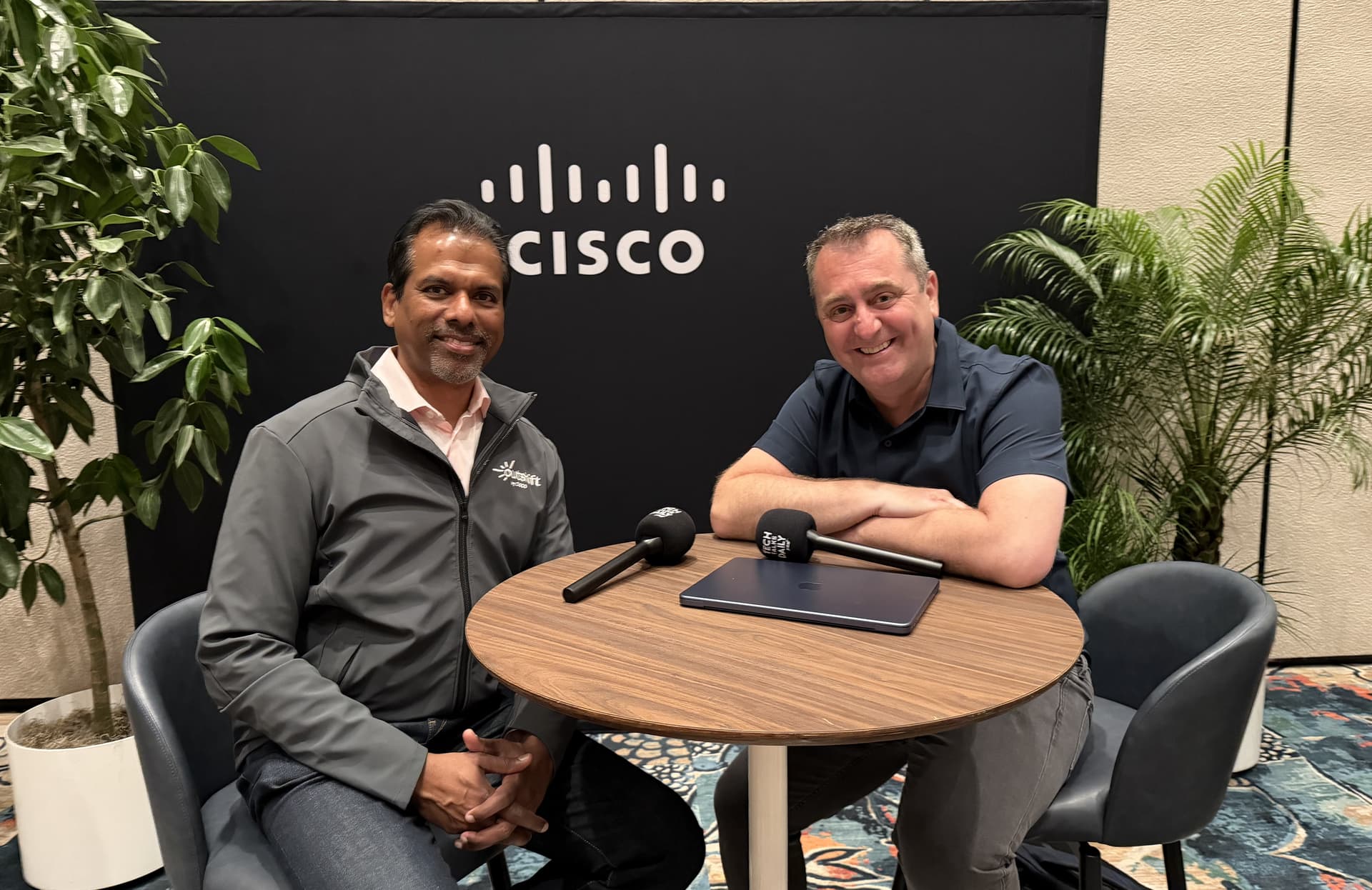
Papi joined me to explain the thinking behind Outshift, Cisco's emerging technology and incubation group, and the work they're doing to help shape the next era of AI. Our conversation explored concepts such as the Internet of Agents, the Internet of Cognition, and AGNTCY, an open-source initiative designed to create the foundations for agent-to-agent collaboration at scale.
We discuss why connecting AI agents is only the first step, why shared intent and shared context could become as important as connectivity itself, and how organizations may need entirely new infrastructure to support an increasingly agent-driven future. Papi also shares his perspective on the challenges of interoperability, governance, trust, and security as AI systems become more autonomous and interconnected.
The discussion moves beyond today's AI headlines and into the bigger questions facing the technology industry. If the internet connected people and systems, what infrastructure will be needed to connect intelligence itself? And what role can open standards play in ensuring that future remains collaborative rather than fragmented?
Whether you're a technology leader, developer, strategist, or simply curious about where AI is heading next, this conversation offers a fascinating glimpse into how Cisco is thinking about the future of agentic computing and the foundations that may underpin the next major platform shift in technology.
How do you think AI agents will collaborate in the future, and should that future be built on open standards or closed ecosystems?
Useful Links
Learn more about Outshift by Cisco,
Internet of Agents (framework for agentic AI infrastructure to support an internet full of AI agents)
Internet of Cognition (framework for distributed artificial super intelligence )
AGNTCY (open-source framework and community-driven initiative originally developed by Cisco's Outshift incubation unit to allow AI agents to collaborate seamlessly across different frameworks and platforms)
Visit our Sponsors
Check out the Nordlayer Browser
[00:00:00] - [Speaker 0]
So a special thank you to Denodo for supporting the Tech Talks Network and helping us keep these conversations going because moving beyond AI pilots all starts with connecting your models to trusted enterprise data. So if you're ready to move beyond AI pilots, Denodo can help you connect your AI models to trusted enterprise data in real time. So you can scale faster and reduce risk. So if you're interested in turning AI into business value, simply visit denodo.com. Welcome back to the Tech Talks daily podcast where this week I'm reporting from Cisco Live in Las Vegas.
[00:00:43] - [Speaker 0]
Now before we get started though, I have to give a shout out to two people who helped make this event what it is for me every single year. First of all, Matt, who somehow manages to know where every interview briefing meeting and keynote is taking place at any given moment. We always have a little fun. I'm gonna miss him this year. His brain genuinely works like a spreadsheet, and he's a lot of fun, and I'm gonna miss him this year.
[00:01:06] - [Speaker 0]
And then there's my friend Justin, who I always look forward to catching up over and old fashioned while putting the world to rights and talking tech and football after a long day on the show floor. Unfortunately for me, neither of them can make it this year, but I just wanted to give them a shout out and let them know I'm missing them. But I do have plenty of great conversations coming your way from Cisco Live. And one of those conversations is with the vice president of product management at Outshift by Cisco. Now if you are unfamiliar with Outshift, it's Cisco's emerging technology and incubation group that is focused on identifying what comes next and turning ambitious ideas into technologies that can solve real business problems.
[00:01:56] - [Speaker 0]
So today, I wanna step into the world of agentic AI, but look at some of the work that Outshift is doing around concepts such as the Internet of agents, the Internet of cognition, and an open source initiative designed to help AI agents work together across different platforms and frameworks. So as organizations move from experimenting with AI to deploying networks of autonomous agents, questions around interoperability, governance, collaboration, and infrastructure, all these things are becoming increasingly important. And my mission today is to find out how Cisco is thinking about that next phase of AI and what needs to happen before millions of AI agents can successfully work together. And on that note, let me introduce you to my guest. So thank you for joining me here at Cisco Live.
[00:02:52] - [Speaker 0]
Can you tell everyone listening a little about who you are and what you do?
[00:02:55] - [Speaker 1]
Thank you for having me, Neil. My name is Pappy Menon. I lead product management and business development for Outshift, which is Cisco's incubator group. Our charter is to look at the landscape of emerging technologies and find the next big thing for Cisco. So that means we that's a pretty big broad charter, so we take a pretty Cisco centric lens to it.
[00:03:15] - [Speaker 1]
What that means is we try to find areas within emerging technologies that are adjacent to the Cisco business, where we have some unique strategic lever that we can bring to bear, some right to play, if you will. So within that, there are a couple of areas that we are looking at for the foreseeable future. One is agentic AI. How do we enable agents to collaborate together more effectively? How do they discover, communicate, connect with each other?
[00:03:42] - [Speaker 1]
And then the other big area is which you'll be hearing about a lot in the in the days and weeks to come is quantum, particularly quantum networking and cryptography. So those are the two areas of focus for us.
[00:03:53] - [Speaker 0]
And there's so much I wanna talk with you about today. But for anyone listening and they're hearing about Outshift for the very first time, what roles does it play inside Cisco, and why is Cisco investing in emerging technologies like Agentic AI and Quantum rather than leaving that innovation entirely to start ups? Tell me more about Outshift.
[00:04:11] - [Speaker 1]
Yeah. So the reason why we do internal incubation instead of just letting the start up ecosystem by the way, we work very closely with our corp dev team, and we keep a very close eye on start ups. So that is an area that we look at. We look at where venture money is going, what kinds of startups are getting funded, and we use that to inform the work that we do. But to your question of why is it that we even do any incubation?
[00:04:34] - [Speaker 1]
Why don't we just rely on startups to just go do the things and then, you know, and then we can just acquire them if need be. Right? Cisco can do that. The reason for that is there are certain areas where, like I said, we bring a unique Cisco centric lens to bear on these emerging technologies, which may not always be obvious to start ups. And the reason for that is a an opportunity for Cisco, you know, from where we are within Cisco as a part of Cisco is not an opportunity that that may present itself readily if you're an entity outside of Cisco, just as an independent start up.
[00:05:08] - [Speaker 1]
So there is a unique set of strategic advantages that Cisco brings to the market that a startup cannot replicate. And so that's where I think as an incubator group, have a particular unique strategic advantage as well as a unique point of view when it comes to what to incubate. So that's what we do.
[00:05:27] - [Speaker 0]
And you mentioned Agentic AI a few moments ago, and we're hearing a lot of excitement around AI agents. But your team has said many organizations are still stuck in AI theater. So what separates a genuine multi agent system from a collection of AI tools that just pretend to work together? Yeah. A lot of what goes on today, do we do kind of refer to as AI theater,
[00:05:50] - [Speaker 1]
and the reason for that is while AI we all know what a transformational force it is. We've all used various language models to to query them, to generate code, and so on. But all of those are more of assistance where there is a human constantly in the loop judging what the AI is sending back and tailoring it according to their needs. Now that is easier to do than a true agentic system which is acting autonomously. And now if you take that to the next level, which is what we are we are saying, where we are encouraging enterprises to try that out and we are building the technology and tooling that will enable them to do so at enterprise scale and with the enterprise guardrails in place is multi agentic systems.
[00:06:38] - [Speaker 1]
And here too, when we talk about multi agentic systems, it's not just multiple agents built as sub agents within the same framework. We are talking about true autonomous multiple agents working across platforms, across frameworks, and truly operating independently as autonomous entities and then coming together to solve a business or scientific problem. This is a very different level of complexity. You know, agents need to now be able to discover each other, understand their capabilities, and then communicate in some form and do all of this with security and observability and all the other enterprise needs in place. This is a very different level of complexity from chatting with, you know, JatGPT or or Claude or what have you.
[00:07:27] - [Speaker 1]
So this is the problem that we are trying to solve, and most enterprises are still early in that journey. But we are building the tooling that will enable them to accelerate that journey.
[00:07:36] - [Speaker 0]
And many vendors talk about shared memory as the answer to agent collaboration. But your research that I was reading suggests that there's only a small part of the story there. So what did your experiments reveal that that maybe surprised you the most? I mean, you you weren't right in the heart of this space, but what surprised you most from that research?
[00:07:53] - [Speaker 1]
The surprising thing is that just because you have shared memory doesn't mean that you have alignment or shared context. Sharing memory is sharing information. It is not sharing knowledge, and that's the big difference. You can tell agents you can share, get agents to share information, but that doesn't automatically bring them to an alignment on their mission or sharing of their knowledge and collectively ratcheting up their intelligence. That's a very different ballgame.
[00:08:24] - [Speaker 1]
You know, you still need to be able to build tooling that lets them do that. You can have agents that share memory, but still are talking past each other. In fact, when you for anyone who has gone through the task of building a nontrivial complex multi agentic system, you will quickly realize that even with shared memory, agents are perfectly capable of just talking past each other. You can get them to share information, but that doesn't mean they get to alignment. Turns out agents are very much like human beings.
[00:08:59] - [Speaker 1]
They love to talk past each other and run up a huge you know, run up a token deficit huge in no time, but getting no closer to their stated mission. This is what we are trying to solve. We want to get past agents just going through AI theater. We saw that with Moltbuck, for example, where we had a lot of agents. Yeah.
[00:09:21] - [Speaker 1]
There are autonomous entities. They're talking to each other. They're discussing all kinds of things, but it was empty theater. There wasn't a shared mission. There wasn't alignment towards common goals, and there wasn't a coordination of actions.
[00:09:35] - [Speaker 1]
Most importantly, there wasn't a shared super intelligence like the agents putting becoming greater the whole becoming greater than the sum of its parts. All of the agents collectively putting their intelligence together and coming up with something bigger than themselves. That has not happened because the tooling for that doesn't exist, and that's what we are building.
[00:09:59] - [Speaker 0]
Now the Internet of agents vision proposes a different future where agents from different vendors and organizations can all seamlessly collaborate. But what business problems become possible when when agents can work across company boundaries rather than just inside isolated platforms? It feels like there's a lot of opportunities there, but where do you see it offering the most value?
[00:10:19] - [Speaker 1]
Let me give you an example to illustrate the kind of thing that we are talking about when we enable agents to work across company boundaries. One of the multi agentic systems we are building is with ServiceNow. So ServiceNow has a an agentic plate platform, and they have agents running there which are trained on enterprise ticketing, which is ServiceNow's forte. So that's their domain. The agents that they have trained are very adept at doing things around ticketing workflows.
[00:10:50] - [Speaker 1]
On the other hand, we have agents. We at Outshift have built agents that are great at network debugging, for example. That's Cisco's bread and butter. That's the domain that we are experts in. But now we have agents from ServiceNow talking to agents from Outshift and Cisco to solve an enterprise IT problem end to end.
[00:11:08] - [Speaker 1]
This includes ticketing workflows, all the data associated with customers, and all of that from ServiceNow side talking to Cisco and debugging issues on the network with all of the network data that's coming from Cisco's side of the fence. So this is the kind of thing where you have agents built by different companies that are trained on different datasets on different domains. Just like human experts, you know, you have humans who who are experts in different domains, and they come together as subject matter experts in their own areas. But then they come together as a team to solve a problem. And we see with the Internet of Agents, what we have enabled is for agents to do the same thing.
[00:11:49] - [Speaker 1]
Agents that are trained on different domains, different subject areas coming together and then putting their heads together to solve a problem more quickly than they would have been able to do on their own.
[00:12:02] - [Speaker 0]
And I'm curious, looking at today's enterprise environment, where do you see the biggest gap between what org organizations think agent agentic AI can do and what it can realistically deliver over the next twelve to twenty four months? As you said, at the very beginning, there's a lot of AI theater out there. What what problems are we really solving here, do you think?
[00:12:19] - [Speaker 1]
When you try to run multi agentic systems in an enterprise, you quickly run into a number of different problems that need to be solved. And those are the things that we have solved with the agency and the Internet of Agents Collective that we've built. There are discoverability problems around how do you find agents that are fit for purpose for the specific task that you're trying to do. There are communication and connectivity challenges with enabling these agents to talk to each other in a secure manner. There are observability questions.
[00:12:50] - [Speaker 1]
How do you ensure that these agents and multi agent systems are doing what they're supposed to be doing and not doing something they're not supposed to be doing? All of these are major challenges that enterprises will have to deal with. We've already seen and another very, very big challenge is this whole idea of cost. Already, we've seen some backlash with the use of AI and how token budgets are going getting out of control. And you're talking about something where people are using it almost as assistant.
[00:13:19] - [Speaker 1]
You've heard of Claude Code and the issues with companies who are struggling to justify the investments and and the ROI for the kinds of investments that they're making. When you talk about agents that are operating autonomously, you that challenge becomes far more pressing because you now you you don't have a human always in the loop. The agent is operating as an autonomous entity. And now with multi agentic systems, it becomes a whole different level. You know, you've just taken that and you've made that you know, multiplied that by the number of agents that are out there.
[00:13:53] - [Speaker 1]
So it exponentially gets more challenging. And I think those are the problems that enterprises have to solve. The answer to that is not saying that we will not do agents or we will not do agent existing. Right? That is not the answer.
[00:14:08] - [Speaker 1]
There is clearly too much potential here. There's too much business value for enterprises to take that kind of attitude towards it. So the only real way forward is to put in place the tools and technologies that will allow enterprises to experiment experiment and build these systems in a way that is safe, in a way that doesn't compromise their customer data, in a way that does not blow through their token budgets. And those are the kinds of tools and techniques and technologies that we are trying to build.
[00:14:41] - [Speaker 0]
And every major tech shift eventually needs new standards as well and governance, etcetera. So how important are initiatives like MCP, a two a, and and other areas here? How will how effective are these in preventing a future where every AI ecosystem becomes just another closed garden? Because it's so important, isn't it, to work together, as you were saying earlier.
[00:15:02] - [Speaker 1]
Very true. And this is very core to Cisco's DNA and is central to the mission that we have with enabling this open interoperable Internet of agents and now the Internet of cognition that we are talking about to to come to being. You know, Cisco is a company. We have our logo is a bridge, and our DNA are right from the from our inception. Cisco has been a company that connects people, that connects companies, that uses technologies to connect the world together.
[00:15:36] - [Speaker 1]
We are all about building bridges, not about building moats. Having said that, we can see that there is an alternate reality that's possible where, as you said, you used the term walled gardens, and I think there is an alternate reality where much of the value from agentic AI is locked in these walled gardens. Now that doesn't mean there aren't gateways to these gardens. Right? Of course, the gardens do have gates through which you enter and exit, and there are things that can go between the gardens.
[00:16:08] - [Speaker 1]
But most of the value, most of that integrated user experience, most of that integrated business value remains locked within the garden. That is the future that Cisco wants to avoid and that Outshift is building technologies to avoid because we truly believe, and this is based on our own experience with the original Internet that we helped build with open technologies, that an open interoperable Internet of agentic technologies unlocks maximum value for every player in the ecosystem. We do not want that to be a case where much of the value is captured by a few small players and everyone else is left with the scraps. We want a place where everyone can innovate, where there are open interoperable technologies on top of which everyone can build the next transformational thing to come along. Build vertical applications, multimodal, multimodal applications.
[00:17:10] - [Speaker 1]
Even for enterprises, the goal for us is to the name of the game for us is optionality. You know, we want to give enterprises the optionality to adopt AI in the way that makes sense for them. That may be adopting a large language model. It may be using a small language model where it makes sense, where you want to save money, where you can get optimal business results, not necessarily from from using the most powerful model. You not everything needs a battle tank.
[00:17:39] - [Speaker 1]
You know? You may need only a flyswatter. Right? So build the model, build the agent that's fit for purpose, put them together in the way that realizes the maximum business value for you, and we will arm you with the tools that you need to connect these agents together in the way that works for you. So that's what we are all about.
[00:17:59] - [Speaker 0]
And if we did fast forward a couple of years, what do you think the equivalent of today's web browser will be from in for interacting with agent ecosystems? Will people know that they're working with dozens of agents behind the scenes, or will it all just happen invisibly?
[00:18:14] - [Speaker 1]
That's a that's a really good question. I really love it. You're asking me to, like, bring out my crystal ball. I love this. I don't know if I have my opinions on this, so I will offer it for you, for your audience, but take it with a grain of salt.
[00:18:27] - [Speaker 1]
Yeah. I do believe that with agents I heard somebody say this, and this was at a at a conference that I attended. And the quote was it stuck with me. I don't remember who said it. My apologies if somebody hears this, and I I don't wanna miss it attributed.
[00:18:42] - [Speaker 1]
But the quote was, cloud gave everyone global reach, and AI is gonna give everyone a world class staff. And I think that is very true. With agents, everyone has a world class bespoke concierge at their fingertips. And so I think that is the way that it is going to I think that is gonna be that web browser experience that you talked about, where the browser was the front end to that entirety of the Internet for most people. Now it will be your personal agentic interface that you can use to then have tailored experiences.
[00:19:20] - [Speaker 1]
You don't need unlike the web, which was the same web for I mean, it's it's slightly customized for for per individual, and we know that. But with AI, it is going to be highly bespoke. So everyone will have their own journey charted through all of the information that the Internet has. So you don't need to have no two people need to have the same manual or the same user experience. Name your experience within the web.
[00:19:48] - [Speaker 1]
It it can be highly customized, highly tailored to your preferences, to your interests, to your background. And so that, I think, is going to be so the agentic interface, to your question to answer your question more more pointedly, I think that agentic handoff is going to be the the web browser equivalent for the agentic era. And that can take many different forms. For if you're a visual person, it could be a very visual interface. If you're a very textual person, it can be a textual interface, or it can even be a spoken or verbal type of interface.
[00:20:26] - [Speaker 1]
We are seeing all of these modes of communication come about, and it will be very bespoke and very tailored to each individual's needs needs and preferences.
[00:20:35] - [Speaker 0]
And before we get too excited about the future, I suspect we will have people listening that still have a few question marks around trust in their organization. So if multiple agents are collaborating, making recommendations, or taking actions, how do you maintain that accountability and explainability should the worst happen and something go wrong? This is so important, and this is one of
[00:20:56] - [Speaker 1]
the biggest. If you think of one thing that is stopping enterprises from completely going all in on multi agentic and agentic systems, it is exactly that. It is trust. We are going through a profound shift in how computers operate, and we are going from a deterministic error to a probabilistic error. And part of that nondeterminism, part of that stochasticity, if you will, of agentic systems is what gives it their power.
[00:21:26] - [Speaker 1]
Right? You ask Chad GPT a question today, you ask the same question tomorrow, you get slightly different answers. And that's that's not a bug. It's a feature. It's a fee that stochasticity, that randomness, that slight nondeterminism is part of what gives generative AI its power and its its potential.
[00:21:47] - [Speaker 1]
So we can take that away. It is very much a feature, not a bug. On the other hand, when we roll out systems within the enterprise, what enterprises crave most of all from their software is predictability. You want it to be predictable. You want it to run.
[00:22:03] - [Speaker 1]
If you ask the same question twice, you want it to give the exact same answer. So these are the places where I think you need to have adequate controls in place to make sure that your the types of outcomes that come from your multi agentic system is bounded in some way. And also that the agents are this is also part of what we have been addressing with the components that we are building out for the Internet of Agencies. How do you characterize the capabilities of an agent? How do you describe what it can do?
[00:22:34] - [Speaker 1]
And how do you make sure that when you pick an agent, you're picking the one that's fit for what you're trying to do? So all of these play into this question of trust. It's a very layered, nuanced question all the way from describing an agent, discovering what its capabilities are, connecting it in a secure way, observing what it's doing through its entire life cycle, putting the right security and guardrails in place, and then making sure that you have stochasticity where it is needed or where it is desirable, but you have determinism where it is where the business needs it to be deterministic. So this is a one of the fundamental questions that we need to address when we design and build multi agentic systems. Our goal at Outshift is to create robust
[00:23:21] - [Speaker 0]
tooling that will enable people to build this in a solid enterprise grade manner. And finally, looking beyond the technology itself, which should CIOs, CTOs, and business leaders listening today, what should they be doing to prepare their organization for a future where humans and agents increasingly work as collaborative teams rather than separate entities, which, again, I think is an important point because we keep hearing about, oh, AI is gonna replace x x x, but it's not it is the two working together. Right?
[00:23:50] - [Speaker 1]
Absolutely. I think you you just you said it better than I could. When we talk about agentic systems, what we are really talking about is human agentic collaboration systems. Right? It's not just that it's, of course, you always want to have humans be able to observe what agents are doing, to provide corrective recommendations where needed, or to step in and have that human in the loop control always, always there within the enterprise.
[00:24:20] - [Speaker 1]
So when we talk about multi agentic systems and by the way, I've been guilty of this as well. It really isn't just multi multiple agents. It's multiple agents and humans coming together as a hybrid, almost like a hybrid team Yeah. And coming together to to solve problems. So we need to think about this deeply.
[00:24:37] - [Speaker 1]
How do we enable the humans? Because the way agents communicate and the way humans communicate is quite different. We know this. We know even from the past, even before AI agents became a thing, we used to have machine you know, documents that were machine readable or human readable. And this is the same thing with agents as well.
[00:24:54] - [Speaker 1]
Agentic information exchange is quite different from human, you know, when when those agents are exchanging information with each other and when they are exchanging it for human or when they are exchanging it with humans or when they want to surface it up or synthesize it for human consumption, they're using different modalities. And anytime you build a system, both of those need to be supported. When there are when it is just among agents collaborating with each other, you we should optimize for speed and density of information transfer. When it is when there is a human in the loop, it needs to be comprehensible. It needs to be explainable, and it needs to be humans should be able to con consume the information and act on it in meaningful ways.
[00:25:37] - [Speaker 1]
So I think all of these are factors that need to be considered any time you're building a multi agentic system. So very, very true. Mult multi agentic systems are not just multi agentic. They're also multi agentic and human. So we need to design for both of those.
[00:25:54] - [Speaker 1]
And I
[00:25:54] - [Speaker 0]
think that is a powerful moment to end on. For everyone listening, I'll include links to everything we referenced, including the white papers, the reports, etcetera, and all the information being released at Cisco Live this week. But just thank you for stopping by. Really appreciate your time.
[00:26:07] - [Speaker 1]
Thank you very much, Neil. I really enjoyed it.
[00:26:11] - [Speaker 0]
What an incredible guy. And what I enjoyed most about that conversation was just how much it moved beyond the usual discussion around AI models, agentic agents, chatbots. And for me, we focused on something much bigger today. And if the next wave of AI is built around agents acting on our behalf, then the ability for those agents to communicate, collaborate, and operate across different systems becomes one of the most interesting challenges facing the industry today. So a big thank you to my guest for bringing a fascinating look at how Outshift is approaching this challenge from the Internet of agents and the Internet of cognition and the broader effort to create common foundations for an increasingly agent driven world.
[00:26:58] - [Speaker 0]
But as always, love to hear your thoughts. Are we heading towards an open ecosystem where AI agents can work together regardless of who built them, or are we destined for a future of competing AI silos? I'm very optimistic that it's the former, but you can join the conversation with me over at techtalksnetwork.com. If you enjoyed today's discussion, don't forget to subscribe so you won't miss another conversation from Cisco Live. I've got 12 interviews lined up, so there's gonna be a lot coming your way.
[00:27:29] - [Speaker 0]
And if you are running a business right now, you may have noticed there's a quiet shift happening, One that most people are still underestimating, and that is your company doesn't live inside your network anymore. It lives inside the browser. That's where your SaaS apps sit. That's where your data moves. And increasingly, that's where attackers are focusing their attention.
[00:27:53] - [Speaker 0]
So NordLayer has just launched its new business browser, and it's designed specifically for small and medium sized companies that need visibility and control without the overhead of enterprise security tools. What I like here is the balance. You get advanced protection, better compliance, and full visibility into how your team is working online, but without slowing anyone down or forcing them to learn anything new. Feels like a practical step forward rather than another security layer that adds friction. So if you wanna see more about how it works, please head over to nordlayer.com/browser and check it out, and let me know your thoughts.
[00:28:35] - [Speaker 0]
But thank you for listening as always. I'll be back again soon with another guest from the show, Fraud. Hopefully, I'll get to speak with you then. Bye for now.