
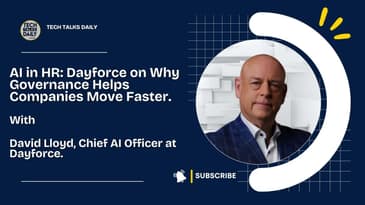
In this episode of Tech Talks Daily, I speak with David Lloyd, Chief AI Officer at Dayforce, about why HR is becoming one of the highest-stakes environments for artificial intelligence and how companies can introduce AI while protecting employee data, maintaining human accountability, and preparing for growing regulatory scrutiny.
HR systems contain some of the most sensitive information companies hold, from salaries and performance records to benefits and personal data. At the same time, AI is increasingly being introduced across recruitment, workforce management, compensation, performance, and employee experience. David explains why this combination creates enormous opportunities but also places greater responsibility on employers to understand how AI systems operate and how decisions are made.
A major theme throughout our conversation is the role of AI governance. David challenges the assumption that governance slows innovation, arguing that the right processes can help companies evaluate AI ideas quickly while reducing the risk of introducing systems that lack appropriate data, transparency, or regulatory safeguards.
Dayforce recently achieved ISO/IEC 42001 certification for AI management systems and NIST AI Risk Management Framework attestation. David explains what independent validation means in practice and why companies evaluating AI vendors should ask for evidence of how systems are governed, tested, monitored, and audited.
We also discuss the principle of "AI by choice." David argues that CIOs and HR leaders should never discover that a new AI capability has suddenly been activated across hundreds of employees without their knowledge. Companies need visibility into where AI is being used, what data employees can provide to models, and whether customer information is being used to train external AI systems.
The conversation examines AI literacy and why HR leaders need to become comfortable with the technology themselves before guiding employees through changes to jobs and working practices. Employees are already experimenting with AI, sometimes through personal tools outside approved company systems. Rather than ignoring this behavior, David explains why companies should provide safe environments where people can learn while establishing clear rules around sensitive data.
Human accountability remains central as AI takes on more responsibility. David discusses why people using AI should remain accountable for its outputs and why human oversight matters when technology influences decisions involving recruitment, compensation, performance, and careers.
For CEOs, CHROs, CIOs, HR technology leaders, and anyone responsible for enterprise AI, this conversation provides practical guidance on responsible AI adoption, employee data, AI bias, model monitoring, regulatory compliance, vendor selection, and building AI governance that can stand up to scrutiny.
The lesson is that governance does not have to be a brake on AI adoption. Done well, it can give companies the structure and confidence to move faster, make better decisions about where AI belongs, and continue using the technology when regulators, employees, customers, and boards start asking harder questions.
https://www.dayforce.com/ https://www.linkedin.com/company/dayforce/ https://www.linkedin.com/in/dtlloyd/