
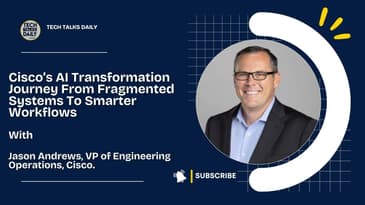
At Team ’26 in Anaheim, I recently sat down with Jason Andrews to unpack how Cisco transformed decades of fragmented tooling, disconnected workflows, and spreadsheet-driven operations into a unified system of work built around Jira, Confluence, Jira Service Management, automation, and AI-ready workflows.
And honestly, this conversation felt refreshingly practical.
Jason oversees engineering operations across Cisco Networking, a business unit with around 22,000 engineers and product managers representing roughly $40 billion in annual revenue. So when he talks about transformation, this isn’t theory. This is operational change happening at enterprise scale.
We discuss how Cisco consolidated more than 85 Jira instances, reduced tooling spend by 54%, and accelerated reporting by 40x while creating a far more scalable engineering organization. But as Jason explains throughout the conversation, the real challenge was never the technology itself. It was getting teams to rethink how they wanted to work moving forward rather than simply migrating years of technical debt into modern systems.
One of the strongest themes in this episode is the difference between transformation and migration. Jason explains why organizations often fail when they focus only on moving systems rather than changing workflows, behaviors, and operational culture at the same time.
We also dive deep into AI adoption inside engineering organizations. Jason shares how Cisco is already seeing significant productivity gains from AI-assisted development, why organizational context matters so much for enterprise AI success, and why he believes the industry is still massively underestimating how much structured data and workflow consistency AI systems actually require.
Along the way, we unpack scenario planning in the AI era, why annual planning cycles are becoming increasingly fragile, and how leaders can move from rigid long-term roadmaps toward more agile operational playbooks capable of adapting to constant disruption.
There’s also a fascinating discussion around the so-called “SaaS apocalypse,” the limits of AI-generated software, and why Jason believes humans will remain central to enterprise operations for years to come, especially in organizations managing millions of lines of legacy code and decades of accumulated institutional knowledge.
If your organization is currently navigating modernization, operational complexity, AI adoption, or large-scale systems transformation, this episode is packed with lessons learned from the front lines of enterprise change.
And perhaps most importantly, Jason offers a reminder that AI alone is not the strategy. The real opportunity comes from reducing friction, improving context, and helping teams spend more time solving meaningful problems instead of manually stitching systems together.