
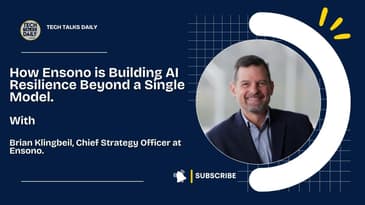
In this episode of Tech Talks Daily, I speak with Brian Klingbeil, Chief Strategy Officer at Ensono, about AI infrastructure resilience, operational dependency, FinOps, legacy modernization, and the growing pressure to prove that enterprise AI investments are producing meaningful returns.
Brian has been speaking with major enterprises through Ensono’s Executive Advisory Council. Three years ago, many participants were experimenting with proofs of concept. Today, they are being asked to present AI projects that are already in production, approaching production, or demonstrating a clear return through productivity, lower risk, service quality, or financial results.
That progression creates a new problem. When an AI model begins supporting product delivery, customer service, logistics, software development, or internal operations, it becomes part of the company’s operating infrastructure. Leaders must then ask familiar IT questions about availability, monitoring, security, incident response, disaster recovery, ownership, and cost.
Brian believes FinOps often provides the first warning. Token consumption can be difficult for CFOs and business leaders to interpret, particularly when hundreds of agents are operating across different models. Ensono’s internal platform has produced around 1,000 agents, prompting questions about which are effective, which are expensive, and who should carry the cost.
We discuss why chargeback and showback could change employee behavior. When AI spending is absorbed by a central corporate budget, teams may have little reason to question whether an expensive model is suitable for a routine task. When the cost reaches their departmental budget, the decision can look very different.
Architecture also matters. Brian recommends systems that are loosely coupled and tightly integrated. Companies should be able to replace a model, provider, FinOps tool, or service as the market changes, while still connecting each component closely enough to deliver useful business outcomes.
That creates a genuine tradeoff. Providers such as Microsoft, Amazon, Google, OpenAI, and Anthropic can offer specialist capabilities that businesses may want to use. Avoiding every provider specific feature can limit what the technology delivers, while becoming too dependent on one provider can make future change expensive and disruptive.
The conversation then turns toward legacy technology. Brian argues that many systems described as outdated still process airline reservations, banking transactions, insurance claims, government services, and other high volume workloads. Turning them off without suitable replacements would create far bigger problems than the word “legacy” suggests.
AI can change the modernization decision. Ensono worked with Markerstudy Group to analyze six million lines of RPG code running on an IBM i platform. The resulting plan identified applications that should move elsewhere while preserving workloads that still benefited from the platform’s reliability and transaction processing capabilities.
Brian treats migration as one possible part of modernization. AI tools can document old code, support modern development environments, and allow younger developers to work with established platforms without immediately beginning a lengthy and expensive replacement program.
We also discuss Ensono’s use of AI operations. Brian says the company reduced mean time to repair by 50% while processing approximately 50,000 tickets each month. The example shows how AI value can be measured through service quality and operational performance rather than relying entirely on direct revenue.
The result is a balanced conversation about moving quickly while building enough control to keep AI dependable. Organizations need space for experimentation, but production services also require ownership, budgets, recovery planning, and people who know what to do when something fails.
If one AI model or provider disappeared tomorrow, how much of your business would stop working? Listen to the episode and share your thoughts with me.