
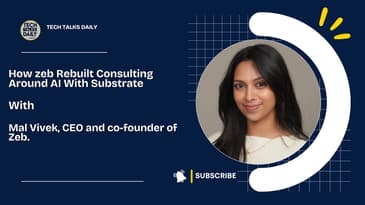
In this episode, Mal Vivek, CEO and co-founder of zeb, joins me to discuss the launch of Substrate, an AI-native operating architecture that challenges many assumptions about enterprise consulting, software delivery, and AI adoption.
Rather than layering AI onto legacy processes, zeb made the bold decision to scrap its own operating model and rebuild the company from the ground up with AI at its core. The result is Substrate, a system designed to learn from every project it completes, continuously improving through a Plan, Execute, Evaluate operating loop while helping organizations move from experimentation to measurable business outcomes.
Our conversation goes far beyond another AI product announcement. Mal explains why so many organizations remain trapped in what she calls "pilot purgatory," investing heavily in AI without producing measurable returns. We discuss why treating AI as an assistant often limits its potential, and why businesses may need to rethink their organizational structures, workflows, and even leadership models if they want AI to become part of their operational foundation.
We also explore one of the most talked-about aspects of zeb's business model: a 100 percent outcome guarantee. Instead of charging for time or software licenses, zeb only gets paid when agreed business outcomes have been delivered. That raises interesting questions about accountability, risk, and whether the traditional consulting model still makes sense in an era where AI can dramatically compress delivery timelines.
Mal also shares why zeb gives customers ownership of their own version of the Substrate engine instead of locking them into a traditional SaaS subscription, how AI changes the relationship between technology vendors and their customers, and why she believes future organizations will become flatter, faster, and increasingly focused on builders rather than management layers.
If you're a technology leader trying to move beyond AI proofs of concept, or a business executive searching for a practical path to measurable AI value, this conversation offers plenty of fresh thinking on what AI-native organizations could look like over the next few years.
Can businesses continue adapting yesterday's operating models for tomorrow's technology, or is it time to rebuild from the ground up? I'd love to hear where you stand after listening to this episode.