
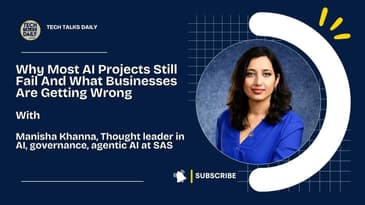
At SAS Innovate, that question came up repeatedly, and in this episode, I sit down with Manisha Khanna, global product marketing lead for AI at SAS, to unpack why so many organizations are still struggling to move from AI pilots to meaningful business outcomes. While headlines continue to celebrate the rapid rise of generative AI and agentic systems, Manisha brings a far more practical perspective shaped by working directly with enterprises trying to operationalize AI at scale.
One of the most striking parts of our conversation centers on why AI projects continue to stall. According to Manisha, the biggest problems are not weak models or lack of ambition. Instead, organizations are running into unpredictable inference costs, operational complexity, governance challenges, and internal resistance to change. She explains why many companies still approach AI as a technology purchase rather than a transformation strategy, and why governance built in from the beginning can actually accelerate adoption rather than slow it down.
We also spend time exploring what agentic AI really means beyond the hype. Manisha shares why SAS chose supply chain as the launch point for its first industry-packaged agent and how agentic systems differ from copilots by acting more like coworkers than assistants. Rather than simply providing recommendations, these systems can actively participate in business workflows, helping organizations move from monthly optimization cycles to near real-time decision-making.
Another major theme is the growing importance of governance and accountability. As organizations deploy AI into regulated industries and customer-facing environments, the focus is shifting away from “whose model is best” toward “who is deploying the best use cases responsibly.” Manisha explains why governing the use case itself matters more than obsessing over model benchmarks, and why companies that bolt governance on afterward create friction for themselves later.
The conversation also touches on where AI is already delivering measurable value today. From customer complaint management in banking to aircraft maintenance support systems powered by retrieval-augmented generation, we discuss how organizations are seeing success when AI augments existing workflows rather than attempting wholesale disruption overnight.
What stood out most for me is how often the human side of AI came back into focus. Manisha repeatedly emphasized that leadership communication, employee trust, and organizational readiness are just as important as the technology itself. If leaders position AI purely as a cost-cutting tool, fear and resistance follow. But when AI is framed as a way to empower people and improve outcomes, adoption becomes much easier.
As organizations continue to implement AI and agentic systems, the biggest question is no longer whether the technology works, but whether businesses are ready to lay the foundations needed to make it succeed.
Useful Links
Connect with Manisha Khanna SAS Blog SAS Innovate Please check the partners of the Tech Tech Talks Network
Denodo Learn more about the NordLayer Browser