
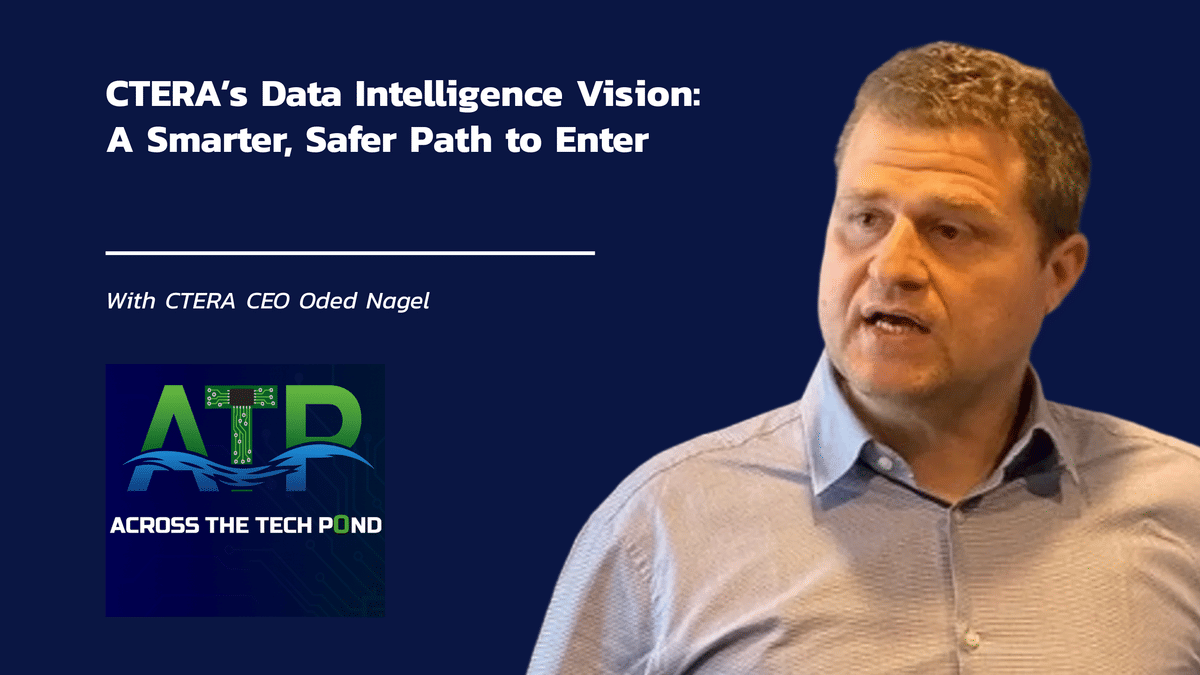
What does it take for enterprises to turn years of fragmented data into actionable intelligence? That was the central question when the Across the Tech Pond team, David Marshall in Austin, Anthony Savvas, and Neil C. Hughes reporting from Frankfurt, met with CTERA CEO Oded Nagel during the IT Press Tour in New York. What followed was an in-depth discussion on how CTERA’s new Data Intelligence Platform could transform the way global organizations approach AI and manage unstructured data.
CTERA, already well known for its global file system and secure cloud storage solutions, is now positioning itself at the heart of enterprise AI transformation. The company’s extensive experience in distributed storage provides it with a unique vantage point. As Nagel explained during the interview, AI projects often fail not because of the models but because of the messy, incomplete, and insecure data that fuels them.
The Three Waves of Data Transformation
During the IT Press Tour, CTERA outlined what it called the three waves of transformation that define how enterprises can achieve accurate data intelligence.
The first wave focused on unified data access, providing organizations with a single, consistent view of their data across on-premises systems, the cloud, and the edge. For many companies, this remains a challenge. Employees continue to save files across multiple platforms, including SharePoint, OneDrive, and local NAS systems, creating silos that hinder collaboration and visibility.
The second wave focused on data security. Once data is unified, it must also be managed appropriately, versioned, and protected. CTERA spent more than a decade building what Nagel calls one of the most scalable global file systems in the industry, enabling enterprises to control permissions, monitor metadata, and maintain a secure data foundation across billions of files.
Now comes the third wave, data intelligence. Once the data is unified and secured, enterprises can finally begin to extract value from it. This is where CTERA’s Data Intelligence Platform plays its most transformative role.
By indexing, classifying, and enriching unstructured data, organizations can prepare their assets for AI and analytics with accuracy and confidence. As Nagel put it, AI isn’t magic. It only works when the data underneath it is clean, secure, and structured in a way that makes sense.
Meeting the AI Challenge
According to research shared during the conversation, around 95 percent of generative AI pilots never make it into production. The reasons are consistent, from inconsistent file formats and poor metadata to duplicate versions and a lack of governance. CTERA’s platform tackles this directly by automating much of the data unification and permission management process.
Neil noted how CTERA’s approach bridges the gap between traditional IT systems and modern AI tools. He observed that enterprises have been sitting on a goldmine of data they cannot use, and CTERA’s model helps them make existing systems more intelligent without forcing a complete overhaul.
Anthony Savvas, was particularly interested in the company’s expansion strategy. CTERA has been growing at approximately 35 percent year-over-year, with strong momentum in both Europe and North America. The company has also seen 60 percent growth in the government sector, as agencies modernize their data management while maintaining strict security standards.
Expanding Through Partnerships
Another central talking point from the IT Press Tour was CTERA’s growing network of strategic partnerships. The company collaborates closely with major players, including Hitachi, Hewlett Packard Enterprise, IBM, Microsoft Azure, Amazon Web Services, and, most recently, Cloudian.
These partnerships help extend CTERA’s data fabric across hybrid cloud environments, enabling customers to move workloads between private and public infrastructure securely.
David Marshall, known for his platform VMblog.com, emphasized how this ecosystem-driven approach aligns with enterprise needs. He explained that businesses do not want to rip and replace their storage systems. Instead, CTERA is creating a unified layer that enables AI, analytics, and cybersecurity to work together seamlessly across existing infrastructure.
The conversation also revealed that CTERA recently raised 80 million dollars from PSG, one of the largest venture firms in the United States. This funding is fueling both product innovation and global expansion, particularly in the areas of AI and cyber-resilient storage solutions. The company’s offerings are now available on both the Azure Marketplace and the Amazon Marketplace, giving enterprises easier access to its technology.
The Future of Data Intelligence
As enterprises continue to expand their digital footprint, the volume of unstructured data grows exponentially. CTERA’s Data Intelligence Platform is designed to make sense of this sprawl, giving organizations a central framework for managing, protecting, and analyzing their assets.
Nagel shared that the platform will soon be offered not only as an extension to existing customers but also as a standalone product for organizations looking to modernize legacy systems. The long-term vision, he said, is to help companies move from simply storing information to truly understanding it.
That vision resonates strongly across both sides of the Atlantic. Whether in the United States government sector, European enterprises, or Asia-Pacific growth markets, the demand for smarter, safer data management is accelerating. CTERA’s data intelligence roadmap could prove pivotal in helping organizations move from AI experimentation to enterprise-scale adoption.
As the Across the Tech Pond hosts wrapped up the interview, one question lingered. Are enterprises finally ready to make data intelligence the cornerstone of their AI strategy? The answer, if CTERA’s trajectory is any indication, seems closer than ever.
Listen to the whole conversation with Oded Nagel on the latest episode of Across the Tech Pond, hosted by David Marshall, Neil C. Hughes, and Anthony Savvas.