
When I spoke with Nirankush "Kush" Panchbhai, Senior Vice President of Product Management at ServiceNow, it became clear within minutes that we were discussing far more than just another enterprise AI platform.
Our conversation explored why organizations must prioritize maintaining trust, control, and accountability. But most importantly, the message for leaders is to stop getting distracted by models or shiny new features and start measuring impact.
Key Takeaways
Governance is an accelerator rather than a brake.
Human-centered AI design builds trust, transparency, and accountability at enterprise scale.
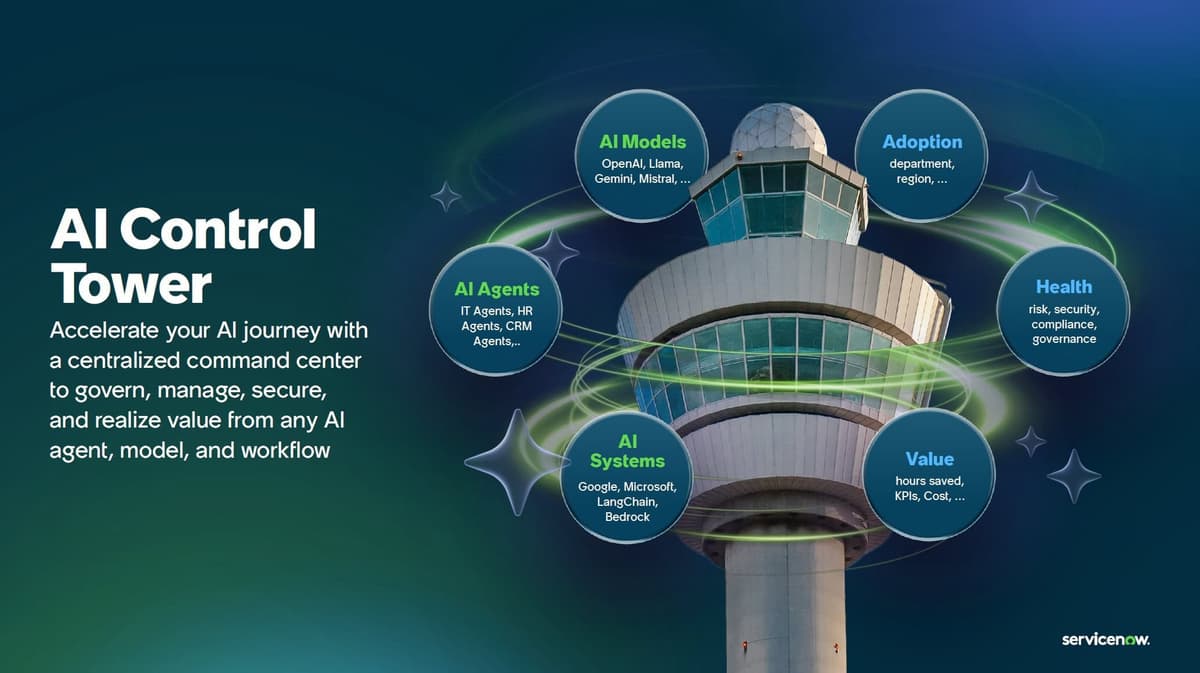
ServiceNow's AI Control Tower manages all AI assets from one unified platform.
Treating AI agents as a digital workforce enables measurable performance and value tracking.
Automation should remove repetitive tasks while preserving human creativity and control.
ServiceNow’s AI Control Tower
Kush Panchbhai leads product for ServiceNow's AI Platform, a space now central to the company's ambition to become the connective tissue for digital workflows. The platform's newest feature, the AI Control Tower, promises something deceptively simple: one place for enterprises to manage every AI system, from experimental models to full-scale agents, while seeing their business value in real time.
The goal is not just to make AI scalable but to make it human-centered at the same time.
Panchbhai told me
"At ServiceNow, we think about both scalability and human-centered design as two sides of the same coin. You cannot achieve scalability through one-off reviews and approvals. You need automated governance so that when you scale from 10 to 1000, it doesn't fall on you. But you also need the human in control."
That idea of "the human in control" came up repeatedly in our conversation. The more we spoke, the more I realized that ServiceNow's approach challenges a common misconception that governance holds back innovation. Panchbhai sees it as the accelerator itself.
Governance as an Enabler, Not an Obstacle
Over the last three years, many teams have hopped on the AI bandwagon, only to stall when it comes to actual deployment. Pilot projects pile up, technical debt increases, and questions around accountability and data lineage create friction.
When I asked Kush how ServiceNow planned to avoid this trap, his answer was direct:
"I truly believe that governance is an accelerator rather than a brake."
It's a perspective that runs against the grain of how governance has traditionally been viewed. Instead of being something external to the innovation process, ServiceNow has embedded it directly into the software development lifecycle.
Panchbhai said:
"Now the developer doesn't need to go to a couple of meetings or wait weeks to get an approval. Everything is done at development time. These workflows are identifying issues that are not detected in production. They are found at build time."
He added:
"If you think about governance as brakes, then you're missing the bigger picture. If you think about governance as an accelerator to achieve the bigger outcome, then you will clearly use it and, in fact, use those paved roads to drive the car much faster with confidence."
It's an image that captures the essence of modern enterprise AI. The companies that treat governance as a structural advantage, not an afterthought, will be the ones who get their AI into production and keep it there.
Beyond Automation: The Human Factor
ServiceNow's philosophy on artificial intelligence (AI) is to take the work out of the work, not the human out of the work. It's a simple phrase, but a revealing one. He explained that enterprises are filled with repetitive, low-value tasks that drain energy from skilled employees.
“ServiceNow’s philosophy on AI is simple: take the work out of the work, not the human out of the work.
— Neil C. Hughes (@NeilCHughe17958) October 22, 2025
As Nirankush ‘Kush’ Panchbhai explains, AI should clear away the repetitive ‘soul-crushing’ tasks so people can focus on creative, high-value work. pic.twitter.com/XUIKRX3Ixh
Kush Panchbhai repeatedly described AI as a teammate rather than a tool, capable of explaining its reasoning so humans can validate, challenge, or refine the outcome. It's a message we have heard many times, but explainability is now front and center of the conversation. He said:
"The AI teammate should be able to say, I did this work, this is my thought process, this is why I did it, so that you as a human could agree or disagree, and tweak it as needed.”
Another theme that emerged from our conversation was how enterprises are starting to regard
AI agents as integral to their workforce.
This isn't just a ServiceNow idea either. A growing number of vendors, from Cognizant's Neuro AI Network to IBM's WatsonX Governance, are introducing similar frameworks for managing AI lifecycles. The direction of travel is clear. AI needs a management layer, not just a deployment one.
What happens when AI becomes part of the workforce? Nirankush “Kush” Panchbhai, SVP of Product Management at @ServiceNow , shares why organisations must start managing AI agents like employees, with oversight, performance reviews, and accountability. pic.twitter.com/giSYbAZT2q
— Neil C. Hughes (@NeilCHughe17958) October 22, 2025
For a moment in our conversation, I put the technology to one side and asked Kush what he had learned from his years at Microsoft, Salesforce, and now ServiceNow. He didn't hesitate, as transparency, explainability, and accountability are the three foundations at the heart of his career.
Each of those pillars is essential, but together they form a cycle of trust.
Transparency provides visibility into the system's operations.
Explainability clarifies why it made those decisions.
Accountability closes the loop by showing whether it delivered measurable value.
ServiceNow has integrated these principles into the Control Tower's core design. Every AI initiative can be linked to financial and operational outcomes, allowing executives to track performance across projects. That visibility, Panchbhai argued, is what gives both technical and business leaders the confidence to scale.
Escaping the Hype Cycle
By the end of our conversation, it was clear that ServiceNow's philosophy reflects a wider maturity in enterprise AI. The era of "shiny AI," which is as full of pilots, prototypes, and over-promises, is giving way to a focus on outcomes and accountability.
Panchbhai said:
"We see so many of ServiceNow customers who are now focused on outcomes and then trying to solve those outcomes. We have many, many amazing examples where people have used our AI agents, and their deflection is like way 2x, 3x more than what was before."
AI projects are no longer being judged by their novelty but by their impact. It's a transition that echoes across the industry. Ultimately, the companies that will use governance will have a much more accelerated journey in making AI outcomes real.
It is difficult to argue with that. We have seen companies chasing novelty for novelty's sake often find themselves paralyzed by complexity or stuck in the pilot phase.
Organizations preparing to deploy swarms of AI agents into the wild without guardrails face significant risk. Although it's not as attention-grabbing to marketers, frameworks and governance will play a crucial role in providing human employees with the confidence and clarity they need to understand how these systems operate. Without that, adoption will always be fragile and risky.
Transparency. Explainability. Accountability.
— Neil C. Hughes (@NeilCHughe17958) October 22, 2025
ServiceNow’s Nirankush “Kush” Panchbhai says these three principles are the foundation for building AI people can trust.
“AI should be a teammate that is transparent, explainable, and accountable for the value it creates.” pic.twitter.com/pHKXRc1Hg7
The Bottom Line
ServiceNow is promoting a vision of AI that enhances rather than erodes human purpose. In that sense, the AI Control Tower is less a product and more a philosophy about how modern enterprises should be approaching automation.
The lesson from the discussion with ServiceNow’s Kush Panchbhai extends beyond any single platform. Governance is becoming the new differentiator in AI. The companies that succeed will be those that make it invisible, reliable, and human-centric.
FAQs
What is ServiceNow’s AI Control Tower?
It’s a unified platform that lets enterprises manage all AI systems, track performance, and maintain governance and accountability.
Why is governance important for enterprise AI?
Governance accelerates deployment by providing structure, trust, and measurable outcomes, helping AI projects scale effectively.