
The technology industry has become remarkably efficient at creating data. Artificial intelligence, cloud computing, scientific research, healthcare systems, financial services, media platforms, and connected devices are generating information at unprecedented rates. While much attention is focused on storing and processing that data today, a less frequently discussed challenge is how organizations will preserve it over the coming decades.
Long-term data preservation remains one of the most difficult problems in enterprise technology to solve. Storage platforms continue to improve in capacity, performance, and cost, but most archival solutions still require ongoing maintenance, periodic migration, and ongoing investment to ensure information remains accessible.
Sure, tape remains the dominant archival medium, but organizations must routinely migrate data between generations of media and maintain increasingly scarce hardware capable of reading older formats.
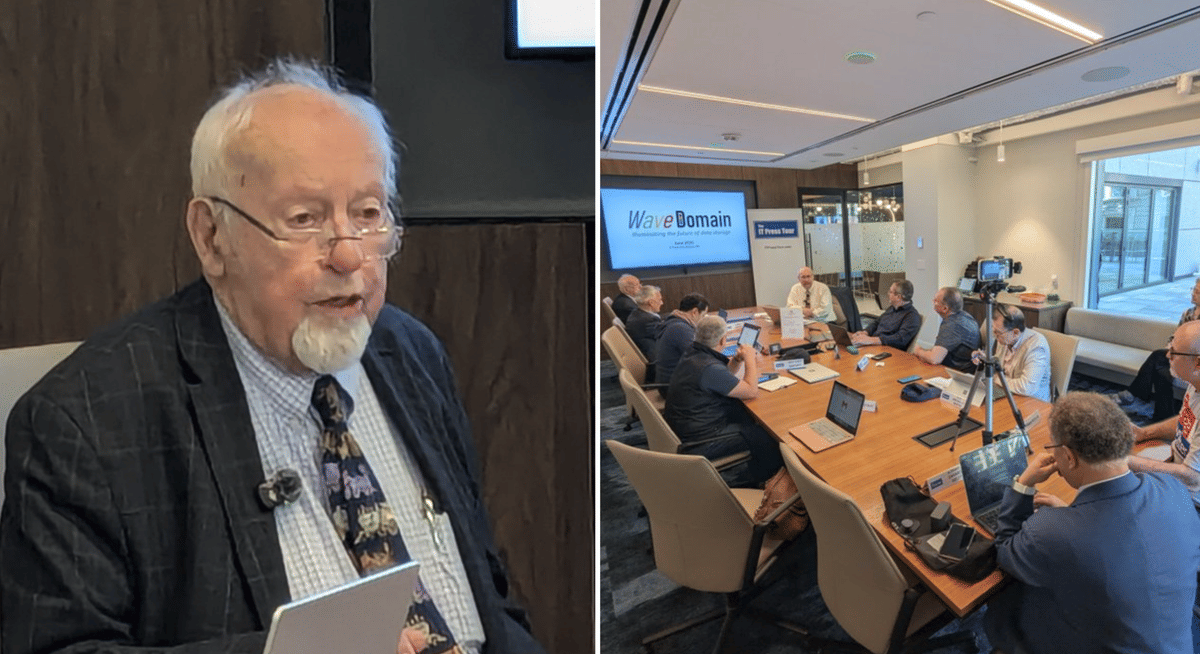
It was against this backdrop that Wave Domain presented one of the most unusual technologies showcased at the recent IT Press Tour in Boston.
Unlike most storage vendors, the company is not attempting to build a faster flash array, a larger object storage platform, or a more efficient backup system. Instead, Wave Domain is developing a completely new storage medium based on scientific principles first demonstrated more than a century ago.
Revisiting A Forgotten Scientific Discovery
Wave Domain's technology is based on the work of French physicist Gabriel Lippmann, who received the Nobel Prize in Physics in 1908 for his pioneering work in color photography.
The technique involves recording color by capturing standing waves of light within a photographic emulsion instead of using dyes or pigments. The process created extraordinarily durable images that remain intact more than a century later.
At the time, the technique was regarded primarily as a scientific achievement rather than a commercially viable technology. The problem was that exposure times were long, reproduction was difficult, and alternative photographic methods proved more practical. But, the durability of the underlying chemistry remained largely unmatched.
Wave Domain's founders believe that same durability could address a modern problem: preserving digital information for generations without requiring continuous migration between storage technologies.
Beyond Binary Storage
Wave Domain is pursuing a multi-state approach. Rather than storing a single binary value in a given location, the technology records multiple color states within the same physical area. According to the company, its planned implementation would allow a single location to represent thousands of possible values by combining narrowband colors. This dramatically increases the amount of information that can be stored within a given physical footprint.
The approach extends beyond simple capacity. It represents an attempt to move away from binary storage architectures altogether and toward a system where information density is achieved through combinations of optical states.
The essence of standing Wave Storage with #WaveDomain - #MultiCloud #Archiving #LongTermPreservation #DeepArchive #Optical #WORF #ITPT @ITPressTour 68th Edition pic.twitter.com/F945ZuTEka
— The IT Press Tour (@ITPressTour) June 8, 2026
One of the more interesting aspects of the Wave Domain approach is that the technology does not rely on exotic hardware. Many next-generation archival storage projects depend on specialized lasers, precision optics, or highly customized manufacturing processes. Wave Domain's architecture uses components already common in consumer electronics markets, including LEDs, LCD technology, optical assemblies, and image sensors similar to those found in smartphone cameras.
According to the company, approximately 95 percent of the required components already exist within established manufacturing supply chains. This focus on readily available components is significant because commercial success in the storage industry is often determined as much by manufacturing economics as technical innovation. A storage technology may offer compelling technical characteristics, but adoption becomes difficult if the hardware required to read and write the media remains prohibitively expensive.
Wave Domain's long-term strategy appears to recognize this reality by designing around components that benefit from decades of investment and economies of scale in consumer electronics.
Durability As The Primary Objective
Perhaps the most compelling aspect of the technology is its emphasis on durability.
Many emerging storage technologies make ambitious claims regarding lifespan, but Wave Domain has already subjected its media to environmental testing that would be difficult to replicate in conventional laboratories. Through a NASA project known as HELIOS, standing-wave storage samples spent approximately 9 months outside the International Space Station, where they were exposed to radiation, temperature extremes, electromagnetic effects, and the stresses associated with launch and orbital operations. According to the company, the samples returned without measurable degradation.
For organizations responsible for preserving critical records, scientific data, government archives, or cultural assets, such testing provides an important proof point. The challenge of archival storage is rarely about accessing information next week or next year. It is about ensuring information remains available decades from now.
Wave Domain's vision is summarized through the phrase "Write Once, Read Forever." While that goal remains aspirational, it highlights the company's focus on permanence rather than performance.
Frozen Light as Forever Storage: Inside Wave Domain’s 19th-Century Physics Bet to Archive the 21st Century. @vmblog https://t.co/Nm97cKinTN #WaveDomain #MultiCloud #Archiving #Optical #WORF #LongTermPreservation #DeepArchive #ITPT @ITPressTour 68th Edition in Boston pic.twitter.com/Xn2zqyIn2Z
— The IT Press Tour (@ITPressTour) June 11, 2026
Competing In A Growing Archival Storage Market
Wave Domain is not alone in pursuing long-term storage innovation.
Microsoft's Project Silica, Cerabyte's ceramic-based storage platform, DNA storage initiatives, and several optical storage research projects are all attempting to address the same fundamental challenge. The common objective is to reduceto reduce the operational burden of preserving information over extremely long periods.
Where Wave Domain differs is in its reliance on multi-state optical encoding and its emphasis on avoiding specialized hardware. The company believes these characteristics could eventually provide advantages in both storage density and system cost.
I cannot stress enough that Wave Domain is still at an early stage of development. Current prototypes are far removed from the capacities discussed in long-term projections, and the company continues to seek funding and strategic partnerships to move the technology toward commercialization.
The distance between a promising laboratory demonstration and a commercially viable storage platform remains substantial.
The Bigger Question
The most interesting aspect of Wave Domain may not be whether its technology succeeds commercially. It is the question the company forces the industry to confront.
Most of today's infrastructure is focussed on the short term problem of providing immediate access, rapid processing, and short-term operational efficiency. But many organizations are increasingly responsible for preserving information that may need to remain accessible for generations.
Scientific research, legal records, cultural archives, medical histories, and government documents all require storage strategies measured in decades rather than quarters. As AI systems generate, consume, and depend upon ever-larger volumes of information, the long-term preservation of data becomes increasingly important.
Wave Domain is proposing an unconventional solution to that problem. Whether the company ultimately becomes a commercial success remains uncertain. What is clear is that it represents one of the most distinctive attempts currently underway to rethink how digital information can be preserved over the long term.
For technology leaders, the immediate takeaway is that the future of archival storage may look very different from the tape libraries and disk systems that dominate the market today. Wave Domain is one of several companies attempting to define what that future might look like, and its progress will be worth watching.
I'd like to have the Wave Domain team on the podcast in the next few weeks. If you have any questions you would like me to ask, please leave a voicemail below to be part of the conversation.