
What does “Life After VMware” really look like for businesses? That question dominated my thoughts during the 63rd edition of the IT Press Tour in Amsterdam, where I had the chance to sit down with EuroNAS founder and CEO, Tvrtko Fritz.
Over two days, the event brought together European and US journalists to meet with infrastructure, storage, and virtualization companies, each with their own response to the industry’s shifting landscape. With Broadcom’s VMware acquisition still reverberating through IT budgets, this wasn’t an abstract conversation. It was grounded in real-world costs, failed renewal negotiations, and organisations quietly testing what comes next.
EuroNAS may not be the biggest name on the list, but their story and Fritz’s direct way of telling it are. It revealed the human side of an industry in transition.
A Small Company Built on Listening
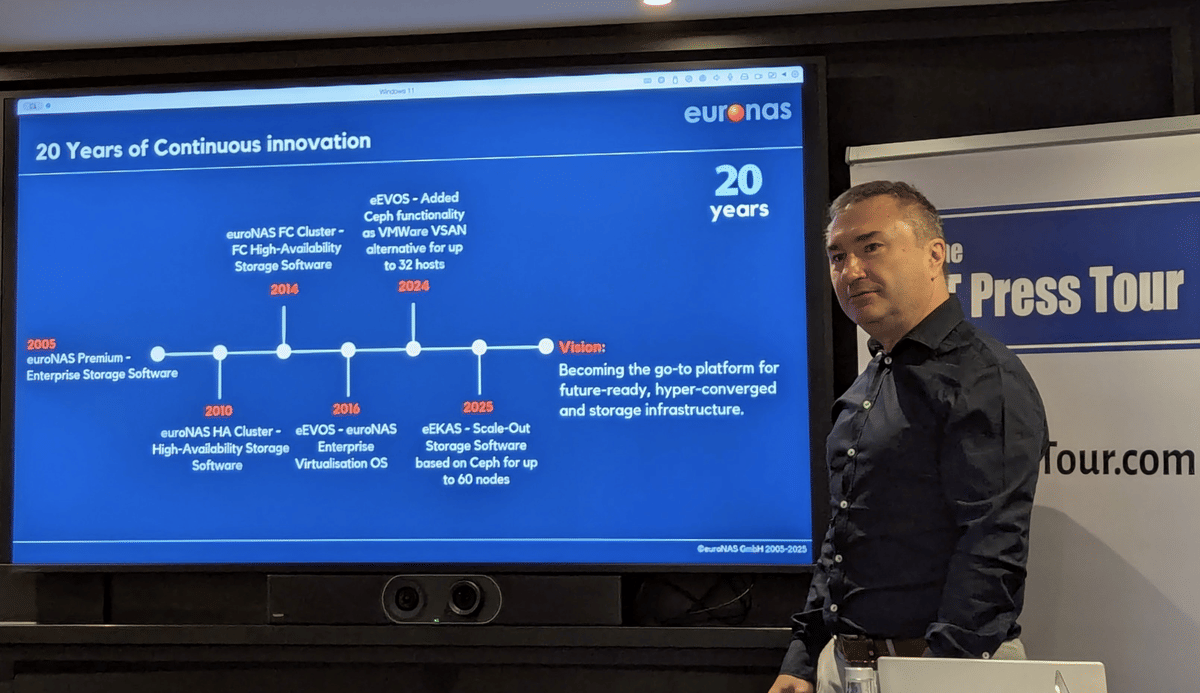
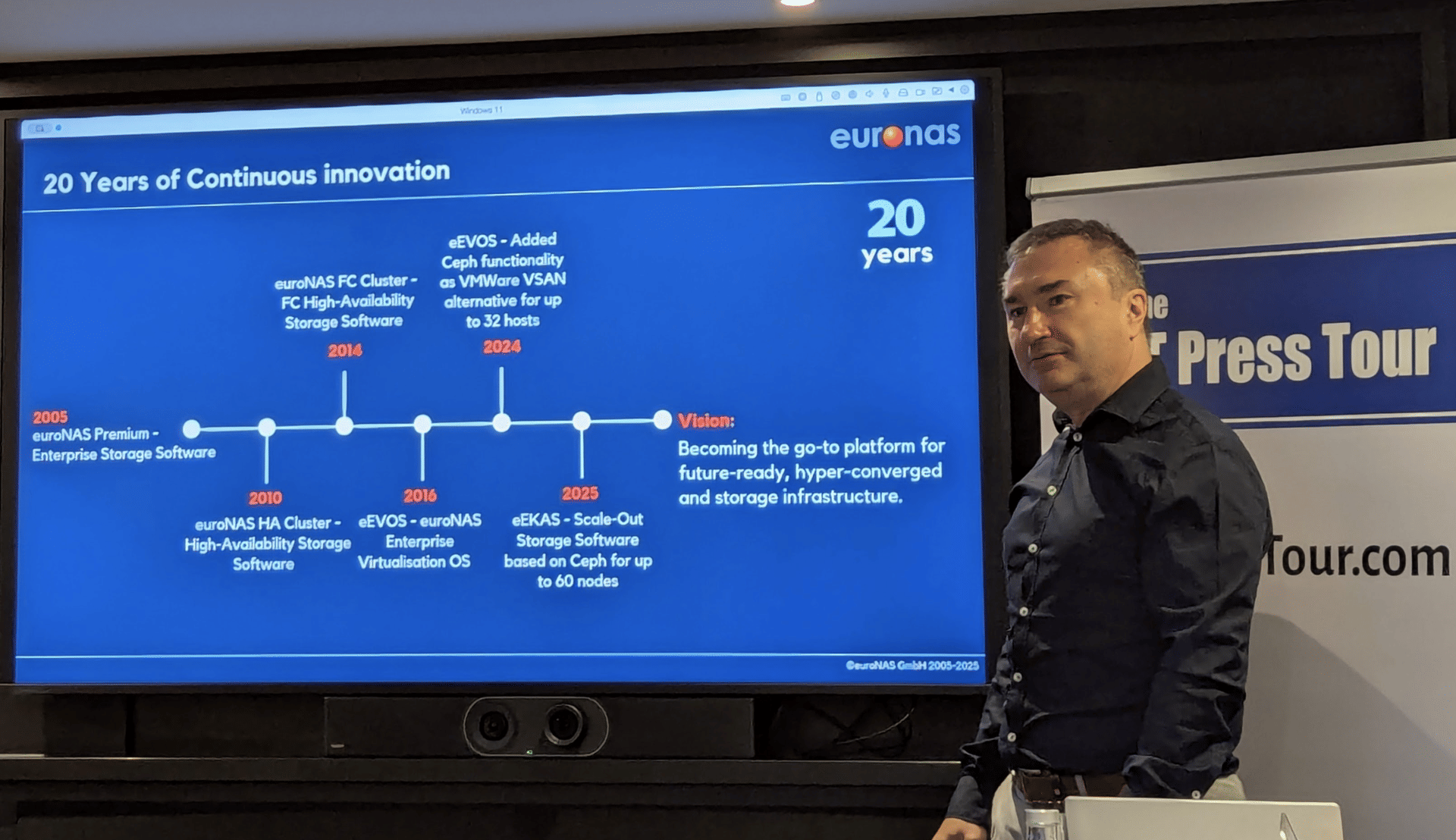
EuroNAS started life in Munich in 2005. Fritz, who had worked at AMD and Adaptec, assembled a small team to simplify storage. “When we started, the idea was to make NAS for the masses,” he told us. “You’d click once, and everything would be set up. But it turned out we never sold anything to home users. It ended up being enterprise.”
Headquartered in Germany with development in Bulgaria, EuroNAS has a staff of just 15 employees and a handful of freelancers. Yet their footprint extends across the UK, Portugal, and further afield through distributors and OEM partners.
What struck me most wasn’t the size of the company, but the way Fritz talked about support.
“I’m a CEO of the company, but I still prefer doing support,” he admitted. “If there’s an issue, I can push straight into engineering. That’s why our satisfaction went up even as licenses grew.”
It’s not something you often hear from a founder. For EuroNAS, support isn’t a department. It’s part of the DNA.
From HA Storage to Hyperconverged Virtualization
EuroNAS’ journey reflects the way customers pull vendors forward. After their early NAS products found a home in businesses, they built HA Cluster, a dual-node mirrored solution designed for redundancy across sites. It was cost-effective, especially for SMBs that couldn’t justify more expensive storage arrays.
By 2014, they extended the design to Fibre Channel mirroring. And then came a turning point: partners asked why EuroNAS couldn’t offer something like Nutanix, an all-in-one hyperconverged platform.
“We thought, why not? I mean, it’s easy. There’s an open-source KVM. What can go wrong?” Fritz joked. However, they soon discovered that KVM alone wasn’t enough. Enterprise customers required a more robust solution, particularly in terms of snapshot and backup capabilities.
That led to eEVOS, the Enterprise Virtualization OS. It combines virtualization, storage, backup, and disaster recovery into one system. The aim was precise: give businesses the resilience they need, without demanding Linux expertise or third-party add-on.
When VMware Customers Started Knocking
The real surge came after Broadcom’s licensing changes. Fritz didn’t downplay it. “After VMware’s changes, the interest is extreme,” he said. “People try to renew for a year while they explore options, but the pipeline is real.”
He shared one UK example that resonated with him. A public sector organisation, which pays around £150,000 annually, suddenly faced a renewal quote of £350,000. They couldn’t take that figure back to the politicians for approval. “Nobody is moving away from VMware because they want to,” Fritz explained. “They leave because they have to.”
In Poland, political transitions left budgets frozen, making subscription renewals impossible. In other cases, customers complained about waiting months to get a VMware quote back from the channel. By the time it arrived, the numbers were multiples of their previous spend.
That frustration is why organisations are cautiously piloting eEVOS side-by-side with VMware. They’re hedging their bets, but they’re not doing it quietly anymore.
Snapshots, Backup, and Hard Lessons Learned
What makes eEVOS stand out isn’t marketing spin. It’s the product decisions born from real failures. Snapshots, for instance, became a problem for customers who forgot to delete them. Six months later, consolidating the deltas could cause a system-wide freeze.
“With KVM or VMware, when you’re creating a snapshot, they’re usually copying the deltas into a separate file. You can really lock down the whole server for a week if you’re unlucky,” Fritz said.
EuroNAS solved it differently, using a reference-link system. Instead of a growing chain of deltas, the system duplicates the index of blocks. “There’s no difference between the original file and the snapshot file,” Fritz explained. “The only difference is the size. So it’s predictable.”
Backup told a similar story. Fritz recalled a dentist who lost an entire workday when a Windows update bricked his VM. Restoring over a gigabit took eight hours. “He phones me every five minutes and asks me, Where is my backup coming back? That’s not acceptable.”
The solution was Instant Backup and Recovery, which allowed a VM to be restarted in seconds while the recovery of specific files continued in the background. These aren’t abstract engineering decisions. They’re scars turned into features.
Making Ceph Consumable
Ceph has a reputation for being robust, scalable, and punishingly complex. EuroNAS was aware of this, but it was pushed into it by demand. “I have never in my whole life sold a product that I haven’t even built,” Fritz admitted. “But cloud providers were begging us for it.”
The result is eEKAS, a GUI-driven Ceph platform that hides the complexity behind wizards and dashboards. Instead of days or weeks of manual setup, Fritz claims customers can be up and running in 20 minutes.
They’ve also tested it at scale. One broadcaster in Poland adds 500 terabytes of capacity every year. Another project paired EuroNAS software with Seagate’s Exos CORVAULT to create a 7.5 petabyte archive. In gaming, EuroNAS supports a 60-node cluster for large studios.
“Ceph storage itself isn’t the value,” Fritz told me. “Making Ceph deployable in 20 minutes with a web UI is the value.”
Licensing: Predictability Over Shock
One of the sharpest contrasts with VMware is licensing. eEVOS is sold per node, with 32 cores included. Additional cores can be added in 8-core increments at no extra cost. Storage solutions are perpetual licenses with a minimum three-year support period, often sold as five-year packages to match hardware warranties.
“Perpetual means if something happens with your hardware, you still own the license,” Fritz said. “You don’t wake up one day and find you have nothing.”
That simplicity resonates in an era where unexpected renewal quotes can derail entire budgets.
OEM, Partners, and Staying Nimble
Around 80 percent of EuroNAS revenue has historically come from OEM deals, with their technology shipped under other brands. Rockstar Data Systems was one such partner that went under during the COVID pandemic. Today, the company is striving to balance its OEM heritage with increased direct visibility, primarily through distributors like Exertis Hammer and regional partners such as Fortuna Data in the UK.
The hardware flexibility matters too. Fritz described one industrial customer with 10 Xeon servers still under warranty. VMware informed them that the servers were no longer supported, meaning they would have to dispose of them. EuroNAS let them keep the hardware, cutting migration costs dramatically.
For resellers, EuroNAS’ model is attractive because they can control the hardware, keep the margin, and avoid being undercut by the vendor later. “Our partners want margin and control,” Fritz said. “We are software only and hardware independent. Keep the servers you already own.”
Culture and Support as Differentiators
Support isn’t just a service for EuroNAS, it’s a strategy. Fritz believes that too many companies separate frontline support from development.
Support guys are motivated, but they don’t have the authority over developers. So, if there’s an issue, they can fix it 10 times, and they can tell the developers 10 times, but they still don’t listen. That’s why I still provide support myself.
This philosophy has made EuroNAS an outlier in a market dominated by giants. Customers know they can escalate directly to the founder if needed, and partners see a vendor who prioritizes relationships over resale volume.
It may not scale indefinitely, but it has sustained the company for 20 years and multiple technological waves.
Growth Ambitions in a VMware Shadow
For now, the wave of customers looking for “Life After VMware” is driving growth. Fritz joked about “2,000 percent” increases that obviously can’t last, but he projected revenues could hit €30–40 million within three years if momentum continues.
They are careful not to overpromise, but the demand is undeniable. Whether it’s governments constrained by budget, broadcasters drowning in video files, or SMBs trying to stay afloat, the appeal of a perpetual license, GUI simplicity, and instant rollback is strong.
My Takeaway From Amsterdam
EuroNAS doesn’t pretend to be VMware. In fact, Fritz openly admitted: “I’m pretty sure VMware is a better product.” However, his point was that affordability, simplicity, and support are more critical for many businesses right now. “Nobody’s moving away from VMware because they want to. They leave because they have to.”
That honesty was refreshing. EuroNAS is not trying to sell a dream. They are continuity of sale at a cost their customers can handle. And in a market unsettled by licensing shocks, that’s precisely what many are searching for.
Over To You
I’ll be sitting down with Tvrtko Fritz from EuroNAS for an upcoming podcast to continue this conversation on “Life After VMware.” What would you like me to ask him? Should I push him on long-term support, compare eEVOS head-to-head with Nutanix or Proxmox, or dive deeper into how customers are handling migrations?
Share your questions, and I’ll take them directly to him on the show.