
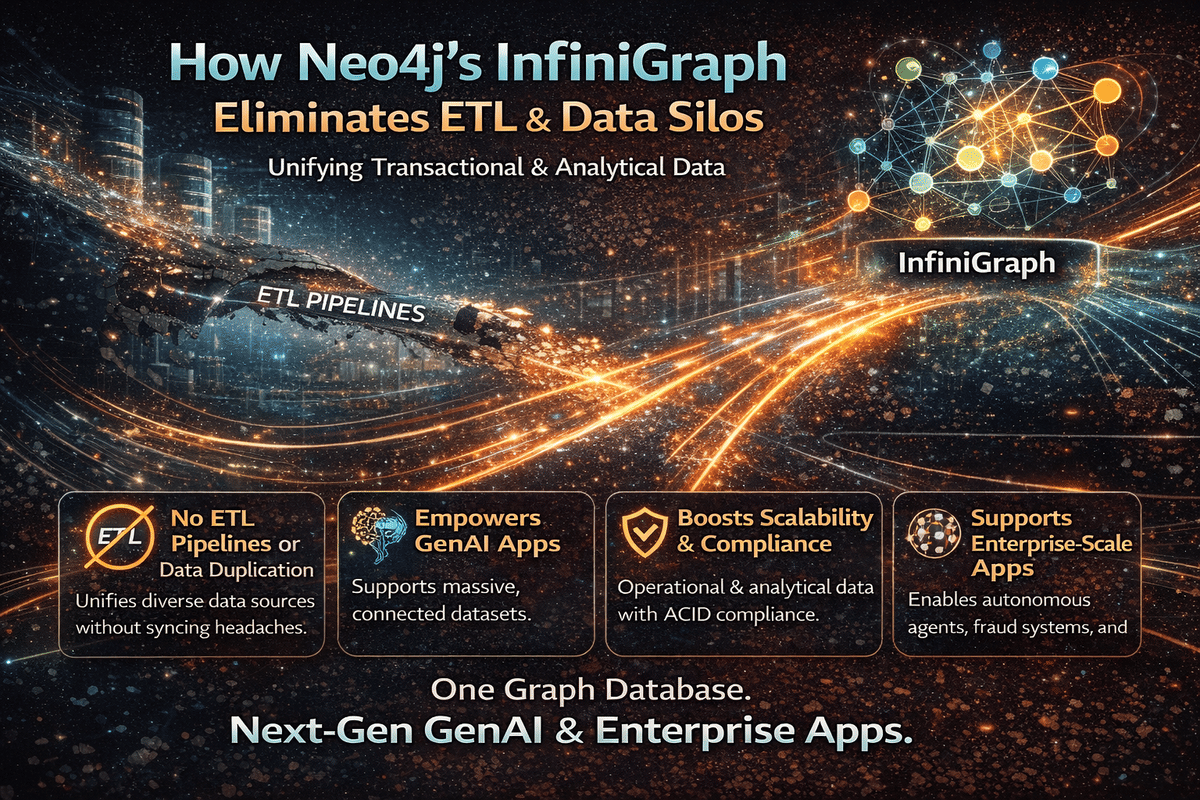
Enterprise data teams have been wrestling with the complexity of ETL pipelines, duplicate infrastructure, and the friction of syncing information between platforms for years. But Neo4j's InfiniGraph suggests that this challenge may finally be over.
InfiniGraph is the result of years of engineering work aimed at scaling graph workloads without compromising performance.
Techopedia sits down with Sudhir Hasbe, President of Technology at Neo4j, to discuss the launch, the technology underlying it, and the kinds of opportunities it may give users.
Key Takeaways
InfiniGraph offers no ETL pipelines, sync delays, or duplicated storage
Supports GenAI deployments requiring massive, connected datasets.
Enables compliance systems, autonomous agents, and transactional apps simultaneously.
Reflects Gartner's call for the convergence of operational and analytical systems.
Multi-year engineering effort focused on performance without sacrificing usability.
About Sudhir Hasbe
Sudhir Hasbe is Neo4j’s President of Technology, where he drives the vision and strategy behind the company’s groundbreaking graph products with over 20 years of experience.
Before joining Neo4j, Sudhir built industry-leading products at startups and blue-chip companies, including leading product management for Google Cloud’s Data Analytics Platform.

Why Unifying Transactional & Analytical Data Matters
The new architecture enables Neo4j's platform to handle both transactional and analytical processes in the same environment at a scale of 100TB+, a leap that positions it for the data-hungry demands of generative AI.
Research firm Gartner has been charting the convergence of operational and analytical systems, noting how the separation of the two has reinforced siloes and slowed innovation.
InfiniGraph addresses that convergence head-on by collapsing the gap between workloads and eliminating sync delays and the need for redundant stacks of infrastructure.
The practical impact could extend across autonomous agents, compliance frameworks, and day-to-day transactional applications. But what does this mean for your business?
✨ Run 100TB+ operational and analytical graph workloads in a single system with Infinigraph.✨
— Neo4j (@neo4j) September 4, 2025
Neo4j is happy to introduce you to Infinigraph: a scalable, distributed graph architecture that allows companies to run 100TB+ operational and analytical graph workloads in a single… pic.twitter.com/vETjWwavEJ
Addressing Data Integrity & Trust in AI
Q: Many enterprises struggle to trust their AI outputs because of poor data integrity and fragmented data context. How does InfiniGraph directly address this gap and make AI results more trustworthy?
A: When silos separate transactional and analytical data, AI applications suffer. It can also slow down decision-making, and complex integrations will also drive up costs.
InfiniGraph enables organizations to run both analytical and transactional workloads in the same system at unprecedented scale, without the need for ETL pipelines. It also supports more connected data than was previously handled in a single system. All while guaranteeing full ACID compliance to ensure that every read, write, and update is consistent, reliable, and recoverable, even with billions of relationships and thousands of concurrent queries.
Historically, as transactional and analytical graph workloads scale, performance, structure, and ease of use are often sacrificed.
InfiniGraph architecture solves this challenge by distributing a graph's property data across the servers in a cluster. Property sharding allows the graph itself to remain logically whole; queries behave as expected, and applications scale without code changes or manual workarounds.
As a result, enterprises can be more confident that their AI outputs are built on coherent and robust data contexts, and also unlock use cases previously out of reach for most organizations, such as graphs for fraud intelligence.
Real-World Impact of Removing ETL Pipelines
Q: One of the biggest barriers to enterprise AI is still moving data back and forth between transactional and analytical systems. What kinds of real-world problems does removing ETL pipelines and sync delays actually solve for your customers?
A: With InfiniGraph, teams can now run both analytical and transactional workloads in the same system.
Teams can now detect fraud and analyse fraud rings from the same dataset. As a result, financial organizations and banks can uncover patterns and identify sophisticated scams up to 1,000 times faster than relational databases.
Organizations can also generate real-time customer recommendations. They can power GenAI assistants, compliance systems, and transactional applications.
New Use Cases at 100TB+ Scale
Q: 100TB is impressive. But from a business leader's perspective, what new use cases does that scale bring that weren't possible before?
A: Organizations are moving beyond the GenAI experimentation phase as they build real systems that need to remember, reason, and make decisions that they can also explain.
InfiniGraph represents a comprehensive graph platform for modeling, managing, and retrieving context, making it easy for developers to build intelligent agents at scale.
This opens up new GenAI use cases that require large, scalable data stores. It also enables existing use cases, like fraud detection and analysis, to operate at a previously unattainable scale.
Risks of Sticking With Traditional Database Architectures
Q: GenAI is pushing enterprises to rethink their AI data management strategies. Where do you see the biggest risks of failure if companies continue relying on traditional database architectures?
A: As AI technologies continue to advance, they place greater demands on the foundational technology stack that powers them. However, many databases don't meet the needs and capabilities of today's graph-shaped, data-hungry, AI-driven workloads.
The problem is that AI systems are only as effective as the data that grounds them. But Scalable graph databases hold the key to unlocking both accuracy and performance in AI systems.
Common Misconceptions About Graph Databases
Q: When talking to CIOs and CTOs, what's the biggest misconception they still have about graph databases?
A: We sometimes encounter the perception that graph databases and analytics are niche or complex. But in reality, graph technology is increasingly easier to use and in some cases is surpassing legacy technologies to become the general-purpose database of choice.
Graphs excel at use cases that need to traverse relationships in the data in real-time, such as fraud detection, and can also handle complex analytical workloads. Not confined to specific problem domains, graphs are emerging as the foundation for unified, enterprise-grade data platforms that enable truly intelligent AI applications.
🎦 Now at #GraphSummit2025 NYC: @emileifrem introducing Neo4j's #Infinigraph ♾️
— Neo4j (@neo4j) September 4, 2025
Learn more https://t.co/lICj87H2OU pic.twitter.com/D8gMXp93z4
The Bottom Line
InfiniGraph is a response to a long-standing architectural barrier that has quietly limited the extent to which enterprises can pursue their data ambitions. For years, organizations have tolerated workarounds, sync delays, and sprawling infrastructure because the alternative did not exist. InfiniGraph is attempting to change that equation.
How many business and IT leaders are prepared to rethink their database strategy at this scale? Adoption will hinge on whether enterprises are willing to break with old habits and bet on a graph-first future.