
The stability of the power grid is something most of us seldom think about. But that quickly changes when the power goes down at airports, hospitals, or hotels, or when entire transportation systems are wiped out.
Earlier this year, I was stranded at New York's JFK Airport for 14 hours after a power issue at Heathrow grounded all flights. I felt compelled to learn more about how this could have happened.
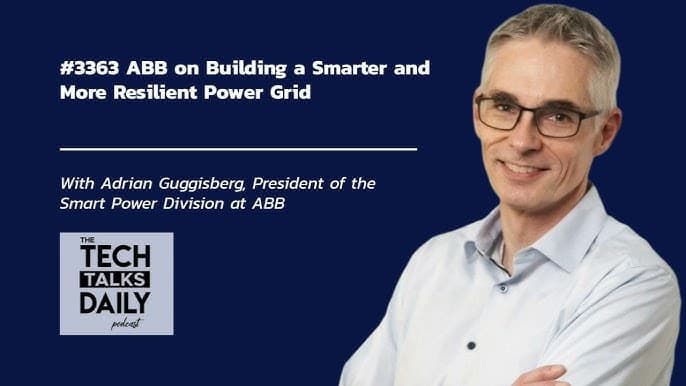
Adrian Guggisberg, Division President at ABB, explains to Techopedia why power grids are under pressure and how to mitigate future disruptions.
Key Takeaways
Power grids are struggling to cope with our increasing electricity demand.
Power outages affecting London Heathrow, Spain, and Portugal underscore the urgent need for improved infrastructure upgrades.
Renewables increase complexity, requiring real-time balancing and more intelligent, distributed grid control.
Electric grid security and resilience demand public awareness, policy support, and courageous investment in digital modernization.
Heathrow Wasn't a One-Off
The fire-related outage at Heathrow wasn't just an isolated incident. "The Heathrow example is a perfect example where the whole air traffic got stuck because of such an equipment failure of the energy distribution," Adrian told Techopedia.
He pointed out that while the airport may have been the focal point of media coverage, such incidents are becoming increasingly frequent and widespread.
"Spain and Portugal, complete blackout after some incidents," he continued. "In the US, I think we're talking more than 500 million hours of lost energy if we accumulate for every person."
That's not a statistic designed to scare. It's an indicator that we're already dealing with energy infrastructure pushed to its limits.
"We're going to rely more and more on electrical power. On the other hand, we're going to be way more vulnerable about events," Guggisberg said.
The more we electrify, the more vulnerable we become to system faults. That isn't a reason to avoid progress; it's a reason to act more deliberately and design for the reality we're heading into.
A Grid Designed for the Past
Adrian Guggisberg was candid about the age of the systems in place. "This whole electrical power distribution… is more than 100 years old," he said. "Up to 20 years ago, the traditional way worked very well."
The old way of doing things consisted of centralized power plants fueled by coal, gas, nuclear, and hydro, delivering power in one direction across a regulated high-voltage grid.
However, this approach is increasingly at odds with how we use and generate electricity today.
Guggisberg explained:
"You have more electrical loads. EV charging, heat pumps, data centers… This balance of supply and demand has to be in sync. If that is out of balance, we get in trouble."
The rise of solar panels, prosumers, and distributed energy resources has made the grid more complicated. It has also made the need for constant, precise balancing more urgent.
What kept the lights on in decades past was often the grid's generous design. It was built with extra room to handle peaks and anomalies. But those safety margins are eroding.
"In the past, the whole electrical power grid was built with a lot of safety margin. That saves us today. That keeps us going," Adrian explained. "The more we go, the more we eat up of the safety margin."
At some point, that buffer becomes too thin. And when that happens, the risk of outages like Heathrow, Portugal, or the US becomes more of a certainty than a possibility.
Where Investment Should Go First
As infrastructure modernization becomes more urgent, I asked Adrian where to prioritize investments. His answer focused not on expanding capacity but improving intelligence.
"What everyone needs is digitalization, making this electrical power grid smarter," he said. Traditionally, grid infrastructure was passive. It simply transmitted power. But that model doesn't support modern demands.
"The distribution power grid is a very passive thing. You just put energy in, and there comes energy out to the consumers," Guggisberg said.
To meet modern requirements, grids need to think. They need to make decisions, adapt, reroute, and isolate problems in real time.
"We talk, for example, about microgrids, clusters that become more independent, that start really to work on themselves," he added.
The vision here isn't about one massive grid holding everything together. It's about building modular systems that can operate semi-independently and recover faster from faults.
"In every point where something splits up or connects, these are connection points. And in these connection points, you need switches which can turn on and off… intelligently," Adrian explained.
He used a household metaphor: "You put it in a toaster, and let me say the toaster gets hot. You do not want to have a blackout in your entire house. You want the switchboard to turn off exactly the line of this toaster."
The same applies to the grid: "If a tree falls and it hits a power line, it should only switch off exactly this power line."
That requires switches with decision-making capabilities. It also needs real-time data and logic to drive these decisions. ABB's role isn't just manufacturing hardware, but embedding intelligence throughout the infrastructure.
Building a More Aware Industry
Adrian believes technical progress alone won't be enough. There's a bigger piece missing: understanding.
"I think it requires more awareness," he said. "It requires that the public understand how important it is to have a resilient and reliable smart power grid."
He also called this part of ABB's responsibility: "We owe it to help them understand better what this takes. And then also probably to help the industries really to outrun, help them with the technologies to make this happen."
Will Renewables Make Things Harder?
There's growing interest in whether renewables make the grid more fragile. After all, solar and wind are variable by nature, and their output doesn't always match demand.
Guggisberg sees the shift toward renewables not as a threat, but as a challenge we need to design around. "We are heading in a good direction," he added. "Probably a little bit more courage will be needed from decision makers to make steps."
That courage will need to include investment in grid intelligence, better planning, and flexible infrastructure that can adapt quickly.
When I asked whether more disruptions were likely shortly, Adrian didn't hesitate:
"I'm convinced we're going to see more incidents. I'm 100 percent convinced on this one."
Part of this is due to infrastructure aging and extreme weather conditions. Part of it is the growing complexity of operating the grid itself. But his outlook wasn't defeatist. It was grounded.
The Bottom Line
Although we are heading in the right direction with smart grid technology, Adrian warned that missteps are inevitable. But with an optimistic smile, he advised: "We will make mistakes. But if you don't make mistakes, you're too slow."
Governments are challenged with bringing intelligence into the heart of our power infrastructure so it can flex, adapt, and recover when pressure hits.
But will leaders have the nerve to build for the future, knowing full well that mistakes will happen along the way?
Listen to the full episode below and let me know your thoughts.