
Walk through any city park, gym, or commuter platform, and you, the more tech observant among you, might have noticed a subtle change in how people listen to audio. Fewer sealed earbuds. More designs that sit on the ear rather than inside it.
What once looked niche has moved into the mainstream, and open-ear wireless earbuds are now one of the fastest-growing categories in personal audio. The shift is driven by safety, comfort, and how people live and work today.
What are open-ear wireless earbuds?
Open-ear earbuds deliver audio while not sealing the ear canal. Unlike traditional in-ear earbuds that block external sounds, these sit just outside the ear or on the cheekbone, allowing ambient sounds to pass through naturally.
There are three ways open-ear earbuds can deliver audio. Air-conduction earbuds place the speakers close to the ear canal to direct sound into the ear. Clip-on or cuff-style earbuds sit on the outside of the ear and allow ambient sounds to pass through. Bone-conduction earbuds transmit vibrations through the cheekbones to the inner ear.
Regardless of the format, you will receive audio while still hearing the surrounding noise. Whether it's a pedestrian calling out to you or a train passing overhead, you will remain aware of your surroundings. While this may seem like a minor difference, it has a huge impact. In-ear earbuds cut you off from your environment, whereas open-ear earbuds blend audio into it.
Why are open-ear earbuds so popular?
Open-ear listening has been around for years. But 2025 & 2026 marked a massive turning point, when the category went from a compromise to a credible option.
Safety plays a significant role in the rise in popularity. Runners, bikers, and urban commuters have learned to stay aware of their surroundings when wearing headphones. While hearing a car coming or someone yelling at you may seem obvious, there are many situations where you don't want to lose situational awareness. Open-ear earbuds give consumers awareness as part of the product, rather than a compromise.
Another factor is comfort. Wearing in-ear earbuds for extended periods can cause discomfort. Since open-ear earbuds keep the ear canal open, they reduce moisture buildup and do not cause the "plugged" sensation of in-ear earbuds. People who spend hours wearing earbuds at work, as parents, or during transitions between meetings will benefit the most from open-ear earbuds.
Hybrid work, always-connected communication, and wearable technologies have created a culture of "listening" as a means of interacting with our environment. Open-ear earbuds fit perfectly into this culture. Users can listen to audio all day without feeling disconnected from their surroundings.
Why Shokz is Dominating the Open-Ear Category
If there were a "default" brand for open-ear audio, it would be Shokz (formerly AfterShokz). Shokz has been developing and refining open-ear and bone-conduction technologies since the early 2000s. Years of research and development, coupled with an extensive patent portfolio, have enabled Shokz to focus on the key aspects of open-ear earbuds that matter most to consumers (i.e., comfort, fit, durability, and sound).
The brand also understands use cases. They are designed around how people move, sweat, work, and multitask, and have built a reputation among athletes and fitness enthusiasts. The terms "open-ear" and "Shokz" are now often used interchangeably by many runners.
Shokz OpenDots One
Last year, Shokz released the OpenDots One, a shift from the company's traditional earhook and band-style designs. These are clip-on open-ear earbuds that look more like jewelry than sports earbuds. At approximately £179/$199 at launch, the OpenDots One was positioned below premium offerings like the Bose Ultra Open, yet it remains firmly in the upper mid-range.
Upon first unpacking them, your first question will likely go online or to an AI agent: "How do I wear the OpenDots One?" But, it's much easier than you might think.
Design is the first thing you'll notice. Weighing only 6.5 grams each, the earbuds utilize a flexible nickel-titanium connector that securely clips onto the ear. Because there is no left/right designation, switching earbuds is simple. Comfort is excellent. Because the earbuds do not sit against the head, they are perfect for individuals who wear glasses, hats, or helmets. Long listening sessions are effortless, making them ideal for both workouts and workdays.
Battery life is among the best in the class. You can expect approximately 10 hours of playback per charge and up to 40 hours with the charging case. There are trade-offs, of course. The touch controls on the earbuds can feel finicky. The call quality is acceptable, but not exceptional, particularly in outdoor environments. Lastly, as with all open-ear earbuds, loud environments will overpower the audio.
The OpenDots One is best suited for runners, gym-goers, and desk workers/commuters who value comfort, safety, and battery life. But it's the latest release that is getting all the headlines.
Shokz OpenFit Pro: Why They Are a Game-Changer
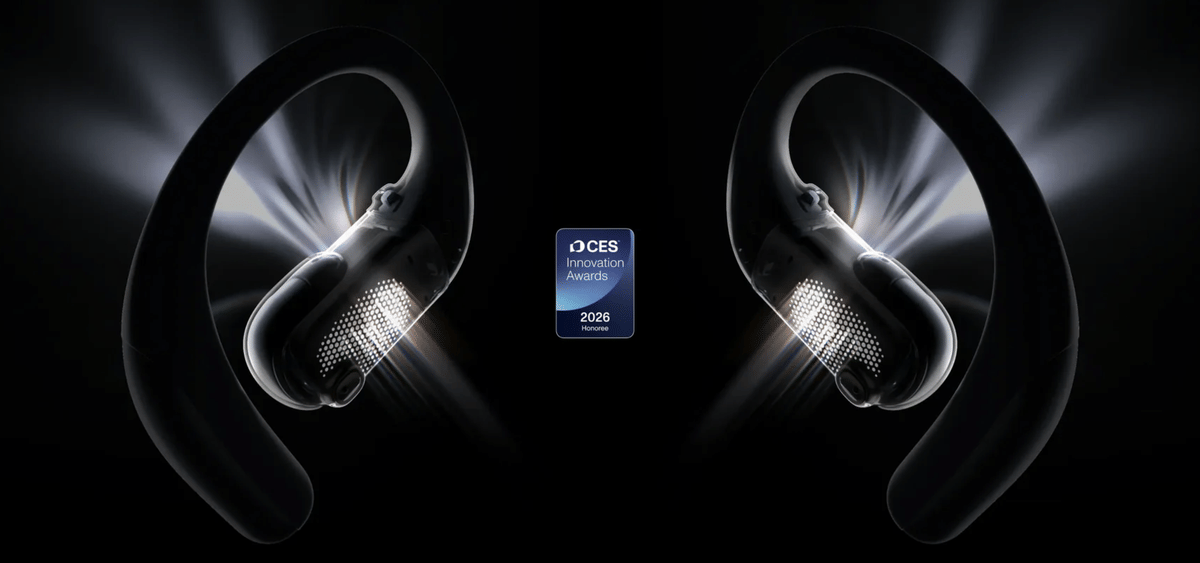
Unveiled at CES 2026, the OpenFit Pro marks another leap forward for open-ear audio. The headline feature is noise reduction. Not traditional active noise cancellation, which requires ear sealing, but intelligent noise softening. The new feature is enabled by a triple-mic system and adaptive algorithms that reduce the harshness of background noise while preserving awareness.
In practice, this changes how open-ear earbuds behave in cafés, gyms, and offices. You no longer need to crank the volume to overcome background noise. Audio feels calmer and more focused, even though you can still hear what is happening around you.
Sound quality is a big improvement. The OpenFit Pro uses a synchronized dual-diaphragm driver design that delivers more bass and clarity. Then there is Dolby Atmos optimization with head tracking, which adds spatial depth to compatible content.
Battery life reaches up to 12 hours per charge with noise reduction off, and around 6 hours with it enabled. The charging case extends total listening time to up to 50 hours.
At around £219 or $249, they are not cheap, and they blur the line between primary and secondary earbuds. But the OpenFit Pro makes sense for people who want awareness without distraction. For many office workers, gym-goers, and commuters who found open-ear earbuds too exposed, there is now a middle ground.
The Bigger Picture
Open-ear earbuds are no longer merely a niche solution. Shokz continues to set the pace by focusing on the actual use cases that matter to consumers, rather than novelty.
The OpenDots One showed how much comfort, design, and battery life have evolved in the last few years. The OpenFit Pro offers a glimpse of where the category is heading next, with better-sounding designs that adapt to the world rather than trying to block it out.
Frequent flyers and anyone chasing silence on public transport will still prefer sealed earbuds. But that's the point: they don't try to be all things to all people; they focus on doing one thing really well.
Many consumers now purchase two pairs of earbuds/headphones. One for immersion, another pair for the gym. If you are looking to dip your toes into open-ear wireless earbuds for days when you want to enjoy audio while maintaining full awareness of your surroundings, you won't go far wrong with the Shokz OpenFit Pro or Shokz OpenDots One.
I’ll be inviting Shokz onto a future podcast episode. What questions would you like me to ask them? Share your thoughts, and I’ll take them straight into the conversation.