

Are businesses really making progress with AI, or are many still stuck using it for the digital equivalent of making phone calls on a smartphone?
In this episode, I sit down with Alison Kay, VP / Managing Director AWS UKI, to unpack what is actually happening behind the headlines of AI adoption across the UK.
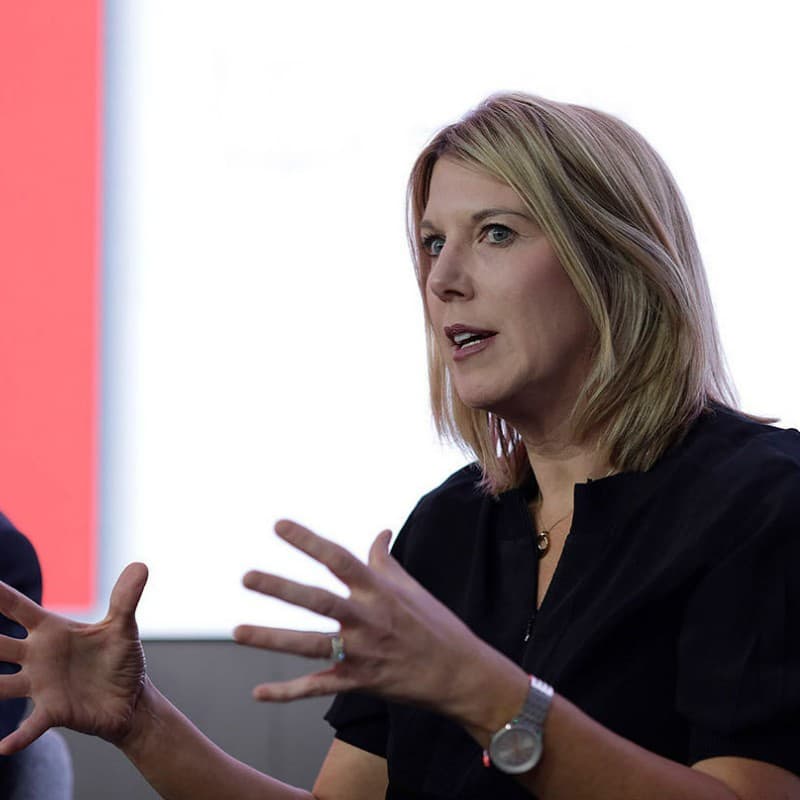
On paper, the numbers look strong. Around 64% of UK businesses are now using AI, a sharp rise from the previous year. But when you look closer, the story shifts. Only one in four organizations have moved into more advanced use cases, where real productivity gains, efficiency improvements, and innovation start to show up in meaningful ways.
So what is holding everyone back?
In our conversation, Alison shares insights from AWS research and her work with organizations ranging from major enterprises like Barclays and the BBC to fast-moving startups. We explore why skill shortages are slowing progress, why many companies struggle to move beyond basic use cases, and how governance and trust are becoming central to scaling AI responsibly.
We also spend time breaking down the rise of agentic AI, a term that is starting to appear everywhere. Instead of simply generating answers, these systems are beginning to take action, writing code, testing software, and working alongside humans to dramatically accelerate delivery timelines. Alison shares a powerful example where a project that might have taken 40 engineers over two years was completed by six engineers in just 76 days with the support of AI agents.
Along the way, we look at real-world examples from companies like Trainline and Evri, showing how AI is already reshaping customer experience and operational efficiency in ways that go far beyond theory.
This episode is a must-listen for business leaders trying to understand where AI is delivering real value today, where the biggest gaps still exist, and how to move from experimentation to meaningful transformation.
So if your organization is already using AI, the real question becomes this, are you using it to improve what you already do, or are you ready to rethink how your business operates entirely?
Useful Links
Please check the partners of the Tech Tech Talks Network
Learn more about the NordLayer Browser

[00:00:00] - [Speaker 0]
A big thank you to Denodo for helping me make more than 60 monthly interviews possible across the Tech Talks network. And as businesses move from GenAI to Agentic AI, trusted data becomes everything. Everything from GenAI to AgenTik AI, Denodo is helping organizations build intelligent, secure, and scalable AI solutions with data access, governance, and explainable results. So build AI that you can trust and do it with Denodo. And you can learn more by simply visiting denodo.com.
[00:00:36] - [Speaker 0]
But now, on with today's show. Are UK businesses really ready for the next phase of AI? Or are most of them still only scratching the surface? We hear a lot around AI adoption, but the latest research from Amazon Web Services or AWS that reveals a much more interesting story. Here's a big stat.
[00:01:00] - [Speaker 0]
64% of UK businesses are now using AI, up from 52 just a year ago, shows real momentum. But there is a catch. Only one in four of those businesses have moved from the basics into what AWS call advanced AI adoption. What does this mean? It means most are still using AI for simple tasks like summarizing documents, creating presentations, or powering basic chatbots, while the real productivity gains are waiting further up the ladder.
[00:01:32] - [Speaker 0]
And the report also highlights that 50% of businesses say the biggest barrier is a shortage of AI skills. And perhaps even more telling, organizations are 78% more likely to adopt AI when they see governments leading by example first. And I think this says a lot about trust, confidence, and the need for leadership in this next phase of transformation. And to help make sense of where we are and where we need to go next, I'm joined by Alison Kay, and she's the vice president and managing director for The UK and Ireland at AWS. And she's someone that has a front row seat to how organizations are moving from simple AI experiments to real operational change and why Agentic AI is now pushing that conversation even further.
[00:02:21] - [Speaker 0]
So in our conversation today, we'll talk about why so many businesses remain stuck at the almost smartphone used only for call stage of AI adoption and understand what separates companies that are seeing real ROI from these experiments and why startups are moving faster than large enterprises. And we'll also unpack what AgenTik AI actually means in practical terms, and why Alison believes it's arriving far faster than many leaders have expected. So if AI is no longer a question of whether but how deeply, then maybe the real challenge becomes how do businesses move from adoption to very real transformation. This podcast only exists because of partners like NordLayer. I'm incredibly grateful for the support that helps me deliver these conversations every single day.
[00:03:10] - [Speaker 0]
And one of the things that I've learned in those many conversations is that hybrid work has changed everything about how teams operate. People are now working from different locations on different devices and often outside traditional networks. But the one constant here, no matter where people are working, is the browser. This is where collaboration happens. That's where the data moves, and increasingly, that's where the risk lives.
[00:03:37] - [Speaker 0]
Now NordLayer's business browser is designed for this new reality. It allows teams to work securely from anywhere, even on personal devices, all while giving organizations better control over access, data movement, and browser activity. And it even supports modern ways of working without forcing old security models onto them. And it is that balance between flexibility and control that is where a lot of companies are still struggling. So if anything that I mentioned there resonates with you, if it sounds familiar, please, I encourage you to take a closer look at nordlayer.com/browser.
[00:04:20] - [Speaker 0]
But now on with today's show. So thank you for joining me on the podcast today. Can I tell everyone listening a little about who you are and what you do?
[00:04:29] - [Speaker 1]
Good morning. Good to see you. I'm Alison Kay. I'm the vice president and managing director of AWS for The UK and Ireland. And I guess in sort of simple terms, that means I look after all our customers here in The UK and Ireland from the very largest enterprises the likes of Barclays, the likes of NatWest, the likes of the BBC, through to startup organisations who are just starting off on their journey.
[00:04:55] - [Speaker 1]
So my job is to make sure that we are serving all our customers in The UKI.
[00:04:59] - [Speaker 0]
Well, it's such a pleasure to have you join me on the podcast today. And one of the reasons I was excited to speak with you is you've recently published new research on AI adoption across The UK. So before we get into the detail on that, what were the headline findings that really stood out to you from that?
[00:05:15] - [Speaker 1]
Yeah, it's been a really interesting report, and the headlines from it are around 64% of UK businesses have adopted AI. That's up from 52% in the last year. So, real momentum on the adoption of AI. However, only one in four of those businesses have adopted advanced AI. So whilst, you know, the headlines are good and the momentum is there, and there's real progress in the adoption of AI across The UK businesses, only one in four are using advanced AI, which suggests there is definitely room for, you know, movement and progress.
[00:05:54] - [Speaker 0]
It really does. I mean, the research suggests that what many businesses are still using AI for, yep, those basic tasks, summarizing documents, running simple chatbots, and so many things that which we all use it for routinely now. But why are so many organizations still stuck at that level?
[00:06:10] - [Speaker 1]
Yeah, it's interesting, isn't it? Because I suppose it is a bit like using a smartphone and just using it to do phone calls. I mean, that's where, you know, sort of feels at the minute. And actually, what I'm hearing from all our customers is that, you know, the barriers are a few. One is skill shortage, and that's the big one.
[00:06:31] - [Speaker 1]
50% of the businesses are telling us that the shortage of skills around AI is the biggest single barrier to them adopting AI more extensively. And the skill shortage is really around can they find the AI skills? And the cost, actually, of employing people with those skills is also going up. So, it's definitely increasing in terms of that skill shortage. And then you could also say that it's all, in some ways, the use of just generic AI models, which we're all using to summarize documents and create PowerPoints for us and all that.
[00:07:10] - [Speaker 1]
That's the path of least resistance. That's the one that's kind of easy to allow your organization to use. But then, if you move in more to the advanced AI, you become much more transformative and you become much more how do you fundamentally change sort of legacy business processes. That's a bit harder. And therefore, it's perhaps just a little bit easier to keep doing what you know, we're doing with the AI at the moment rather than actually leaning into that fundamental transformation of your business.
[00:07:37] - [Speaker 1]
But yet, the companies that are doing that and the companies that are moving and adopting the events they are seeing some incredible results, actually. So, if I think about Trainline, which is a sort of online digital platform where you can buy train tickets from. Have now got to 87% of their queries, their customer queries, are done through AI. And the customer satisfaction scores have gone up. So, where you see, you know, companies leaning in and using the AI, the results can be actually quite dramatic.
[00:08:14] - [Speaker 0]
And one of the things that stands out to me on what you've just said there is there's a very clear ROI on this kind of technology and working differently. Know there's been a lot talk around ROI on tech projects recently, but there is the ROI. You've set a great example of what separates those organizations that are using AI for more complex tasks. But why is progress still stalling at the point where the biggest gains are available? The math doesn't almost add up there, does it?
[00:08:41] - [Speaker 1]
I think it's understanding and the art of the possible for organizations. And I do start by and the report does share this that the role of government in its ability to demonstrate and lead the way forward by the government's own sort of narrative is that, you know, they think there are $45,000,000,000 worth of savings to unlock within departments across governments. And it's very clear that businesses will follow where governments go. So, the opportunity for the government to really be able to unlock and show the way and lead the way is very, very real in The UK context. So, I think that, you know, that leadership from governments I mean, governments are doing a really good job of messaging around the importance of AI, so, you know, that is absolutely there.
[00:09:32] - [Speaker 1]
And they do share their own perspectives of what they think is possible in government. And I think businesses will start to really follow that when they see the trust and the adoption. I think the other thing that I'm also seeing is in boardrooms where the question has become around governance and the governance of agents and AI. And one of the things that, you know, we say to our customers is, Look, you've got to have a responsible AI framework that your customers and your stakeholders can trust. And it doesn't slow you down.
[00:10:04] - [Speaker 1]
Why doesn't it slow you down? Because trust drives adoption. Adoption drives innovation. So, if you have a really responsible governance framework that the board can trust, your shareholders can trust, you know, you can say with confidence, I think that really will accelerate, you know, the progress in AI rather than, you know, thinking that either the governance model will slow you down or indeed, if we don't have a governance model, then, like, we can't move forward with it. So, you know, we're very clear that that is a really critical unlock as well, having a very responsible AI framework in place.
[00:10:42] - [Speaker 0]
And something else that also stands out in the report is you highlight the rise of Agenetic AI, and for people in organizations that are still using AI just for those basic tasks, they may find the term Agenetic AI quite intimidating or overwhelming with how complex it can sound. But for listeners hearing that term more often, how would you explain it, and what is it that is changing the conversation? Because it is more than just hype, this one, isn't it?
[00:11:08] - [Speaker 1]
It's a lot more than hype. And, you know, I've personally been really wowed by just this pace at which Agenza KI has come onto the scene. If you think about the time it took to go from like, to get from three gs to five gs, it took quite a number of years, as an example, whereas the move from just, you know, AI to agentic AI has happened in months. I mean, you know, it's been really rapid, the pace of it. And the difference is, so if you've just got generic general AI, that's when you can do query and it'll give you some answers.
[00:11:45] - [Speaker 1]
So, and answer format. Where AgenTek AI, these are agents that are doing tasks within your organization. They are actually you deploy them, they can fix bugs, they can code, they can test, they can do all these activities. To bring it to life with an example from AWS, we had to completely redevelop the inference engine that sits behind our Bedrock platform, and we had to do it from scratch. And if you'd have asked me, you know, two years ago what that would have taken, I would have said it would have taken, I don't know, 40 engineers, two years, and a whole lot of coffee.
[00:12:24] - [Speaker 1]
And it took six engineers seventy six days. How? Because they weren't working alone. They were working with Kiro, which is our software development agent, and it was working around the clock. So while the engineers slept, the agents kept working.
[00:12:40] - [Speaker 1]
And it coded, it debugged, it tested, it deployed right around the clock. So the pace at which you can work with humans and agents to actually accelerate timelines and accelerate innovation and accelerate your organization is just incredible. And that's the difference between querying and getting an answer and actually using AgenTik AI to work alongside humans within your organisation to accelerate the pace.
[00:13:09] - [Speaker 0]
And there are so many big opportunities around that, and startup founders in particular, they seem to be enjoying the most success. They seem to be leading the way with a much higher percentage reaching advanced AI adoption. Are they getting right that larger organizations are still struggling with? Is the pace of change? Why are those larger enterprises struggling?
[00:13:30] - [Speaker 1]
Of course, it's great to see startups flourishing in the way that they're flourishing, and I love it in The UK that there's such a vibrant start up community. It's fantastic. And they do show the way and they do lead the way. They, of course, are not encumbered by legacy systems and, you know, all the technologies that enterprises have to deal with and have to use. So, I think the start up environment allows, you know, the enterprises to really look at it and say, you know, what can we learn from the startups and how can we take, you know, some of the learnings from that.
[00:13:59] - [Speaker 1]
But, of course, startups have their own challenge in how they're scaling up and how they need to then expand their business. At AWS, we are truly privileged to work with so many startup organizations, and, you know, the ability to support them as they grow and scale their business internationally is just phenomenal.
[00:14:18] - [Speaker 0]
And something else that really stood out to me in the report is this point that the public sector, where adoption is far more advanced than people might expect. People just assume that the private sector is running away with it, and the public sector is constantly playing catch up, but that's not always the case. So what role could the government play in accelerating AI adoption across the wider economy here?
[00:14:41] - [Speaker 1]
Yeah. Look, I think we could see real acceleration of adoption if the government really further leaned in. And I think the organizations, you know, reports saying that the organizations are 78% more likely to adopt AI if they see the government doing it first. And so, it builds the trust and it builds the confidence in business to actually adopt AI further. So, I think there's a lot the government can do.
[00:15:10] - [Speaker 1]
There's a lot the government can gain from further implementing AI. But they are advanced and it's fantastic to see. And I think the further they go, the more likely we are to see the scaled adoption across The UK.
[00:15:21] - [Speaker 0]
And if we take a step back and look at that bigger picture, what is it you think needs to happen next for The UK to move from widespread AI adoption to real economic transformation and unlocking some of them big opportunities that you've mentioned?
[00:15:35] - [Speaker 1]
I think we've got all the ingredients for success, actually, in The UK. We've got incredible research capability in The UK. We've got, you know, a phenomenal startup community, which we've spoken about. We have great technical capability in The UK. It's known globally for all the technical capabilities.
[00:15:53] - [Speaker 1]
So, all the ingredients are there. And we've got a government that's leaning into it and caring about it and really driving the AI agenda. So, I would say everything's in place. I think what now needs to happen is more momentum carrying it forward. That requires skills and further development of skills and enhanced skills.
[00:16:11] - [Speaker 1]
It requires the government to continue to lean into this AI agenda and really, you know, demonstrate a lead from the front in its adoption of it. And, of course, it needs organisations to continue to build the infrastructure in their own businesses in order to unlock the powerful potential of AI.
[00:16:32] - [Speaker 0]
And one of the things I try and do on this tech podcast every day is educate, entertain, and inspire business leaders to go out there and make those changes. And the report shows organizations using AI at a deeper level, they're seeing far greater efficiency gains and much faster innovation. Now you mentioned the train line example. I'm I'm curious. Are there any other real life examples of what more advanced users are doing differently just to maybe bring it to life for people listening?
[00:17:00] - [Speaker 1]
Yeah, look, I think there's a company called Every, which is a parcel delivery company here in The UK, and I've loved what they've done over the last number of months. So, they've used generative AI to analyze the over 90,000,000 photographs that their couriers are taking every single month. So, 90,000,000 every single month. Like, how are they doing that? They're doing that so that every parcel photograph gets taken before it's being delivered so that they know that the parcel is being delivered safely and securely and in the right place.
[00:17:31] - [Speaker 1]
And it can tell the courier within seconds if that has been the case or it's not been the case. And if it's not been the case, they've got to go back and sort it out. So, from a customer satisfaction perspective, huge, but also from a cost of business perspective, it actually really helps to avoid issues with cost of delivery. So, that's just a real life example that's happened fairly recently where Every have used AI. It's a real great benefit for their business.
[00:17:58] - [Speaker 0]
Well, thank you so much for sitting down with me today. I think when many people hear AI and agentic AI, they do have that ROI question, but we're moving beyond simply, generative AI and going into more complex things there. We're unlocking well, let's forget about the technology at the moment. We're unlocking here greater efficiency, faster innovation. That's something that every organisation can relate to.
[00:18:21] - [Speaker 0]
So I will post a link to the research that we've referenced today. I'd urge everyone listening to go check that out, and maybe even continue the conversation with yourselves. But more than anything, just thank you for shining a light on this today.
[00:18:32] - [Speaker 1]
Well, thanks so much. It's been fabulous to speak to you.
[00:18:35] - [Speaker 0]
After speaking with Alison today, I think it feels clear that The UK does not have an AI awareness problem. It arguably has an execution problem, because the adoption numbers look very strong on the surface. 64% of businesses using AI. All this sounds incredibly impressive, but when only one in four have actually moved into advanced AI, it tells us that many organizations are still standing at the edge of the pool rather than actually swimming. So come on in.
[00:19:05] - [Speaker 0]
The water is fine is the message. But seriously, what stood out to me most was Alison's point. The current stage of adoption is like owning a smartphone and only using it to make phone calls. The real value sits in changing how the business works, redesigning processes, improving customer experiences, and creating entirely new ways of operating. And if we're honest, I think that takes more courage than simply debrawing another chatbot.
[00:19:32] - [Speaker 0]
And I think her examples today brought all of this to life brilliantly today, whether it was Trainline resolving 87% of customer queries through AI while improving satisfaction or ever using GenAI to analyze 90,000,000 delivery photos every month. For me, this is where the conversation shift from hype to very real measurable business outcomes. And, yes, there is Adjantic AI too. And this is where things get very real very quickly. Because AI is no longer simply answering questions, it is now completing tasks, writing code, testing systems, and accelerating delivery at a pace that would have sounded completely unrealistic just a year ago.
[00:20:16] - [Speaker 0]
Just to keep our feet on the ground here. None of this works without trust, without governance, and the skills needed to move it forward. So for business leaders, they need confidence that, yep, AI is safe. It is responsible and aligned with their very real business goals. And maybe governments do need to lead by example, and leaders need to start asking whether AI matters and start asking, where can it make the biggest difference first?
[00:20:41] - [Speaker 0]
So if The UK already has the ingredients for success, the real question now is, are you ready to move from experimentation and low level tasks and actually start building the future? Well, I'll include links to everything that we've talked about today in the show notes. Head over to techtalksnetwork.com. You'll find a blog post associated with this episode and all the links that you need there. There's also 4,000 interviews and a myriad of ways that you can send me a message.
[00:21:11] - [Speaker 0]
You can even drop me an audio message too. But that is it for today. So thank you as always for taking the time to listen, and I'll return again tomorrow with another guest. Hopefully, I'll get to speak with you again. Bye for now.