
Can a startup launched with £180 grow into a global business serving some of the world’s largest companies?
In this episode of Startup Builders & Backers, I speak with Conor McKenna, co-founder and CEO of Go Swag. His story begins in a Glasgow software agency, where he and co-founder Ben wanted to create a memorable first day for a new employee arriving from Italy.
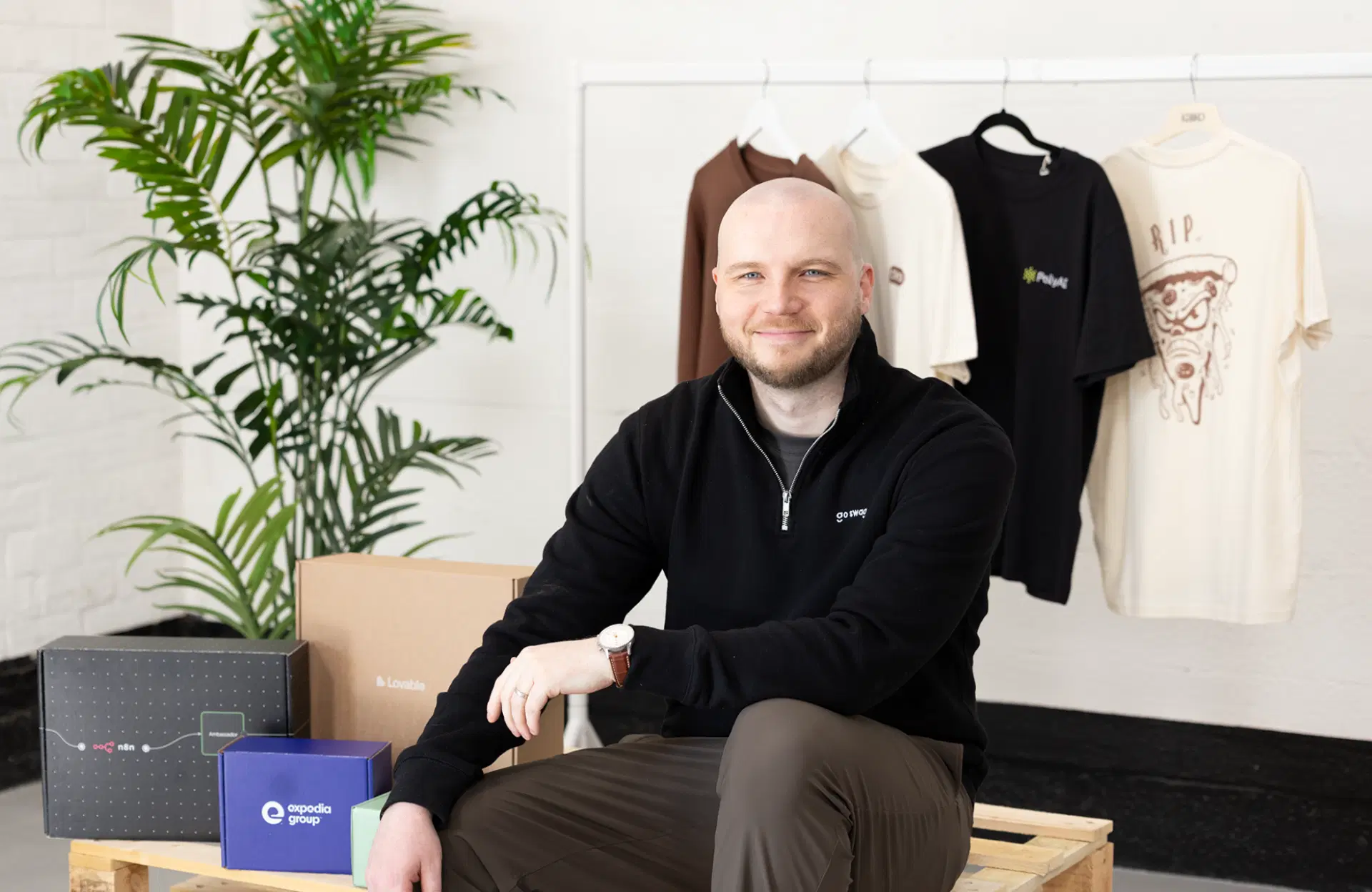
The welcome gift made an immediate impression and was shared across social media. When Conor suggested creating the same experience for every new employee, colleagues explained how difficult the process would be to repeat across the company.
Conor and Ben searched for a corporate gifting provider capable of managing design, sourcing, branding, logistics, and international delivery from beginning to end. When they could not find one, they launched Go Swag with approximately £180.
Their lack of corporate gifting experience became an advantage because they approached the industry from a software background. Previous work involved building digital products for slow-moving sectors such as banking and pharmaceuticals. Go Swag applied the same thinking to an industry where administration traditionally increased alongside revenue.
Conor explains the company’s DRY principle, meaning “don’t repeat yourself.” Administration, quoting, and logistics should be handled by software, allowing employees to concentrate on customer relationships and creative decisions.
This approach helped Go Swag grow without increasing headcount at the same rate as revenue. Neil notes during the interview that the business has achieved five consecutive years of triple-digit growth with a team of approximately 30 people in Glasgow.
We also discuss why the founders decided to build globally from day one. Corporate gifts sent to employees in India or South America should provide the same experience as packages delivered to London or San Francisco. Scotland’s smaller domestic market also encouraged the team to think internationally earlier than many startups.
Operating globally introduced difficult questions involving customs, tariffs, taxation, warehousing, and logistics. Go Swag launched in 2019 and subsequently faced COVID, Brexit, the UK mini-budget, rising energy prices, and changing tariffs. Conor jokes that he began the company with hair, which provides an unofficial measure of the pressure involved.
For founders pursuing enterprise customers, Conor advises against entering meetings apologetically. Large companies care about consistency, ownership, problem resolution, and avoiding surprises. A startup’s smaller size can offer an advantage because its team can move faster and provide forms of support that larger competitors struggle to approve.
Conor also discusses the discipline required to reject revenue. Smaller contracts may feel attractive during the early stages, but they can consume the time needed to pursue enterprise opportunities. He applies the same thinking to warehouses, international offices, and other investments that might impress people without solving a customer problem.
The conversation closes with Go Swag’s use of generative AI. Conor describes the “blank canvas problem” facing buyers presented with thousands of products and finishing options. Go Swag is developing models that begin with the buyer’s intended outcome and recommend an appropriate gift rather than expecting the customer to become an expert in printing techniques.
Could your startup grow faster by automating repeatable work, rejecting distracting revenue, and approaching enterprise customers with greater confidence? Listen to the episode and share your thoughts with me.
Useful Links
Learn more about Go Swag
Startup Builders and Backers Go Swag
00:00:00 Neil : So thank you for joining me on the podcast today. Can you tell everyone listening a little about who you are and what you do?
00:00:07 Connor: Yeah. Thank you. Neal. It's good to be here. My name is Connor. I'm the co-founder and chief exec of Goal Swag. So we are corporate gifting partner for high growth startups and enterprise companies. So we handle everything from onboarding packs to client giveaways to event giveaways and everything in between in that space, myself and Ben. Prior to starting Goal Swag, Ben's my co-founder spent our career in software before moving into this space, and since twenty nineteen, We have been trying to fix this industry to make it a bit better on the planet and better for its customers.
00:00:46 Neil : It's such an incredibly cool story, and I'd love to go back and learn more about that origin story. So let's start right at the beginning, because I was doing a little research on you, and I read that you launched Ghost Swag with less than two hundred pounds. So tell me about that. And what was the original problem that you wanted to solve way back then? And at what point did you realize it had potential to, to become the global business that it is now?
00:01:11 Connor: Yeah, exactly. Yeah. So our, our grand seed investment was about one hundred and eighty pounds, um, between, between Ben and I, which is how we started the company. So that was mainly to fund, we got a few items branded, um, some, some hosting for our website really. Um, but at the time we still. So Ben and I met in a software agency. So Ben was the head of design. I was the head of design research. And at the time we were recruiting a design team. And for one of our first hires who actually turned out to now be our chief product officer, a chap called Marco. He was a Roman guy from Italy, and he was coming over to be hired in the east end of Glasgow. I thought, God, this suave guy is coming over from Italy. We're going to have to impress him. He's coming to this kind of rough area of Glasgow. We're going to have to to give him a decent first day else no chance he's staying. Um, so we pulled together a gift for him. And basically, long story short, when we pulled together this gift that had great impact, it got shared on socials and it landed really well. And we went to our team, the kind of people behind who organise things like, uh, merchandise and employee onboarding and said, we did this thing, you should do it for everyone. And they were just like, this is you do know how difficult this is? Like, there's no way we could do this for everyone in the company. And it was a classic case of we thought, well, there must be a challenger service out there. There must be a company that does this for you sort of end to end. And there just wasn't there was no one in the space. And we decided to build, build that solution really come into the industry with, with honestly no experience in the space. But we kind of looked at it, realize how gigantic the space was and how broken it was, and thought, well, with our sort of software know how, we could probably do something interesting. And at the time, to be honest, we didn't realize this as we were doing it. But our experience in software in the later start, you know, part of our career was perfect set up for building go swag. So what we did is we went into big, slow moving industries. So industries like banking or pharmaceuticals and built software solutions for them to, to try and capture market space. So it was perfect training ground ultimately to, to then build, go in terms of when we realized we had proper traction or product market fit, I think really early we started to acquire big companies. So we worked with Spotify really early. Um, worked with a company called branch that deep linking technology, and they were bending their their procurement rules to work with us. You know, we were tiny. We were a two person company, three person company. And they were bending their procurement rules to, to work with us because we were just like nothing else in the industry. So they wanted the solution that we were offering. And that's when we realized, okay, there's something to this. If these kind of companies are willing to work with such a small team, there's we should we should try and scale this properly.
00:03:59 Neil : Wow. It's just such an inspiring story. And if we were to look at the startup guidebook founders have traditionally been told to, hey, let's just dominate your home market first before even thinking about expanding internationally. But you decided to tear up that rule book. You chose to think globally right from day one. So why did you take that approach and what advantage did it give you?
00:04:23 Connor: Yeah. Good question. I mean, I think there's a few parts to this. The you can talk about it from a strategic point of view. Part part of our service is global delivery, right? So we historically in this space, if you happen to reside in India or South America, you would get a completely different experience or, or no experience at all in comparison to your colleagues in the Bay area, in San Francisco or London, in the UK. And we kind of rejected that and said, well, we want to work with truly global companies, with distributed teams and customers. And if we are gifting to those people, it shouldn't matter where you live, we will create the same service. So it was a pillar of our service to work out how to do that and, you know, serve as a truly global market. There is also an aspect that we are we are based in Scotland. It's not exactly the biggest booming economy in the world. So it's a fairly small country. So we were kind of forced into thinking, well, if we want this company to big to be big, sorry, we, we need to work out how to service regions outside of, of Scotland and outside of the UK. And both Ben and I also have a kind of way of working which is leaning into the hardest problems on the table. Um, I truly believe that most good startups are built by just pure grit and resilience into the hardest problem. I think avoiding it. It's easy to avoid these kind of problems to start with, right? Because it's like, well, I don't know how to scale a company globally or I don't know how to incorporate in the US, or will I get sued and end up in jail or something in the US? But it's a you just have to face these problems head on and, and by doing that, you build kind of muscle of, of facing these problems because it's, it's good having the option to face difficult problems. You kind of want to build up that muscle before you have to face difficult problems with, uh, when you don't intend to face them as such, you know, they come out of, of customer crisis or whatever for whatever reason. If you've got kind of, um, acumen in that area, it serves you well in the future.
00:06:28 Neil : And from launching with just one hundred and eighty pounds just to to bring to life what we're talking about here. You've built a business that now serves companies like meta, Apple and Netflix, to name but a few. There are some massive names from a team of around thirty people in Glasgow. So what were the the key decisions that allowed you to scale, but without consistently or constantly adding more and more headcount? How did you get around that?
00:06:55 Connor: Yeah, I mean, ultimately that gets to the root of why we've been successful. So yeah, there's a few points, I guess to break it down, I would cover three main areas. So the first is what we refer to internally as DRI. So this is um stolen from a, a programming or software engineering principle of, of don't repeat yourself, which is um abbreviated to dry. We believed from the start that admin should be handled by algorithms and computers and relationships should be handled by people. That is not being how the industry traditionally operates. The problem with scaling companies in this industry is admin scales pretty much in lockstep with revenue. So if you want more revenue, you need more people to handle the more at the increase in admin. What we said is when looking at it, it's complex, but it's very we can automate most of it. And that's honestly what we've been doing for the last five to six years, is trying to work out how to free up smart people, to build relationships with other people, and all the heavy lifting from an admin and quoting and logistics point of view is all handled by bi proprietary software. The second is is as hard as it is ignoring revenue that doesn't scale. It's really easy in the early days to get locked into servicing small contracts or tickets, because it's revenue in front of you. It looks easy, right? It's like the small company, they need something by two weeks time. It's easy to to service those kind of businesses. But what we found, and we did it to start with, um, we worked this out over time, but what we found is selling to an SME or a small team quite often is more at least, if not the same amount of work as selling to enterprise. Um, it takes more guts to sell to enterprise. Um, it's scarier, but if you work out how to do it and kind of get in those rooms, often that work, you know, has a much harder, higher ROI in general. So but to do that, you need the bandwidth. So you need to turn away from those small ticket items to allow your team to, to go after the big ticket. And then finally, I would say is not chasing what I would refer to as like vanity initiatives or projects. It's really easy as a founder, you know, when you start a business, you have to have a bit of delusion as a founder, right? You start off thinking, you know, I've cracked this big idea, especially if you're going into, you know, the promo or gifting industry. Corporate gifting industry has been around for one hundred plus years at this point, right? So it's a bit ludicrous on paper to say we've worked out we're going to solve it. And that could be applied to most industries. So it's easy to try and find like proof points, invest into things that publicly look good. So you can post on LinkedIn or we've opened in the United States or we've taken on this massive warehouse. It strokes the ego, but it doesn't do much for, for the actual company scale. And what we focused on is only putting capital or investing into areas that are truly required by customers and holding capital back until we knew it was definitely, definitely needed by customers. Um, and then what that does is it means that you're, you're hyper focused on, on your customer and their problems versus what makes you look good as a, as a founder.
00:10:22 Neil : Um, on the surface level, corporate gifting. It sounds incredibly straightforward, but I would imagine as soon as you start operating in multiple countries, things like customs regulations and logistics networks, it can quickly make things challenging and quite complex. So what are the some of the toughest operational challenges that you've had to solve, and what did they teach you about building a resilient business in so many different countries?
00:10:48 Connor: Yeah, it sure can. Well, I had here when I started go Swag and now I don't. So that tells you something about, uh, what's required to, to go through these problems. But, you know, we, we incorporated in two thousand and nineteen. And if you think about what happened post that point, it honestly was like the bingo card of UK economic disasters really. Like we, we went through Covid, Brexit, the mini budget, tariffs, energy prices, you know, went through it all. But there's that old saying, right? That pressure creates diamonds. And we ship to every country imaginable every day. Tariffs and and geopolitics, etc. is always changing. And what that does is creates an immense amount of pressure. And what it forces you to do is become unbelievably skilled and, and, um, pressure tested at solving these problems. And to me, that builds a really good business because you become resilient. And that's over time. What we focused more on. We can never predict what's going to happen next. Right. And when it comes to logistics, definitely. But across the board, when you're running a company, you have, there's so much of it you can't control ultimately. So the only bet you can control is building a team and a sort of ethos and culture of solving problems when they come up really quickly and not letting them sort of burn you and sort of slow you down.
00:12:17 Neil : And winning your first enterprise customer, that's one thing. But keeping them, that's a whole other ball game right there. And on behalf of other startup founders that could be listening today, what do large global organizations expect from you as a young company, and how did you earn their trust? I mean, to begin with, it sounds like they were bending over backwards to want to work with you, but how did you eventually earn their trust and ensure that they stay customers?
00:12:43 Connor: Yeah, yeah. It's, um, I mean, the thing is about being a small company, big companies, I would argue, don't really care your small company most of the time. And I guess that's the first piece of advice. Don't, don't give yourself away. Don't come in being, you know, being so grateful. And you know, I can't believe you want to work with us. We are tiny, etc., etc. act like you should be in the room and you've been in this room fifteen times before, even if you never have. because it's not a big deal to them. So don't don't let it be. Don't, don't make it one. I think it doesn't matter if you're if you're small or, you know, massive. Most companies, especially enterprises, I would argue, want consistency. They want ownership. They want not to care about whatever the service it is that you're delivering. And they want no surprises. If you can do that, it doesn't matter what what skill you are really. Um, and we since the early days, Ben and I have always kind of had this ethos of, of go above and beyond is what we refer to it internally. And you as a small business have this massive unfair advantage of how small you are, how flexible you are, and you can do things. There's the famous Paul Graham essay of doing things that don't scale, right? And it's like, if you can, because of your scale and size, you can do things that big companies could never do because they would have to go through lots of, of red tape and bureaucracy to be able to go out and visit the customer and bring them out to dinner and do all sorts of fancy stuff if you wanted to, or deliver a service that's completely outside the normal sort of offering that you have. But you should do these things. You should show what working with you looks like and what it should look like. Is the ethos of above and beyond that, you will go above and beyond to solve all their problems and make their life easier. Then the fact that you are a ten person team or a five person team is irrelevant at that point because you've fixed a problem that they have.
00:14:38 Neil : And it's a strategy that's certainly paying off. I mean, looking at when I was doing a little research on you, you've achieved five consecutive years of triple digit growth. I mean, growth is incredibly exciting. But with that becomes a certain amount of pressure. So again, for founders listening, what are some of the hardest lessons you've learned as the business scaled so quickly?
00:15:00 Connor: most of it is about people, right? Like I think, yeah, building a company is really hard. Never mind. You're trying to do something abnormal. You know, you could say, depending on what market you look at, most markets grow about seven to eight percent max a year. To be a successful high growth company, you're looking at minimum to be growing fifty sixty percent year on year, ideally closer to one hundred. That's a really abnormal thing to achieve and do. And with abnormalities comes stress and difficult days and equally really high days. But you need to partner with people that can ride that journey with you. Um, and I think to do that, you got to look for a few things. One, ideally, people who are smarter than you and can operate in areas have skills that you don't have that complement you really well. Um, like my co-founder Ben is a perfect example of that. We complement each other really well. Um, he's, he's the best salesperson I've I've ever worked with. Um, he's, I call him a social SAS soldier. He just flies into any situation and everyone's his friend all of a sudden, whereas I'm much more analytical and technical, so we complement each other brilliantly. Um, and he's also one of my best friends. So he going through the journey of building a business. It takes one thing to be skilled and experienced in certain areas, but also a lot of the time it's just really hard. You have to be open to be to talking with the person or people that you're working with at eleven o'clock at night or two a m when you know everything's hitting the fan. Um, so yeah, find people that you're, you're willing to be in the trenches with for three to four to six years, you know, to come. And also, I think a lot of your job is to find people who are best suited for high growth companies. It's, it's most people aren't, I would argue, and they won't know that, um, to start with, but as I said, with that or not abnormal growth, it's a very stressful experience. And not everyone, everyone wants that out of their working life. And that's totally fine, but it's your job to identify that early and sort of select those people out or in to your company. And if you get that right, that pressure becomes a lot easier because you're essentially building a collective of people who are excited by that pressure and are motivated by it.
00:17:19 Neil : And that also be many entrepreneurs and founders listening that assume technology is only part of the solution. So from your side and your experiences here, how important is having your own platform, being in helping ghosts compete against so much larger and better funded competitors?
00:17:37 Connor: Yeah, I mean, everything really, ultimately, as I mentioned near the start, it's where we come from is the software world. And so as I'm sure we are biased, I guess, in thinking that, but ultimately it's, it's what's allowed us to scale at the rate we've had, we have done so far. And also we are introducing software that this industry has never seen. And that's truly why we believe we're kind of creating a new category in this space. We are truly solving for the customer in this space, and building tooling and software that makes their life easier and the end recipient of the gift easier. And it's what blows enterprises away because when they come to, to interact with us and meet with us and realize what we can offer from a software point of view, it's night and day in comparison to to your big incumbents. And so yeah, it is, it's truly at the core of, of kind of why we've scaled at the rate we have.
00:18:33 Neil : And if we look back one more time to that day when you started with one hundred and eighty pound, what's what's one piece of advice, advice you would give to startup founders who are trying to build an international business, but they feel like they they don't quite have the resources, the connections or the confidence. They have imposter syndrome and all those things that, uh, prevent them from taking the first step. Any advice for that startup founder?
00:18:57 Connor: Yeah, I've got loads. Um, I think get started and don't stop would be the easiest way to summarise it. The thing is the imposter syndrome, the feeling out your depth, etc. get comfortable with that. It's never going away. Um, if you're doing your job right, if you're scaling quickly, you should never feel comfortable. You're every six months, you're essentially operating and running a new business because you're operating at a different scale than you have before. So you just have to get comfortable with being really uncomfortable ultimately, and sort of seek out that discomfort almost. Because if you're comfortable, you're doing something wrong, I would argue. Um, and in terms of like network and resources, look, there's always going to be people with a better network, more money than you, better connections than you. I'd say the only thing you you can do is work harder than anyone else. That's the only true thing that you can, you can influence or you're likely to be able to, to do more of ultimately than anyone else. If you really, if you really go for it. Um, most people I find give up when the problem gets boring or particularly hard. I think there is like a, you know, within Hollywood or literature, etc. the reality of being a founder and starting a business is, is quite different from how it's portrayed. Often people don't see the bit where you're working out international VAT or, you know, the reality of, of how to calculate square footage of a warehouse. Right? These problems are super dull. No one wants to interact. No one wants to to work these things out. But you have to. And your job as a founder is to be the person that that dives into the hardest problem in the room, right? And, and often those things are really dull and boring. So keep going through that. I believe businesses are built by compounding resilience, ultimately not overnight success or connections. So so the key is just keep going and don't give up.
00:20:48 Neil : And I'm curious, looking back to when you started to now over the last three years, AI has taken over everything. Have you had any real impacts and benefits from AI. Have you embraced it as it improved things? Made your life easier at all?
00:21:01 Connor: Yeah, massively. I mean, we, we, I'm a, you know, completely certified nerd, right? And, and so when, when this sort of boom and generative came along, we were all over it. It really sort of it was perfect timing. It locked right into what we were trying to do about scaling without scaling headcount and admin. So suddenly when you had these models that were able to do really, really impressive analysis or, you know, artwork generation, etc., I think various things that kind of tuned into what our service is. We, we adopted it as fast as humanly possible. So yeah, we're doing some really interesting stuff in that space. Um, we're, we're building our own proprietary tooling in the space. So to cover that quickly, we, we believe we talk about the blank canvas problem, right? So right now the industry says if you come looking to buy or create onboarding packs or event giveaways. The industry's response to that is here's a catalog of of thousands of items and tens of finishing options. Most of our buyers will have never done this before. Yet the industry expects them to be experts like Neal. If I ask you the difference between sublimation and digital printing, I assume you don't know the difference. Now, imagine you had half a million pounds of budget and you had to know the difference. And you're responsible for clothing your bosses and colleagues and highest value sales prospects. Quite anxiety provoking situation, right? So what we see is we won't give you a catalog. We won't ask you these questions. We'll ask you what you're trying to do. Your intent. You want to create a sales prospecting gift that lands big business. We'll say, okay, we'll go away and we'll design a gift that does that and say, this is what we think you should do and what we're doing in AI, we're building models to make those connections. Right now, there is hundreds of thousands of items you could pick and we rely on really smart consultants and people that work in our sales team to make those bridges and connections. And now we're automating that and pulling that into a model to to delete that blank canvas problem so anyone can come on to our service and work out what they should gift based on what they're trying to do.
00:23:11 Neil : Love it. And finally, looking ahead to the future, you're only a few years away from the tenth anniversary, which probably scares you. That's how quickly that time has flown by. But I mean, where do you go from here? Any any big goals that you're aiming for before you hit that tenth anniversary?
00:23:27 Connor: Yeah. It doesn't feel like it doesn't feel like that. Um, if I'm honest, but yeah, I've got a lot older and in that time, um, yeah, look, ultimately what we were trying to do is become the default player in this, in this space. So the way I talk about it internally is if you think about CRMs, right after a certain scale, you assume a company uses HubSpot or Salesforce ERPs. You assume a company uses NetSuite or SAP? There's no default company in the gifting space that people assume you use at a certain scale of enterprise. And that's what we are building towards. And yet, definitely we should do it before the ten year anniversary has become the go to supplier of the biggest companies in the world.
00:24:11 Neil : Wow. What a powerful moment to end on an inspiring note as well. And for anybody listening that is much earlier in their journey, or maybe want to find out more information about Go Swag, work with you or connect with you or your founder there. Where would you like me to point everyone?
00:24:26 Connor: Yeah. So, well, first of all, we're hiring everyone. It feels like right now. So go to swag dot com and find our careers page and that you can, you can keep up to date with myself or go swag on LinkedIn by just searching my name and swag or just checking out our website.
00:24:42 Neil : Awesome. Well, I will include links to everything there. Such a an inspiring story from starting with one hundred and eighty pounds to everything that you've achieved and still marching forward their triple growth, their etc. for so many years now. And I'd love to stay in touch with you and see how your story evolves before that tenth anniversary, man, and we'll get you back on. But thanks for joining me today.
00:25:05 Connor: Yeah. Thank you so much for your time. Appreciate it.