

What happens when a founder who built a billion-dollar company during a global crisis steps into the centre of industrial AI and begins reshaping how entire organisations think and work? That question sat at the heart of my conversation with Somya Kapoor, CEO of IFS Loops, recorded live on the show floor at IFS Industrial X Unleashed.
Somya's journey carries a level of grit and perspective that shines through every answer. She shared how surviving the Gulf War as a child shaped her instinct to take on the most complex problems in technology. That mindset not only guided her early career at SAP, ServiceNow, and other enterprise giants, but it also laid the foundation for Loops, the agentic platform she co-founded in 2020 with a simple scribble on a notepad that eventually grew into one of the most significant acquisitions in the IFS ecosystem.
Her stories about early rejections, the wave of scepticism around AI in the early days, and the first customer conversations held on Zoom during lockdown reveal the human side behind a platform many now take seriously across the industrial world.
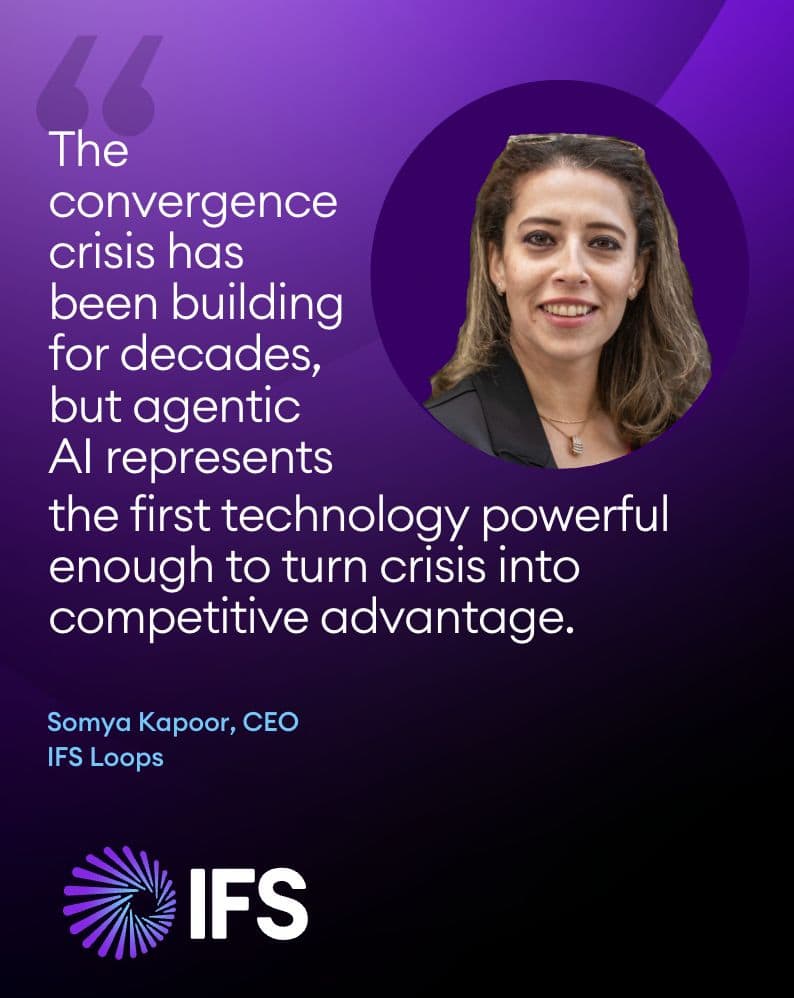
Across the episode, Somya explained in plain terms what makes IFS Loops so different. The platform connects data across systems using natural language, helps redesign processes that were locked inside individual applications, and introduces digital workers that remove grunt work from everyday operations. She brought the technology to life with examples that landed with real clarity. From supplier order handling to complex field service tasks, and the now famous Kodiak Gas case, where thousands of hours were saved each year, she showed how agentic workflows change what is possible for industrial companies that have spent decades wrestling with fragmented data and rigid processes.
We also talked about the importance of keeping people at the centre of AI-driven change. Somya was clear that amplification, not replacement, is the story that matters. The shift requires new skills, new supervision models, and a thoughtful approach to adoption. Her reflections on change management, the energy she felt from customers at the event, and the speed at which leaders now want to move painted a picture of an industry that feels very different from the early days of AI excitement. The hesitation has faded. Curiosity has taken over. Action is starting to follow.
Somya closed with a message aimed at every leader who might still be watching from the sidelines. The technology is real, adoption is accelerating, and the window to learn, experiment, and adapt is narrowing. She believes this is the moment for teams to decide whether they want to lead or be led by others who are moving faster.
As you listen to this conversation, I'd love to hear what stood out for you. Do you feel the same shift in confidence and urgency around industrial AI that Somya described? Let me know your thoughts.
NordLayer sponsors Tech Talks Daily:
Get the exclusive Black Friday offer: 28% off NordLayer yearly plans with the coupon code: techdaily-28. Valid until December 10th, 2025. Try it risk-free with a 14-day money-back guarantee.
[00:00:04] - [Speaker 0]
There are days in this podcast life that feel like I get a glimpse of the future. An IFS Industrial X unleashed event in New York was certainly one of those moments because the scale of what unfolded on stage went far beyond product announcements. It felt like the moment where the industrial world stopped talking about AI and really started showing what it can genuinely deliver. And this wasn't about chat interfaces or novelty apps. It was actually about grids that can think, field operations that can adapt in real time, and robots working shoulder to shoulder with technicians in some of the harshest environments on Earth.
[00:00:51] - [Speaker 0]
And throughout the day here in New York, one theme kept resurfacing, And that for me was that the AI race that really matters is not happening in consumer tech. It's actually happening in factories, energy systems, aerospace, logistics, and the physical infrastructure that keeps our societies moving. And with people from Microsoft, Siemens, Anthropic, Boston Dynamics, and IFS, all highlighting a similar theme here, I learned that trillions are currently being invested in industrial infrastructure. Yep. The critical infrastructure that we all take for granted too.
[00:01:30] - [Speaker 0]
And that capital only works, though, if intelligence is embedded from the very beginning. So if leaders deploy today's hardware without the intelligence to operate it, they could risk creating tomorrow's stranded assets. And another thread running through every conversation here was the shift in workforce economics because industrial sectors are facing gaps that technology must address. You cannot inspect thousands of miles of grid lines or or run around the clock facilities without a new kind of labor model. And one of things that really excited me here was the idea that a 300 person team operating with the power of 3,000.
[00:02:13] - [Speaker 0]
That's something that resonated, well, I think, everyone in the room. Not as hype, but as a practical reality of digital workers, robotics, and agentic systems, and humans all working together. And the reason that I wanted to set the scene of everything that I've seen and heard at the event is I also was very fortunate to be able to sit down with the CEO of IFS Loops. And my guest today, she's lived this shift long before it became a headline. She built a billion dollar company without outside funding, survived the Gulf War as a child, and carries a resilience that has shaped her entire career.
[00:02:54] - [Speaker 0]
And her very personal story is not only inspiring, it's also part survival, part engineering, part curiosity, and conviction that technology can solve real problems that people have struggled with for decades. So on stage here at Industrial X, she showed an end to end live demo of an agentic workflow. I built it in just three minutes, and it went flawlessly. No scripts. No safety nets.
[00:03:26] - [Speaker 0]
She and her team believe that autonomy only matters when it is tangible and measurable, and the demo that I saw here proved exactly that. So my guest today will share her origin story, the grit required behind startup life, and why she believes the industrial world has finally moved past skepticism and explains the thinking behind IFS Loop, how natural language can reshape ancient business processes, and why some companies are already unlocking millions in ROI, like Kodiak Gas Services saving ninety thousand hours a year. Most importantly, she will also share the messages she hopes leaders will take away from this moment, and that is AI is real, showing real value, and the cost of inaction is growing faster than many realize. But I'd just like to pause for a second to thank our sponsor for helping me share these stories with you, because keeping the Tech Talks Network running and producing over 60 episodes every month takes real support behind the scenes. I'm I'm genuinely grateful that they've helped make this possible.
[00:04:37] - [Speaker 0]
If you've been listening to any podcast on Tech Talks Network for a while now, you will know I'm always trying to find practical tools that make security feel less like a chore. Security doesn't frustrate users or slow them down from doing their work, and NordLayer is one of them. It's built for real businesses, the kind that have people working in multiple cities, countries, time zones, and networks. But best of all, it gives you enterprise level security without the enterprise level headache. Setup literally takes minutes, and it scales as your team grows.
[00:05:15] - [Speaker 0]
And it protects you against the kind of threats that never make the headlines until it's too late. And it's one of those rare tools that just works quietly in the background. So why not give your team the protection that they deserve? Visit nordlayer.com/tech talks daily, and use the coupon code tech daily dash 28, and you'll even get 28% off your plan, part of a special Black Friday deal that we've got at the moment. So check that out, and let me know your thoughts.
[00:05:47] - [Speaker 0]
But enough from me. Let's dive straight into our conversation now, and let me officially introduce you to my guest today. So thank you for joining me at the event here. For everyone listening, can you tell them a little about who you are and what you do?
[00:06:05] - [Speaker 1]
Absolutely. Hi, everyone. I'm Somya Kapoor, and I'm the CEO of IFS Loops. Today, prior to being here, I was the CEO and the cofounder of the Loops platform, an agentic solution that IFS just bought, in in June. And before that, I have also had leadership roles at ServiceNow and SAP.
[00:06:25] - [Speaker 1]
So I've been in the enterprise space for the last thirty years. Know what I you know, know this space very well enough, and now I'm excited to be at IFS taking this to the next level.
[00:06:34] - [Speaker 0]
Awesome. And I will talk about the event in a moment, but you've had an inspiring story, career. Tell me a little bit more about your origin story and the path that led you to a career in tech. It's quite unconventional, isn't it? But inspiring equally.
[00:06:47] - [Speaker 1]
Well, you know, at at a young age itself, I was very much intrigued by tech. My dad was in tech, so I think, you know, it was always kinda making sure being a, you know, computer. We had the first computer in the house. I remember Yahoo Messenger. Woah.
[00:07:02] - [Speaker 1]
In my teenage years, giving that all away right now, giving my age away. But also of the very fact, what led me to doing a start up is is the key aspect. I think to do a start up, you need to have a lot of perseverance and grit, especially an early stage start up, getting your idea out and formulated when nobody else has anything, was was came from my background where as a survivor of the Gulf War itself. When you have a gun at your head at nine years old, I think everything changes perspective in life from there on. So I was always been asked, you know, why are you picking the most difficult path in your life?
[00:07:42] - [Speaker 1]
Because I fundamentally get very excited about tech, and I love telling the world how this is gonna change their life. So that's got me where I am today.
[00:07:51] - [Speaker 0]
Wow. Such a fantastic story and so inspiring for for women listening all around the world because there is still a diversity problem here in the industry, isn't it?
[00:07:59] - [Speaker 1]
It is. It is. And I, and I think it's changing. It's drastically changing, but it's also it we have to acknowledge what it takes and why it takes to happen, especially in the start up world or the VC world. Very few tech, founded, women founded start ups exist, but we're trying to change the bar one day at a time.
[00:08:19] - [Speaker 0]
And when you arrived in The US, taking you back in time again, you began carving out your career. What experience helped you recognize some of the problems in the industry that that maybe traditional software could never solve? Is there a story there as well?
[00:08:32] - [Speaker 1]
Oh my god. I think, you know, when I, graduated with my bachelor's and master's degree in computer science, I was very much fascinated about you know, I had an offer from Apple and from IBM and Sun Microsystems in those days. Can you believe it? The names some names don't even exist anymore, right, in the world that we live in. But SAP was my first, company.
[00:08:58] - [Speaker 1]
And why I liked, why I chose SAP at that at that point was the very fact that they were at the brink of technology and business. Every other company was doing technology. But what has always from ground up excited me is how to apply the technology in a business mindset. And SAP was doing financials and leave requests. Oh my god.
[00:09:20] - [Speaker 1]
I date myself right now. Thirty years ago, and I'm coming back to it all over again. But, you know, that being that conduit that brings technology and really see a business process evolves gets me super excited. So that's why back to IFS again, you know, another ERP company.
[00:09:38] - [Speaker 0]
And, essentially, you've built a billion dollar company without funding at a time when many founders are still chasing validation through capital. So what was it that drove that conviction, and how did you navigate maybe some early resistance that you may have encountered?
[00:09:52] - [Speaker 1]
You know, early stage startup, you always have resistance because you're way ahead of your time, and you have to bring people along. So there are things that we have seen on the way, and you carry your wounds because everybody 99 of the time, you get a no. And only 1% of the time, you get a yes. Right? So that's where the grit and the perseverance really comes in.
[00:10:11] - [Speaker 1]
But this was a calling. I mean, we started loops in 2020. And prior to that, you know, we had just come out of another startup that did NLP. And my cofounder at that point, my partner in crime, I like to call him, Ravi, was dabbling a lot with NLP and had come from fraud detection, selling his company to Splunk at that point. Right?
[00:10:32] - [Speaker 1]
Yeah. We were sitting down, and we were getting some inclination of OpenAI happening in the market. We're hearing some buzz around it, that there's some deep reasoning going on. Something is going to fundamentally change. And at that point, we were sitting and saying, if that has to happen, you got to need a platform that's bringing data together as the first layer itself.
[00:10:51] - [Speaker 1]
And then you gotta have a knowledge graph built on top of that to seed some of these reasoning because that's a fundamental problem that we saw with NLP when we were trying to do on that side. And then he brought his fraud detection, you know, graph mindset with PST algorithms. He went too techy. I will not bore you with all of that right now. But that was I remember the coffee discussion.
[00:11:12] - [Speaker 1]
We sat down, and we're like, I think we need to take a platform approach to this. Why don't we start something? We scribbled something on the paper. We went to the VCs. It was March 2020.
[00:11:24] - [Speaker 1]
COVID was hitting US. They literally went shut down, and we went up to customers remotely calling Zoom calls and saying, what do you think? What do think? Not a single customer said no. Wow.
[00:11:37] - [Speaker 1]
They said it's an it's a nice idea, but I'm going through this upgrade. It's a nice idea, but I'm going through that upgrade. We spoke to Salesforce, ServiceNow, SAP, you name the customers. And that gave us the founding that there is something here. We just have to be at it.
[00:11:52] - [Speaker 1]
So that's led us to where we are right now.
[00:11:55] - [Speaker 0]
Wow. And the rest is history. And I'm conscious if we do have people listening anywhere in the world, they're new to IFS Loops. How would you describe the problem that you're solving and and what industrial companies struggled with the challenge for for decades until now?
[00:12:09] - [Speaker 1]
This technology is highly revolutionary. So what IFS Loops is it's an agentic platform that helps you connect data sources, including IFS and any other data source, to redefine a agentic workflow, which is your, business process. Historically, we've always looked at business processes in the context of the systems that we had. If I was in IFS, I always saw my business process within IFS. And if I needed to mash that up with financials coming from Oracle or SAP, I had to be scratching my head, getting 10 developers or RPA systems to do all of that stuff.
[00:12:47] - [Speaker 1]
Right? Now that is very much possible through natural language. As long as we have a connector within IFS loops, you can go ahead and redefine any business process. You can load that data into IFS, different systems. You don't need to worry about the grinding and the work.
[00:13:04] - [Speaker 1]
And we do all of that, and it adds intelligence in the thing. For example, let's kind of talk about supplier order manager. Very back end operations person. You get process. You get tons of POs in your inbox, and you are manually loading the PDF.
[00:13:21] - [Speaker 1]
Sometimes the details are in the body of the email. You have people manning and kind of uploading that in IFS or any ERP systems. Here, you have an agent that comes in your inbox, automatically scans through all that information, uploads it in IFS cloud, looks at the part conversions that needs to happen. If there's an exception, send you a notification on Teams if that's where you like it or, you know, keeps in an exception filter so your folks can concentrate on the exception handling and not the grunt work of daily loading those POs. And there are endless processes that we have around this, like, you know, searching.
[00:13:58] - [Speaker 1]
A field technician being on-site has to go through, like, I don't know, forty, fifty page of a document manual to figure out which part and where to upload what manual and which part to order. If I give you a simple keyword that he searches, oh, let me give you this part number. I was looking for a combustion engine part, and I need to do this. And it it finds that and updates a work order based on that stuff that saves you endless hours and ease and problem. That's what Kodiak Cast use case that we highlighted yesterday was saves Kodiak Cast three million and ninety thousand hours per year.
[00:14:32] - [Speaker 1]
Right? So there are fundamentally so many things that you can change and now rethink from a business process standpoint that you traditionally couldn't do, and that's what agentic platforms are driving.
[00:14:42] - [Speaker 0]
And I'm glad you mentioned the Kodiak example there. I know they're delighted because I've seen on LinkedIn that they've been sharing the ROI. And when we're talking about AI and agentic AI, the ROI question is something that crops up again and again. It's phenomenal, the kind of figures that you're mentioning there, isn't it?
[00:14:57] - [Speaker 1]
It is. And, you know, I was like, I and I'd honestly tell you, I did not even prep Pedro for it. I was like, Pedro, you gotta just talk about some ROI, right, that we've been able to see so far. And he just came and he gave the numbers, and I was like, woah. Okay.
[00:15:10] - [Speaker 1]
That's that's good to know. But, you know, with all these digital workers that we are launching, we do recommend every customer to give us an ROI on what is success looks like for you. A success can't be 100%, I want this done. Right? Because even humans can't do a task 100% accurate.
[00:15:29] - [Speaker 1]
So why are we expecting a machine to do it 100%? So I think it's much more to think about processes that can move the needle, that can save the agitation that they traditionally couldn't be resolved with technology, and now you have the possibility of doing that.
[00:15:44] - [Speaker 0]
And I must admit, I was a little nervous for you yesterday because live tech demos and have notoriously always go wrong. But you proved it from start to finish in just three minutes. For for people that didn't see that, can just tell them briefly what you did there in those few minutes?
[00:15:59] - [Speaker 1]
We we have a policy in our team. We don't do mock demos. We always wanna do live demos, especially when my CTO is trying to do these demos. He he he gets worked up if he doesn't have a live machine in front of him. You should have seen the demo rehearsal.
[00:16:12] - [Speaker 1]
They were trying to they changed his machine up, and the browser was not coming. And for five minutes, he was fumbling on the stage. So I was like, oh, you gotta give this guy a live demo. Otherwise, you're gonna mess it up. Right?
[00:16:22] - [Speaker 1]
So we're used to doing live things. That kinda shows you the tangible aspect of the product. And, you know, that's the key aspect. Automation is not new. It's been happening in our environment, but it took a long time.
[00:16:36] - [Speaker 1]
It used to take nine months, twelve months, ten developers. And now you can have business owners do that in a day or a week's time, granted your data is in some consumable format. Right? I'm not saying this is magical. So you put a wand up and a fairy kind of comes up and changes everything.
[00:16:53] - [Speaker 1]
Right? But it is very, very tangible, and it's very there. So you don't need that kind of manpower anymore. You don't need that kind of, you know, time anymore. It's happening very fast.
[00:17:06] - [Speaker 1]
So that is opening doors for people to learn new skills, to learn how to kinda use a technology like this, but it's easy. It's a natural language. You just write your instructions, and it works.
[00:17:18] - [Speaker 0]
And I think another key message here is the importance of keeping the human in the loop and not about replacing people. And a big figure I remember from yesterday is turning 300 people 10 x into 3,000 people with the help of agents. That's the message here is it's not replacing them.
[00:17:31] - [Speaker 1]
It is absolutely. I you know, there there there is gonna be some rules that you would see where, you know, you're probably going from 10 to two people because now you don't have enough work. But what do you do with the other eight? They do have a skill set. Now you need still people to manage and monitor these agents.
[00:17:49] - [Speaker 1]
Right? They have a brain of their own. That's why we have a supervisor monitoring aspects of it. You need people to now look at systems as you're deploying these agents. So it's not about replacement.
[00:17:59] - [Speaker 1]
It's about amplification. Right? It's about how do you amplify each and every employee's skill set within your environment so they can do a lot more than they're traditionally used to doing.
[00:18:11] - [Speaker 0]
And, of course, we're here to talk about industrial AI at the event. It's all everyone's talking about. I'm curious. You've you've presented. You've had so many conversations back to back interviews.
[00:18:20] - [Speaker 0]
What are you taking away from this event this week?
[00:18:22] - [Speaker 1]
You know, I'm taking away excitement. I have not met a single customer. Right after I met, you know, I had all the salespeople. Like, I've got this meeting, this customer meeting. I'm like, wow.
[00:18:33] - [Speaker 1]
Why didn't we do this before? I don't think anybody in that room was saying, I don't believe it. Right? Every each and every conversation that I've had is how can I get on it right now? What do I do to bring that mindset shift?
[00:18:50] - [Speaker 1]
What do I do to bring that process shift? What do I do to change so I can use and adapt? How do I get access to it? I have not seen hesitation. That's what got me excited.
[00:19:02] - [Speaker 1]
Like, wow. Four or five years ago when AI went let's say, 11/31/2021, when GPT came out, world was skeptic, and I think across industries. And I don't see skepticism anymore, which is which fascinates and excites me of the potential of the technology that we have from IFS and what it can do.
[00:19:25] - [Speaker 0]
And finally, as you look ahead, what message do you want leaders to hear listening around the world about industrial AI, the role of IFS, and the shift from data systems to systems that think and act? What's that message you wanna leave them with or get them think?
[00:19:39] - [Speaker 1]
The message that I wanna give everybody is AI is real. It is showing value and way fast. Technology is only 40% of the problem. There is a change management that needs to happen, which is 60% of how you get that technology adopted in your environment. Whatever it is, whether it's anomaly detection, prediction, agentic, whatever flavor of it that you would like to take.
[00:20:05] - [Speaker 1]
It is very real. And I think it's upon every leader within the industrial space to look upon this and not close their eyes and say, how do I start? Some might say, go full big bang and I do everything. Some say, I start small and tangible and see the benefits of it. But if you don't act on it, you're going to be left out, and your competition will have an added advantage that you won't be able to ever catch up on.
[00:20:29] - [Speaker 1]
So I don't think it's this this revolution that we're in is not an opportunity to sit back and have a popcorn and see the world do it. It's actually jump in to see and say where I'm gonna play my game first.
[00:20:42] - [Speaker 0]
And I think that is a powerful moment to end on. So I will link to your LinkedIn and social channels. I know you're very active online, including the IFS Loops website and everything. But just thank you for joining me on the show floor today.
[00:20:52] - [Speaker 1]
Thank you for having me. I'm super excited.
[00:20:56] - [Speaker 0]
Wow. I think speaking to my guests in the middle of the Industrial X unleashed summit event felt like capturing a real snapshot of an industry that has stopped debating and started building. And the energy across the venue certainly reinforced her point because skepticism has been replaced by urgency, and leaders are no longer asking whether industrial AI will work. Instead, they're asking how quickly can they adopt it and where can they begin. And that shift alone, I think, marks a real turning point that this is no longer theory because it is applied, measurable, and in many cases, delivering outcomes that traditional software has struggled to unlock, unlock for decades.
[00:21:44] - [Speaker 0]
So the conversations I enjoyed throughout the day here, I think, also reflect the same sentiment that my guest shared. AI is only 40% of the journey. The harder part, the bigger challenge is change. And the shift from data systems to systems that think creates cultural friction, new responsibilities, and new and bigger expectations. And yet the companies embracing this change are really discovering an an almost unexpected advantage.
[00:22:15] - [Speaker 0]
They're not just automating tasks. They're reorganizing how work gets done and how people contribute. And they're also turning frontline expertise into intelligent workflows and freeing workers from the repetitive drudgery so they can focus on exceptions, judgment, and oversight because they're building systems that don't just record data but actively act on it. So the message for my guest today that I am gonna take away is that this isn't a moment to sit on the sidelines and wait for clarity. Because by the time your next road map becomes obvious, I think the competitive gap will already be set.
[00:22:56] - [Speaker 0]
And when it comes to industrial AI, it is accelerating faster than any previous cycle. And the real winners will be those organizations that are able to experiment early, learn continuously, and adapt their operating systems around intelligence rather than inertia. And the opportunities are vast, and the risk is failing to participate. So I will add links to everything from the event and all my, guest information, including the IFS Loops website, and maybe dig a little bit deeper for yourself and explore her work further. It really is inspiring what she's doing here.
[00:23:39] - [Speaker 0]
And if you simply wanna understand the next chapter of industrial transformation, her perspective, again, is one worth following. And after everything that I've seen here in New York, I think one thing is clear. The real AI revolution is happening far from consumer headlines. It's unfolding in the physical world, and the company is bold enough to embrace it. They are the ones that are helping shape the next decade ahead.
[00:24:07] - [Speaker 0]
But over to you, please email me techblog@writeroutlook.com. Send me a DM on, Instagram, LinkedIn, x, just at neil c hues. And remember, there are thousands of conversations just like this one over at my website, techtalksnetwork.com, where where there are eight different podcasts and over three and a half thousand interviews. But that is it for today. Time for me to fly back to The UK now, but a big thank you for listening as always, and I'll speak with you again very soon.
[00:24:40] - [Speaker 0]
Bye for now.