

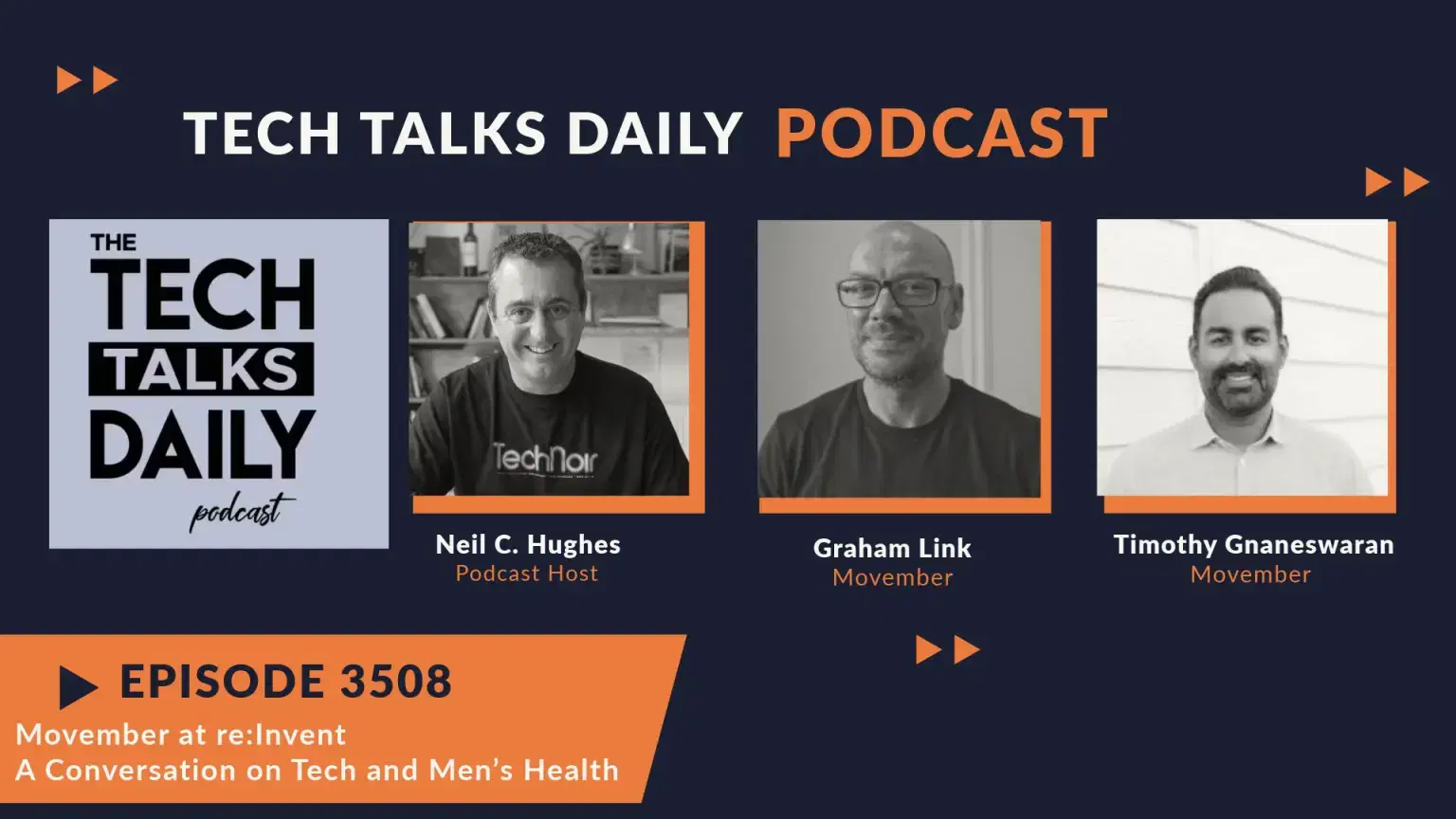
Have you ever wondered how an idea that begins with two friends in a pub ends up shaping conversations about health all over the world? That was on my mind as I met Graham Link & Timothy Gnaneswaran from Movember on the show floor at AWS re:Invent.
Their story has grown far beyond the mustache that everyone recognises. What started with a simple gesture of support has become a movement that now reaches millions, raises vast sums through a global fundraising platform, and backs projects focused on prostate cancer, testicular cancer, mental health, and suicide prevention. Hearing them describe how that original spark grew into something this wide and long lasting gave the conversation a real sense of depth.
Recording in the middle of re:Invent added its own flavour. AI news filled the halls, yet Timothy and Graham were there speaking with engineers and builders about something deeply human. Their booth stopped people in their tracks, offered barbershop shaves, and created space for personal stories.
They talked openly about how Movember built its own platform to handle sixty to eighty million dollars in four weeks, how it must stay resilient every minute, and how AWS has supported them for more than a decade. They also shared how technology shapes the work behind the scenes, whether it is clinical quality registries, digital conversations tools, or new research paths that explore how AI might support healthier behaviours.
What stayed with me most was the honesty about the tensions they face. Men are still reluctant to talk about their health. Loneliness is rising. Social platforms create new openings and new barriers at the same time. They see how AI can help someone begin a difficult conversation, yet they are clear about the risks when people rely on tools that were never designed for mental health support.
They also talked about the patterns they see across different regions, the sobering statistics in the major markets where they operate, and how younger audiences now gather in gaming communities rather than traditional spaces.
Movember knows it needs technology to reach scale, but it never wants to lose the human connection at the heart of its mission. What part of their story stands out most for you, and where do you think technology can genuinely help shape the next chapter of men's health?
Useful Links
[00:00:04] Have you ever wondered how a simple idea can grow into a global force? The kind of force that changes how we talk about health? Well, this is a question that crossed my mind when I met Timothy and Graham, two voices helping to shape Movember's mission today. And what started with a few friends and a bit of fun has turned into a worldwide effort that has sparked conversations many of us once avoided.
[00:00:32] And Timothy brings a mix of engineering and leadership experience to the US team. And Graham, he's been working across the movement to connect long-term purpose with fresh momentum. But this is a tech podcast. I want to understand how they see the next chapter, especially now that technology is influencing everything from research to outreach.
[00:00:56] And I think their blend of passion and practical thinking made this one of those conversation that just stays with you long after you've listened to this podcast episode. So today, as you listen, I hope you feel that same spark of curiosity that I did. And when you hear their story, I'd love to know which parts resonate with you the most. But enough from me.
[00:01:20] I invite you to join me on the show floor at AWS reInvent, where you can join myself, Timothy and Graham in conversation right now. So a massive warm welcome to the show, both of you. Can you tell me a little about who you are and what you do? Thanks, Neil. Graham Link, Chief Technology Officer for Movember. And we've got not but one, but two guests joining me today. Can you tell everyone listening a little about you? Absolutely. Thanks for having us, Neil.
[00:01:48] Tim Nannis, we're an Executive Director at Movember in the US. And the first question I've got to ask you, we're meeting here at AWS. One of the things I try and do on the podcast every day is get people thinking differently about technology, its impacts on areas you don't associate with technology. Movember, we all know what it is. Great cause, but you don't automatically think of technology. So what brings you here? Yeah, absolutely. And I'll pass it to Graham to answer those deep tech questions. But AWS has been a great partner of ours for many years now.
[00:02:15] We represent the nonprofit booth here at reInvent. And we're giving out free haircuts and free shaves. Because as Movember, everyone knows the iconic mustache. And so we do pop-up barbershops to raise awareness. This is obviously just wrapping up November, which is our annual giving campaign around prostate cancer, testicular cancer, mental health and suicide prevention. And so we're here raising awareness to all the men here at reInvent. We know there are many of them. And Greg can touch on sort of our connection to AWS and their platforms. And you're doing such great work.
[00:02:44] But I've noticed neither one of you have shaved off yet when we're in December. When are you booking yourselves in? Stopped shaving as of two days ago. And so it was clean shaven and it had a really big handlebar mustache. But when the clock turns to December, it's time to sort of let it grow back in. Yeah, this thing's coming off on Friday, Neil. Doesn't usually grow other than one time in the year. Movember is a really interesting story. Movember started 22 years ago in Australia and today operates in 20 countries around the world.
[00:03:13] And reaches millions of people every year who participate in what you would have seen, that craziness of the mustache and the fundraising. And Movember, if you could kind of go back 17 years ago, really carved out and created what we refer to as the peer-to-peer kind of fundraising segment. You know, if you think back 20 years ago in the UK, like Red Nose Day, it was right. People donated to charities directly. Phone up, give you details, send a check in. And Movember started like that too. You know, we had a website and you'd send a check in.
[00:03:42] But really the power of the Movember campaign are people fundraising on behalf of this movement. And so we had to create that technology. And that's what lives on today. We've created our own fundraising platform that scales around the globe, reaches millions every year. And, you know, within the month of November alone in those four weeks, we'll collect $60 to $80 million through that platform. If you annualize that out, that's an $800 million e-commerce platform that runs. It needs to run that with a small team.
[00:04:10] But it needs to be resilient and secure and work. Like every minute that's not working is downtime and income generation impact for us. So that's one aspect. There's a whole impact in health aspect as well from kind of cancer and clinical quality registries or delivering digital initiatives for young men's health in sport. It's a huge channel for us around sport. So we have our fingers in a few different areas. But the main focus of this time of year, at least, and where tech is showing up and a big reason why we work with AWS is that scale.
[00:04:40] It's that resilience for fundraising and the platforms we run there. And one of the things I also try and do before we find out about the great work you're doing now, what it's grown into, is your origin story. What started all this? Is there a story there? Yeah, we love to tell the story. It started in Australia and Melbourne with two mates in a pub. And one of their friends had just been diagnosed with prostate cancer. And they were thinking about, you know, experiencing and seeing the breast cancer movement just starting out and seeing all the pink. And they're saying, well, what a great idea this is.
[00:05:08] But where's the equivalent for men? Like, where's the equivalent for prostate cancer? And so they decided, hey, we're going to grow some mustaches for November in November. And they raised about $30,000 that year and donated the check to Prostate Cancer of Australia. And it was the biggest donation to Prostate Cancer of Australia from sort of a third party that they ever received. And they said, you guys should do this again. And so from those humble origins, where now, as Graham mentioned, we operate in six markets, but fundraised in 20 countries around the world.
[00:05:36] We've raised over $1.3 billion USD around that time and have funded over 1,350 men's health products around the world. So from humble beginnings into the largest men's health charity in the world. I'm curious, when you're wandering around here at AWS, where do you see the greatest potential to maybe strengthen the way that we understand men's health trends? Because you've got a unique perspective here. A lot of people are here for one reason. You're here for something completely different.
[00:06:03] I mean, I think the first is partnering with all these massive tech organizations. So we work with companies like NVIDIA. We work with Amazon and Total across all their branches. We do a lot of corporate fundraising in those workplaces. And so raising awareness in those corporate workplaces is huge for us. Obviously, a big fundraising component for our campaign as well. So just even starting there and engaging deeply with corporates and people in the tech space has been a great starting point for us. And then we've seen a lot of growth there as well.
[00:06:32] And when I was doing a little research on you guys before you came today, I was reading that you've funded more than 1,000 projects around the world. So how is technology shaping which projects get funded and how outcomes are measured and how quickly learnings can be shared across all those different regions? So, yeah, there's a lot of work that's going on within those projects. And Movember's strategy is around changing systems, behaviors and norms for men's health. And kind of underpinning that is a collective impact strategy.
[00:07:01] And what we mean by that is we work with a lot of organizations. So, you know, much of the funds that come into us have gone out into other organizations to run projects, some existing, some new. But some of the programs we've been involved in, Movember's out-handed them because we've been the catalyst to change. We've seen that there's this gap in the market and nobody has lent in to solve that. And so one example of that would be clinical quality registries for prostate cancer. So Tim mentioned prostate cancer. You know, one in eight men statistically will be diagnosed with prostate cancer in their life.
[00:07:31] Same prevalence of prostate cancer as breast cancer for women. And we have very little research on that. And so Movember lent in 14, 15 years ago and started to create prostate cancer registries with other health organizations that run that. We continue to be involved. We needed to create electronic patient outcome measure technology. So actually measure these patients kind of health and emotional outcomes post-treatment of prostate cancer without going too deep.
[00:08:01] There's a whole world there and a whole lot of stuff that comes out of that space that isn't well understood if we just look at the oncology aspect of prostate cancer. And so not that it's Movember's role to be involved long-term in running these things, but it's been our role to be a catalyst for change and to show how some of that's done. And so technology's got involved there. I think we're, you know, it's super interesting in where we're going to go with AI.
[00:08:24] We can't not mention AI in this space and what's the impact of AI on men's health and health in general and where the opportunity opens up. And we've got research underway at the moment in that space. But we're certainly starting a journey ourselves thinking about how we might want to bring this to life. We have one of those that we may see sooner than later is we've got a platform called Movember Conversations. And it's this, we actually partner with Pringles. So you might see the Pringles cans around the UK and they've got a barcode on the mustache.
[00:08:54] And if you scan that, it takes you to the Movember Conversations platform. And it's backed by research. It's a really great way to kind of interact and role model how you might have a conversation with someone who might be struggling a little bit and kind of unpack that and understand how you might help them stay with a partner. I think it's our last year in that format that it's there with where generational kind of generative AI has gone now.
[00:09:17] You're going to have to lift just the experience alone, but also the power of the conversation of what's going to come in there, which takes us into a whole new territory around how do you deliver health impact with AI? Because it's not just a, you know, a visual piece at the end or an experience that there's more to it. It's non-deterministic. So, you know, we have to be really deliberate how we set that up. So I say Movember's early in the journey around this, but aware that, you know, AI and tech is going to flip the model in health in lots of different ways.
[00:09:47] And we want to be at the front of that working with our partner organizations. And it's interesting you bring up mental health there because it is incredibly nuanced and often underreported. So how do you think AI and cloud services might be able to help Movember reach men early, especially those who don't enter those traditional support channels? Because we're not the best at talking, are we? We are not, no. And I think it's, you know, it works both ways, right?
[00:10:12] I think with AI and with social media and with this sort of proliferation of platforms, there's so many ways to engage men. But I think we're also seeing because of the amount of platforms, men are becoming more and more disengaged over time. And we're seeing sort of epidemic of loneliness. We're seeing, you know, an increase in suicides. Four out of five suicides are men. And so how can we sort of overcome some of the challenges and barriers that social media technology is creating by also using technology to overcome those barriers?
[00:10:41] So it's a challenge and there's a lot of nuance into it. But we believe that, you know, in every aspect of what we're doing, the whole point is to increase social connections and increase conversations. And so whatever you can do, if it's one-on-one, if it's in a large format like reInvent, we're trying to reach 60 or 70,000 men that are here. The goal is really to have those meaningful conversations, help equip men to have those conversations.
[00:11:05] And we know because men don't often prioritize their own health, what are the sort of more effective ways to reach them? And we found that, like, if you can educate men how to help a friend, then they're much more willing to engage and learn about topics to help somebody else versus themselves. So how do we bring some of that research-backed evidence into technology and reach those men that are unfortunately increasingly becoming more socially disconnected? 100% with you there. And you work with communities in many different countries.
[00:11:33] So have you seen any cultural patterns in how men talk about their health? And how do you think technology can bridge some of those gaps without losing the human element? Yeah, I'm probably not sure I can answer it on the cultural pattern difference. I can definitely answer it by the demographic. So, you know, we've got a program of work at the moment in young men's health. It's a key pillar of ours. And, you know, there's – and sport is one of those channels.
[00:12:01] So we've done a lot of work over time working in sporting communities, whether it's in, you know, rugby union. And in Australia, it's the footy rules, rugby league in the UK and soccer now and what we're doing in that space. And a lot of the delivery of mental health work in there has been in person. But when you kind of step back and you look at – to address part of the earlier question as well on tech, you know, to reach more, you've got to use technology in there somewhere. And one of the settings we're now turning up in is in gaming.
[00:12:29] And so it's early days for Movember, but there's not really many else in there. And it's not a crowded space around mental health. But we're looking – you've got a community of hundreds of millions of people in gaming, most of them quite young, boys and girls. And how do we turn up in them? So we're learning in the way that we engage with that community and online is really different to, say, how you'd engage with a group of guys in their 50s, you know, in a smaller community setting and what we do around that. So definitely by the segments, we see those are different.
[00:12:58] And quite harrowingly, though, within the major markets we work, the 20 major markets, and the biggest of those being there's a UK, Ireland, US, Canada, Australia, New Zealand, and then, you know, a number of other countries around that. But they're the major market is the health statistics line up in those markets. Tim mentioned, you know, four in five suicides are men. You know, we lose a guy every 60 seconds to suicide.
[00:13:26] It's the biggest killer of men under the age of 35 in those markets. We also see consistently across those markets that men die on average four to five years earlier than women. Like we're leaving our partners and our family earlier. It's not genetics. The majority of those deaths were due to behavior. And they were mostly preventative causes. So the systems, the health systems and other systems, educational systems surround those men, the norms, the behaviors.
[00:13:56] You'll be all right, mate. Tough enough is fine. All that stuff contributes to men dying much earlier. And this and the one that does change by a couple of years, depending on the country you're in. But, you know, we see that two in five men typically would die before the age of 75. Many of those before the age of 70. It's worse here in the U.S. actually. And Tim can comment on that one. But so we do see this commonality in those markets.
[00:14:24] And therefore, a lot of the work we do can target those same kind of wicked problems that exist. And one of Movember's strengths is that ability to spark real conversations. And a year where generative AI is everywhere, how do you balance the digital tools and the technology that you need to reach more people with the need for an authentic human connection at the same time? It's a bit of a balance, I would imagine. It's difficult.
[00:14:49] And I think the emergence of AI, particularly ChatGBT, is sort of changing the conversation because there's a narrative that men don't want to hide these conversations and can't reach out for help. But I think we've seen and studies have shown that one of the largest use cases of ChatGBT is people using it for mental health. It's sort of like digital online therapy, which is incredibly problematic and full of risks. But there's also some value there in making it as easy as possible for men to reach out to have that first conversation if they don't have anyone they can turn to in real life.
[00:15:19] So while we would always want someone to turn to someone in real life first, go see a licensed therapist, someone that's equipped to handle these conversations, there obviously is some value in creating AI tools that can facilitate that. And I mean, to build the guardrails around how that would work and not saying that Movember's going to take the lead in that. But eventually that needs to happen to protect the people that are online using ChatGBT and other AI tools to have these conversations that are clearly not meant to have those conversations. And we know can actually be more harmful in the long run than help people.
[00:15:48] So it's an evolving landscape as everything in AI is and something that we're really keen to look into deeper and help push that forward because there is value, but it's also a lot of associated risk there as well. And when I think of Movember, when I look back at everything that you've done here, you've always been known for bold messaging, creative campaigns. If you look ahead five years, any other tech-driven engagement or intervention you think could maybe change the way that men approach their health?
[00:16:14] I appreciate I'm asking you to look into a crystal ball of sorts, but is there anything that you see where you could take this? I mean, the ecosystem's changing so rapidly. And, you know, because we've been going 20 years, I think there's already been a lot of evolution in how Movember started and where it got to today. And, you know, about 10 years ago, we started to break into social media, for instance. You know, we co-developed with Facebook the whole fundraising platform in Facebook and Instagram, for which some of those features are not available now and started to peel away.
[00:16:44] But what's changing as well now is our audiences aren't necessarily in those platforms either anymore. The younger, newer audiences are elsewhere. So, as those ecosystems evolve and as AI and other pieces evolve that as well, we're going to need to find a way to turn up. And we need to be there. We need to connect with our audience in a very humane, you know, human way as well. I don't think Movember works with something that feels artificial in it. It's not what Movember is. It's not our brand and how we talk to people.
[00:17:11] We need to use technology to scale, but we need to have the humans in there and the mix. And so, it still very much is, you know, the campaign we run for fundraising is an awareness campaign as well. You know, the movement for Movember and it's an amazing opportunity to talk about men's health and kind of, you know, connect your friends and check in on how you are. Like, and actually know how you really are, you know, and asking someone where they're at. They're human conversations, right? And so, they don't change.
[00:17:37] But how we reach people to educate on that and how we interact, I think, will evolve. And, yeah, Neil, I don't know. We'll see where it lands, right? We're ready to catch some of these curveballs that come our way for sure. But, yeah, it's evolving. It's evolving quickly. And you've led teams across healthcare, tech and consulting. And when you think about the partnership between AWS and Movember, what does success look like for you? And how do you know when you've moved the needle for that next generation that you just mentioned?
[00:18:06] You know, we have a partnership strategy with AWS. There's a lot of things we lean in which are not tech related, like bringing the best of their organization and their knowledge to Movember, to Men's Health on things like data and how we work around that. Even in the U.S., around our brand within workplace and how we can use other brands to kind of reach more men and raise more awareness. That's a testament of a great partner. And that's where AWS kind of steps up to the cause with Movember.
[00:18:33] So we've, you know, I think we've had a phenomenal decade working with them. And there's no reason to not believe that the next decade, you know, is super exciting as we sort of start the next chapter of, you know, evolving our tech as well. And we already are. And using AI to modernize, for instance, is stuff we're doing with AWS at the moment that's super interesting. And finally, a question for both of you. You've both spent the last few days here in Vegas surrounded by cloud engineers, builders, AI innovators.
[00:19:01] From everything you've seen and heard, what has surprised you most about the kind of conversations that you've had or maybe overheard in the run up to today's session? Anything that you've seen or caught your attention? Well, I think I'll bring it back to the AI piece again. I think we're at this real precipice of AI has been around for quite some time. You know, we've had it for, I've been involved in AI for more than a decade. And for the last couple of years, we've seen all the building block of some of the building blocks start to fall into play that we can do some real good workloads.
[00:19:30] But it's still been really hard to really achieve it. And I would say only the most resource, you know, best resource organizations can really capitalize on that. I think what we're starting to see the shift here at this event is the opening up of that technology. To many more organizations because the tools are going to do more stuff. So whether it was the announcements today on, you know, agents to do all your security, to do all your pen testing or agents to run your DevOps. Like these are the sort of limitation organizations like Movember struggle with.
[00:19:59] You know, we have a capped investment in our technology. And so there's only so much stuff we can do with that. And when you see this stuff come on the table, it opens up so much more potential for us. So I think the conversations around what that means for organizations, is it going to get easier to adopt AI? Because it hasn't been easy for us. We had some good wins, but it's been hard. That's super exciting. I'll take the flip side. I'll say, you know, AI is dominating so much of the mindshare and the attention span.
[00:20:24] But when folks see a barbershop in the middle of re-invent, people quickly switch over to, oh, yes, of course, prostate cancer is important and mental health is important. So I think like as much as AI is important and dominating the conversation, there's so much of the competition needs to be happening.
[00:20:38] And I think we can see people switch in those topics and truly understand that like as much as AI is going to revolutionize society, there's so many other challenges that people still need to lean into getting involved in, you know, in real life that AI is not going to solve immediately and hopefully maybe never solve or maybe controversially maybe never solve.
[00:20:57] But we're seeing just like the amazement of somebody walking up to our booth, seeing a barbershop, same level of amazement as they may see an AI platform somewhere else or a hologram platform somewhere else or, you know, all the other cool activations here. So there still is a place in these conferences where AI is dominating to have so many other meaningful conversations. And when those people approach your booth, do anybody share any stories of how your work has maybe impacted them or their family or their friends? Absolutely. All the time. We have folks coming up to us.
[00:21:25] I mean, I think my favorite sort of part of the booth is somebody that knows of Movember, that's done Movember in the past, walk up and seeing us in this conference and just a sheer look of excitement and joy of meeting us and seeing us in real life, sharing their story, sharing their lived experience, sharing the struggles that they've gone through. But, you know, at the end of the day, it usually results in, you know, so much thankfulness for having the conversation, spreading the awareness and the fact that we're showing them places like this and bringing awareness to people that may not have had the experience previously.
[00:21:54] So that happens all the time. And it's a really meaningful part of being here. And that's a beautiful moment to end. But before I do let you go, anybody listening, maybe they're inspired by how you've invested in technology, maybe want to share a few stories or how you might be able to help them or just keep up to speed with all the great work you're doing. Where would you like to point everyone? Movember.com. You can find everything you know about Movember. You can follow us on social media. You can reach out to us. But yes, get engaged. Please reach out for any support needed to engage with our tools.
[00:22:23] We're wrapping up Movember this month. Today is Giving Tuesday. So if you want to make a donation, we're doing gift matching as well for any donations made today. So please don't continue to donate to us to help us fight this good work and help us reinvest in tools and technology to help us in the next future of Movember for the next 20 years. Well, I'll add links to everything, including all the social channels. I urge everyone listening to check you guys out. But more than anything, thank you for stopping by today. Thanks for having us. Thanks, Neil. It's been great.
[00:22:50] Talking with Timothy and Graham left me thinking about just how much impact begins with steady commitment rather than grand gestures. And Movember's story, I think, reminds us that raising awareness is just the starting point. The real work shows up in research projects, community support. And the way that technology is helping the team at Movember reach people who might otherwise have slipped through the cracks is absolutely priceless.
[00:23:19] And I think their honesty about the challenges and the hope for what comes next. I think all these things gave the conversation a real sense of purpose. But I'm curious to hear what parts of the story stayed with you and which ideas do you think could help shape the next 10 years of men's health? Let me know. What stood out for you? How do you see technology playing a part in this wider movement?
[00:23:46] Techblogwriteroutlook.com, LinkedIn X, Instagram, just at Neil C. Hughes. And remember, 3,500 interviews over at techtalksnetwork.com. But that's it for now. I'll be back again tomorrow with another guest. And I hope you'll join me again then. Speak with you soon. Bye for now.