

What happens when AI moves from a standalone tool to a teammate that works inside the flow of your organization?
In this episode, I'm joined by Mick Hodgins, General Manager for EMEA at Notion, to explore how the idea of a connected AI workspace is reshaping the way teams collaborate, make decisions, and measure productivity. With a career that includes more than a decade at Google scaling growth across multiple countries, Mick brings a unique perspective on what it takes to build technology businesses across diverse markets and why this moment in AI feels fundamentally different from previous waves of innovation.
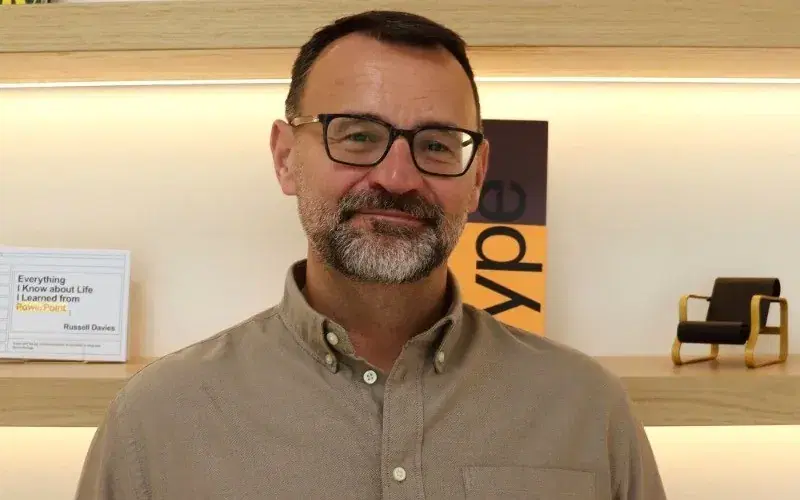
We talk about Notion's journey from a flexible, block-based collaboration platform to an AI-native workspace where context is the real differentiator. Mick explains why AI performs better when it understands how work actually happens, and how embedding agents directly into shared workflows allows teams to move from prompting tools to orchestrating outcomes. From automated reporting and knowledge management to self-improving agent loops that learn from their own performance, the conversation brings to life how organizations are already using AI to remove the "work around the work" and focus on higher-value thinking.
A major theme throughout the discussion is return on investment. In a world where many companies are still stuck in pilot mode, Mick shares how leaders can reframe ROI around productivity, speed, and the elimination of repetitive tasks rather than treating AI as a single project with a fixed payback period. We also explore how roles, org structures, and hiring priorities are beginning to shift as agents become extensions of team capability rather than experimental add-ons.
Because Mick leads the EMEA region, we also dive into the differences in adoption between the US and Europe, from regulatory considerations and cultural attitudes to the growing strength of the European startup ecosystem. It's a balanced view that recognizes both the caution and the creativity emerging across the region.
This is ultimately a conversation about friction. What happens to an organization when coordination overhead disappears, when reporting builds itself, and when knowledge stays current without human intervention?
So as AI agents move from novelty to infrastructure, are businesses ready to redesign how work gets done, and what becomes possible when teams stop managing tasks and start compounding impact?
Useful Links
[00:00:04] - [Speaker 0]
Welcome back to another episode of the Tech Talks Daily Podcast. And today's episode lands on a big day for a company called Notion. Because as this conversation goes live, Notion custom agents are being announced to the world. And you, my friends, are gonna be among the first to hear exactly what it means in practical terms. So, yeah, we will talk about AI agents right now because it is noisy out there.
[00:00:33] - [Speaker 0]
The headlines are loud. But today, the promises are even louder. But what does this actually look like? A world where agents move from hype to something that your team can use. Not next month, not all next year, but right now, this week.
[00:00:49] - [Speaker 0]
Well, today, I'm joined by Michael Hodgins. He's the general manager for EMEA at Notion. He's also an ex Googler. And we're gonna unpack together what custom agents really are, why this launch matters so much, why it is a game changer, and also talk about how agents can be embedded directly into the place where work already happens. And for those of you that are tired of hype stories, we'll talk about exactly how quickly they can be set up, what real return on investment looks like, and why you should stop treating AI as an experiment and start treating it as a teammate.
[00:01:27] - [Speaker 0]
So especially if you've been stuck in pilot purgatory, unsure where to begin, or just quietly wondering whether Agenta AI is ready for prime time, is ready for your enterprise, hopefully, this episode will deliver you lots of value today and a few takeaways because this conversation isn't about theory. It's about what's possible today. With that scene perfectly set, let me officially introduce you to my guest right now. So thank you for joining me on the podcast today. Can you tell everyone listening a little about who you are and what you do?
[00:02:04] - [Speaker 1]
Sure. I'm Mick Hodgins. I am the general manager for Notion in EMEA. I was appointed last year in summer twenty twenty five. And my responsibilities are really to lead the company's operations and growth in the EMEA region.
[00:02:20] - [Speaker 1]
So that's building out the regional footprint in EMEA, looking after their relationships with customers and partners, and scaling up the team. And and before I joined Notion, I I spent thirteen years at Google in EMEA where I led teams in large customer ad sales and ad tech as the managing director for EMEA. And, and that gave me an opportunity to to get this, like, really good moment of earning my technology stripes and, you know, scaling growth teams, working with customers in over 20 different countries. So that's me.
[00:02:52] - [Speaker 0]
Love it. So and ex Googler, what by if you were with Google back in the day, was it all multicolored beanbags, slides, and bikes, or or was that a bit of a myth?
[00:03:01] - [Speaker 1]
There were a lot of multicolored beanbags. Yeah. But they tend to be single color beanbags with a multicolor arrangement, Neil. You know? We have Right.
[00:03:08] - [Speaker 1]
Lots of box holes. Lots of fun. Google is phenomenal. I I I really did learn so much there, and I I was there from an early stage in the company, not quite early early, but, you know, 2011, still scaling up, working it all out. Yeah.
[00:03:22] - [Speaker 1]
It was a it was an incredible place to learn, and I still have a lot of really great friends there.
[00:03:27] - [Speaker 0]
Love it. And, of course, that path would take you to Notion where you are today. And for people listening that could be scattered all around the world, could you just tell me a little bit more background on Notion as a company for people that are hearing about them for the first time?
[00:03:41] - [Speaker 1]
Yeah. Sure. I'll I'll focus on where we are today because Notion's story is is really interesting, and and maybe I'll encourage our listeners to to listen to the founder story. Ivan Jout has this phenomenal story about how he founded the company, and maybe you should get him on some day to have a chat about it. But it's an interesting story about resilience and reinvention and innovation.
[00:04:03] - [Speaker 1]
But just where we are today, Notion is a connected AI workspace. So if you think about a multiplayer space where teams can create and collaborate and communicate, that's what we try to provide. We try to provide a space where teams can come together and build tools that take busy work out of the system so, you know, you can focus on doing the things that are gonna drive value, and you can focus on your life's work. So we've got more than mid 100,000,000 users worldwide. 80% of those users are are international.
[00:04:37] - [Speaker 1]
They're outside of The US, which makes us a little bit of a an inversion anomaly. And last year in mid twenty twenty five, we we surpassed half $1,000,000 in ARR. So it's been an incredible journey. We we also opened hubs in London, Paris, and Munich last year. We're going up markets.
[00:04:55] - [Speaker 1]
We're we're trying to scale up into the enterprise space. So it was really, really important for us to to get a beachhead in The UK, in Paris, and in Munich to expand further across EMEA and to just really invest in local talent and get a lot closer to our customers. And now we see that we've got, you know, today tens of millions of users in EMEA and tens of thousands of businesses who are using our products.
[00:05:21] - [Speaker 0]
And fast forward to what we're doing right now. I've been to several tech conferences this year already around the world, and one of the themes that is predictably carrying on from last year is Agentic AI or AI agents. They seem to be the technological innovation of the moment. But everywhere I go, they generate much discussion and debate. So from your side at Notion, what are you doing what are you doing in this space, and and how do you see AgenTiKi fitting into Notion's long term vision for its product?
[00:05:51] - [Speaker 0]
Presumably, you're you're gonna be looking at this too. Right?
[00:05:54] - [Speaker 1]
Yeah. It's noisy out there, isn't it?
[00:05:56] - [Speaker 0]
Yeah.
[00:05:57] - [Speaker 1]
Very noisy. But let me just take a little step back and talk to you a bit about about the history of AI and recent history of AI in Notion, and then the bet that we're placing on agents and how we've moved into that space. So we were very, very early to generative AI. Why? Because the founders realized a little bit serendipitously that it fit perfectly with with how Notion is built.
[00:06:20] - [Speaker 1]
So Notion is built on this principle of building blocks. Make it easy for developers to build tools without any coding and make it as simple as possible to assemble that in a workspace where you've got context. So the simplicity of it is that AI just works better when it has better context. We introduced Notion AI, little fun fact, in private alpha in November 22, two weeks before chat g p three came chat g p t three came out to the market. So, you know, we like to to tell people that we were first to market with AI GBTs.
[00:06:54] - [Speaker 1]
And since then, we've been just iterating on new features, technologies evolving at such a rapid pace. We've been adding capabilities from, you know, things like content generation to information retrieval, enterprise search, AI meeting notes, just just a lot of stuff that has supercharged Notion's building blocks. And last September, we launched Notion Agents. We we encourage our teams and our customers to think of them as sort of personalized AI teammates that are built directly into the workspaces where teams collaborate and do work so that they can complete tasks end to end on demand. So you you know, typical chatbot type of setup.
[00:07:36] - [Speaker 1]
You ask a question. You prompt something to do something, and a Notion agent will respond. But what we're really excited about now is just the recent launch of custom agents. They're agents that run automated workflows based on a schedule or a trigger or a prompt that you set up, and you just have to let run. So if you are, you know, working in a a marketing team or you're working in a a DevOps team and you set up an agent for a key workflow just once, then your entire team has got an AI team mate to go and drive that process.
[00:08:10] - [Speaker 1]
So just to bring it to life a little bit, some of the use cases we see internally, you can create a weekly reporting agent to compile updates across all your projects. You can you can use a knowledge agent to keep your documents fresh and up to date. We're seeing customers use cleaner agents to go in and and tidy up, project management databases. It's just an incredibly exciting time to be in that space. And and to answer, I think, your question about strategy, we we believe that, you know, we're firmly, firmly positioned to embed AI into knowledge work, And that's really the the core bet that we're placing.
[00:08:46] - [Speaker 1]
It's a core part of our long term vision. You know, there's a lot of transformation going on, and there's gonna be a lot of winners and a lot of losers. And we believe that you if you win and you're to win, you're gonna need revenue, obviously, from AI and from your AI products. You're gonna need growth from customer acquisition, more customers coming in to to play with those products who are attracted to your solutions. And number three, you're gonna need a really, really clear point of differentiation.
[00:09:17] - [Speaker 1]
So for one or two, at the end of last year, 2025, more than 50% of our ARR came from AI enabled customers, and that percentage more than doubled over the last year. So we think we got the revenue and the growth thing not perfect, but it's moving in the right direction. And in terms of differentiation, we are the are one of very, very few multiplayer solutions out there in the marketplace who use context and collaboration to drive better performance in AI. So it's it's wild out there. It's moving at a ferocious pace.
[00:09:53] - [Speaker 1]
The market is not waiting for anybody, but we're really excited because we believe we're really well positioned to do a brilliant job for customers and for partners.
[00:10:03] - [Speaker 0]
And just for any business leader that could be listening anywhere in the world, just heard what you said there, and you've given several examples of the kind of things that can be handed over to agents and relatively quickly. How much hard work is needed to set that automation of a report, and what skills do their teams need? So if we have somebody wanting to tidy up their project database or that set that weekly report, What kind of skills do they need, and how quickly would it take to automate something like this?
[00:10:29] - [Speaker 1]
Yeah. Look. You can automate in seconds for basic routines, and you can also select from a a list of predefined agents that are available in the workflow. But just to build an agent within the the the agent card, it's all natural language. You can select the, applications that you can link into and just write your prompt, experiment, and then invite the agent to improve the performance of that agent.
[00:10:54] - [Speaker 1]
So they are, at the base level, very, very easy to set up. Obviously, we're learning so much from our customers and so much from our communities about use cases that that weren't even on our radar. And some of them was our some of those are complex and will require more work. But at at a simple and baseline foundational level, these are not hard to set up, and that is the attraction of our AgenTx solution.
[00:11:19] - [Speaker 0]
And one of the reasons I wanted to answer is I think the other big thing that has followed on from last year, whether it be GenAI or AgenTik AI, is ROI. We've seen many companies get stuck in pilot purgatory, can't get the things over the line. And just to bring to life how easy this is that we're talking about here, I don't expect you to name any names. Are there any other examples of tasks or context where these custom agents can provide a unique advantage and deliver that ROI relatively quickly?
[00:11:49] - [Speaker 1]
Yeah. I think look. If you if you wanna think about return on investment as a single definition for a project, you're gonna struggle.
[00:11:57] - [Speaker 0]
Yeah.
[00:11:58] - [Speaker 1]
And I I think that's one of the really interesting challenges that business leaders are facing today. So how do I define return on something that feels like vaporware? It feels so intangible. And I think it's really, really important when you're in that space with your customer success manager, whether that's Notion or another provider or working with your account executive, you know, we've seen that many of our our employees are evolving into AI cons consultants and helping people understand, well, what are you trying to defray? What are you trying to improve?
[00:12:33] - [Speaker 1]
Are you looking to displace cost? Are you looking to improve productivity and displace busy work? Getting that ROI nailed on is is really, really super important. But but maybe just to talk a little bit about the the the areas where AgenTic AI can really, really drive value, it's it's in its essence about enhancing productivity. Yeah.
[00:12:54] - [Speaker 1]
Agents are really simple. You can set them up. You can share them. One team member can create create an agent. The ripple effect is that everyone can gain hours of time back, and and that value compounds as you you automate more workflows and you scale across the team with some of those core processes that you've cracked.
[00:13:15] - [Speaker 1]
I think as well another use case that we're we're seeing a lot of is the automation of high volume tasks. So monitoring support tickets for trends, work that was previously too expensive for a lot of businesses to prioritize, but it provides really invaluable insights for your teams to improve how they operate. So we're seeing a lot of bug intake and triage agents or marketing creative requests coming into marketing organizations, which are being triaged by agents before they hit the desk of the people who are determining what the r r RFP looks like. And I think the other thing for me is, you know, if you just zoom out a little bit, ultimately, the key value driver of an agent in a business is its ability to accelerate innovation, increase productivity, eliminate the busy work, as we say, so that you can focus on those higher level tasks. And that drives ROI.
[00:14:08] - [Speaker 1]
Think about all the times you don't now have to produce a a product road map, and you can invest more time thinking about commercially how you're gonna launch into new markets or commercially how you're gonna launch new products into new sectors. It's just a absolute game changer.
[00:14:25] - [Speaker 0]
And just to further bring that to life, I'm curious. What would you say are the the biggest opportunities that you see for AgenTek AI that will enhance productivity within businesses? I'd love to inspire people that could be listening in enterprises of all sizes and maybe rediscover the art of the possible. What what do you see here? Where do you see those biggest opportunities?
[00:14:47] - [Speaker 1]
You know, we're talking a lot about how limitless this potential sphere is, but, you know, let's get down to simple things, down to brass tacks. And maybe just to give you some examples of stuff that's coming back in from customers, several customers in The UK who are are using our custom agents, we're getting a lot of positive feedback. We're getting a lot of creative ideas, but we're also getting a lot of commonality about baseline use cases, automating recurring, high context coordination, and time consuming tasks. So, for example, one of our leading European fintechs uses a meeting notes agent to just build daily recaps and generate tasks from across all of the meetings that have happened in the company that day. That's incredibly powerful.
[00:15:32] - [Speaker 1]
Another one is using an agent to keep their company databases continually updated for external knowledge or insights related to certain companies that they're doing business with. So you don't have to go out onto the web to try and look for an investment report or an update. You can have an agent that will pull in that information and provide real time insights into what's happening with that company out in the marketplace, which is quite incredible. But there's one as well that I I found really interesting, which has come from one of our French ecommerce clients. They have a an agent that basically makes the other agents better.
[00:16:14] - [Speaker 1]
So they've got a governance and self improvement loop agent. That agent runs into an agent logs database, and they record every single success, warning, or failure with an agent run-in that database, but they have a separate improver agent that looks across all of the patterns and suggests instruction updates and shares learning across the agent community so they can perform better. So, like, it it's just quite bizarre, the the extent to which the market is just moving forward, and customers are getting so much more creative about how they surface insights, drive activity at scale, and really, really just focus on taking the busy work out of their day. It's it's phenomenal.
[00:17:02] - [Speaker 0]
I love that. I was speaking to a few people at a tech conference recently, and they were talking about adding agents as a member of the change advisory board in IT, and that they was seeing big results from that as well. And I I I would imagine when you create and launch these custom agents, you will begin by creating templates for the most frequently asked kind of things that people want inside an enterprise. Most enterprises are very, very similar. They have the same kind of request of things they wanna automate.
[00:17:30] - [Speaker 0]
So you will create those those as a starting point, but then you're gonna be talking with a lot of enterprises that say, hey. What about this? What about that? I'm I'm curious. From those conversations, is there anything that surprised you that that maybe they they come and ask you for, and you say, oh, wow.
[00:17:44] - [Speaker 0]
I didn't think of that. Because once these things are are launched into the wild, so to speak, businesses, they can always create a life of their own and and bring different ideas and different ways of working to life, can't they?
[00:17:56] - [Speaker 1]
They can. And, look, there there are numerous examples of custom and bespoke agents that organizations want to build, and organizations are being really, really open and innovative and, you know, expansive about how they think about the the future of agents and the future of work. I think there's been one interesting one for me through media agencies and and sales and marketing companies that we've been working with, you know, many who work through client specific workspaces across different functions. And and the ability for an agent to pull across, you know, Slack communication channels internally and externally and ensure that every day there's a daily brief on what's going on each of those individual companies has been something that we didn't see as a use case. But I think this is just the start.
[00:18:45] - [Speaker 1]
The tech forward companies and the tech forward enterprises, the Monzo banks, the the Quantos of this world, they're very much thinking about how they can just embed agents into the the essence of where the work happens, every single workflow in their business, anything that requires coordination that's gonna help them drive speed. The more traditional organizations, they're taking their time. They're trying to find that little use case which will allow them to prove the value, demonstrate understanding, and then accelerate the way that they can scale. And there's a lot of a lot of people thinking about how that's gonna even change the way that organization structures are designed. You just gave the example of, you know, people saying there's an agent in the room.
[00:19:31] - [Speaker 1]
Well, maybe there's gonna be an agent in the boardroom, and the agent in the boardroom is gonna assist in the, collation of information to make better decisions in the moment. So, you know, when I say that this opportunity is limitless, it really is. But if I was starting or I was encouraging a company to start, I would get them to use a very a very simple high probability, you know, sales operations use case, DevOps use case, customer service use case, and and just start from there. You would be astounded at how quickly you can get value from using a custom agent within Notion, within the the workspace.
[00:20:09] - [Speaker 0]
Completely agree with you. And right now, we are talking about early days and starting with those simple use cases and evolving from there. But I'd love to maybe inspire people listening again. If we look further into the future, what what should we expect to see from the evolution of AI agents in 2026 and even beyond and how agents could transform the future of work? And I realize this is a bit of fun and crystal ball gazing to a certain extent, but where do you see this heading?
[00:20:40] - [Speaker 1]
Yeah. It's you know, I'm a tech optimist, but I'm also a tech pragmatist. And Yeah. You know, we we've heard a lot of conversations about singularity and and about, you know, where the the agentic future could be, but I think we can say with a high degree of realism that we're gonna see agents very quickly become further ingrained into daily workflows. So there's a little bit of agent hesitancy amongst the nontech forward corporations and companies that we're working with, but they're still very much aware that agents are gonna be an extension of an employee.
[00:21:17] - [Speaker 1]
They're gonna be an extension of a team's skill set. They're gonna be an extension of the team's capability. They're gonna help teams do their best work, and they're not gonna be, you know, where for some organizations today, they're perceived as a nice to have, listen, tech gadget, for want of a better phrase. I think I think the future of work will be really shaped by the efficiencies that that agents create. And and we've gotta have a really strong point of view as a pioneer in that new workspace.
[00:21:50] - [Speaker 1]
So think about a situation where where work isn't gonna depend on constant coordination or organizations start to to eliminate eliminate that busy work and compound their advantage. What changes then isn't just speed. What changes is the removal of of friction.
[00:22:09] - [Speaker 0]
Mhmm.
[00:22:09] - [Speaker 1]
And as that friction fades, teams are are gonna stop managing the work around the work and just start moving with work. So I think you're gonna see a lot of organizations selling work, not tools. I think you will see a lot of organizations bringing together humans and agents who have different skills and capabilities to partner on specific projects in specific moments, and people's roles are gonna change. Like, we've gotta rethink org structures. We've gotta be a little more open minded about the people we hire and and their ability to problem solve and their systems thinking, and we're seeing that already with the the evolution and the enablement of our own people within Notion and the people that we're trying to hire out in the market.
[00:22:55] - [Speaker 1]
So I think we're at this unbelievably exciting point in technology. And like any great transformation, it's, it's hard to look too far beyond the next twelve to twenty four months because this is just gonna be so foundational and fundamental.
[00:23:13] - [Speaker 0]
And we are recording our conversation in The UK and Ireland today, but we will have many, many people listening in The US. And I'm curious from what you're seeing and the conversations you're having there, what what would you say are the the key differences in how The US versus The UK and EMEA markets are approaching agentic adoption? What are and if so, what are those differences? I would imagine over here in UK, Ireland, and Europe, we're much more guarded, cautious. There's the old saying that The US innovates and Europe regulates.
[00:23:45] - [Speaker 0]
So what what what are you seeing here in those differences?
[00:23:49] - [Speaker 1]
Yeah. I think that's a great question. I just wanna start by saying that, look. Yeah. European tech is in root health.
[00:23:56] - [Speaker 1]
UK tech is in root health. It really is. You know? You got businesses like Parloa, Synthesia, Monzo Bank, Lovable, Mistral AI. You know, that sort of I think that application layer, we've done a really, really, really good job in Europe.
[00:24:11] - [Speaker 1]
And and these companies are building serious businesses and disrupting serious segments and based out of based out of EMEA, and that's that's really, really exciting. But I think we're still at that point where it's a little bit of an exception as opposed to the real. EMEA has historically been a lot slower in moving into automation compared to The US, compared to APAC. There's a lot more regulatory considerations. There's a stronger focus on, let's call it, the principles of, like, social democracy and privacy.
[00:24:45] - [Speaker 1]
But, you know, there's a culture of experimentation bubbling up in Europe, and the ecosystem is thriving. And even if you look at the recent EU Inc. Initiative, that's an incredible example of of regional alignment, innovation, and and momentum. So I think you've got those sort of foundational differences, those, you know, move fast and break things as a mentality. It's sort of becoming more ubiquitous across all of the regions.
[00:25:10] - [Speaker 1]
But for agents, look. What we're seeing, we're seeing a lot of feedback, similar feedback from customers across markets. They just want AI that automates heavy workflows, not just one off tasks, heavy workflows. And it doesn't matter if that's a US company or a UK company. That's that's what they want.
[00:25:28] - [Speaker 1]
And there's still a bit of a gap between their expectation about what agents can deliver and the reality of what agents can deliver today. So with Notion, I think I think you get safe and reliable compounding AI. If your agents live where the work happens in the workspace and, you know, the the teams collaborate in a certain area where the teams coexist, your knowledge coexists, and now your agents are there to to do a lot of the heavy lifting for you, then that reinforces the the notions of value proposition, and it reinforces the value of our our connected workspace.
[00:26:12] - [Speaker 0]
I think that's a powerful moment to end on. I can't thank you enough for sharing your story, your insights, the value of these custom agents, which we will, provide everyone listening the details of how they can get up and running with those in a moment. But before I let you go, I want you to leave one final gift for everyone listening. We have a tradition on the show of asking my guests to share a book that has inspired you or mean something to you that we can add to an Amazon wish list or a song that we can add to a Spotify playlist. Guilty pleasures are allowed, but what would you like to leave us with and why?
[00:26:44] - [Speaker 1]
I tell you, I'm not gonna give you a song because I'm a I'm a fan of Jamaican ska and dance dancehall, so we could spend it's like a long time chewing the fat on sixties and seventies records, but but I have been inspired by a lot of books. I'm a pretty avid reader, and there's one that I go back to quite a few times over the last sort of thirty or forty years. I read Albert Camus' novel, The Plague, when I was a teenager. And, for those of those of you that that haven't read it, it's about an epidemic in an Algerian town in the nineteen forties. Not very uplifting and, you know, ideological, but it really, really hit me about, you know, a young teenager hit me about the frailty of of humanity.
[00:27:30] - [Speaker 1]
It raised my eyes and opened my eyes to what can happen when societies don't pay attention to stuff that's unfolding right in front of their eyes. I don't want to spoil it for your listeners, but but it's a really good read. There's these there's lots of suffering, and there's lots of acts of heroism. There's lots of isolation camp narratives, but there's a really, really, really strong anti fascist narrative. So for me, that's a timeless read.
[00:27:55] - [Speaker 1]
So pick it up, and after you read it, lift your head, give it a rating, have a look at the world around you, and don't be a passenger.
[00:28:02] - [Speaker 0]
Oh, woah. Brilliant. I will get that added straight to our Amazon wish list. And for anybody listening wanting to find out more about Notion, connecting with you or your team, learning more about these custom agents that we've talked a lot about today, where where should they go?
[00:28:17] - [Speaker 1]
Well, you know, just go and check out the Notion website, Go and check out any of our YouTube channels, and check out any of the podcasts that any of our founders are doing or any of our leaders are doing on all of your favorite platforms.
[00:28:33] - [Speaker 0]
Awesome. Well, I will add a link to everything that you mentioned there. I'll also, include a video, one of your videos to the blog post that will be associated with this episode over at techtalksnetwork.com. Have a look at that. After listening to this conversation, maybe ask yourself, where could I begin with these custom agents?
[00:28:52] - [Speaker 0]
I'd love for you to get in contact with me. Share your stories, your use cases, what you're thinking of doing, your successes, things you'd do differently. Let me know. But more than anything, just a big thank you for starting this conversation today. We will have to get you back on maybe later in the year and, shoehorn some Jamaican scar in there somewhere as well.
[00:29:10] - [Speaker 0]
But thank you for joining me today.
[00:29:12] - [Speaker 1]
Thanks, Neil. Thanks for having me. Really great, great chat.
[00:29:16] - [Speaker 0]
I think if there's one idea I hope that you take away from my conversation today with Michael, it's this. The future will not be shaped by tools alone, but it will be shaped by how we rethink the way that humans and intelligent systems collaborate. At Notion custom agents, they are an example of this shift. They're not positioned as a novelty feature or a shiny extra. They are designed to sit inside your existing workflows, remove the friction that is slowing your teams down.
[00:29:49] - [Speaker 0]
And in the early days, whether that is compiling reports, cleaning up databases, refreshing knowledge, or quietly improving other agents in the background, all the stuff that has traditionally eaten up your team's time, These things can be improved and very quickly. So the real story here for me is about reclaiming time and attention throughout teams in an enterprise. But, yes, this is just talk today, isn't it? But here's my challenge to you. Where could you introduce a custom agent that gives your team back an hour, a week, or possibly even longer?
[00:30:23] - [Speaker 0]
And what could change in your organization if you got back those hours, those five hours, those days? What could you do differently? How could you move quicker as an organization? Today was about talking about the tools that can help you do all this, but I wanna help spark an idea that you can share with your team, that you can get off your the tube, the metro, the bus, the car, walk into the office and go, hey, guys. I've listened to a podcast today.
[00:30:49] - [Speaker 0]
Custom agents, we need to look into this a little bit. What could we do with them? If you could walk away with a valuable takeaway like that, then my work here is done. But, as always, reach out. Tell me how you're thinking about custom agents in your own organizations because your stories are the ones that will shape what will happen next, and I wanna hear about them.
[00:31:11] - [Speaker 0]
So please go by techtalksnetwork.com. You can record me a audio message or send me a DM on socials or an email, whatever is easiest for you. So I will await your ideas. Keep them coming, and I'll return again tomorrow with another guest. How's that sound?
[00:31:28] - [Speaker 0]
Deal? Good answer. Speak with you all again tomorrow. Bye for now.