
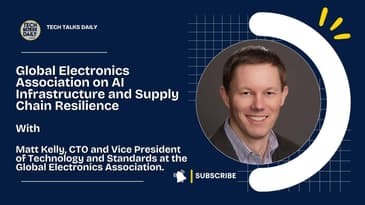
In this episode of Tech Talks Daily, I speak with Matt Kelly, CTO and Vice President of Technology and Standards at the Global Electronics Association, about the growing pressure on AI infrastructure and the supply chains that support it.
Drawing on insights from thousands of member organizations across manufacturing, automotive, and electronics, Matt offers a practical look at what business and technology leaders should really be preparing for in 2026 and beyond.
Our conversation begins with the shift from cost optimization to resilience and system-level performance. Matt explains why the old procurement mindset of chasing the lowest-cost supplier is rapidly being replaced by what he calls confidence-based sourcing. In a world shaped by geopolitical disruption, pandemic aftershocks, and surging demand for AI, organizations are discovering that cheap sourcing means little if critical components fail to arrive on time.
We also discuss why dual sourcing has evolved from a procurement strategy into a business continuity requirement. Matt shares real-world examples of how something as small as a missing capacitor can prevent the delivery of million-dollar AI infrastructure systems. That single point of failure has pushed resilience metrics such as recovery time, geographic diversity, and validated backup suppliers into boardroom discussions. Another major focus of the episode centers on AI infrastructure itself.
While many conversations around AI focus on software models and automation, Matt argues that the true bottleneck may soon become power availability. From server cooling and energy consumption to sustainable hardware design and material shortages, the industry now faces challenges that stretch far beyond compute performance alone. Matt also explains why fully localized supply chains remain unrealistic for the electronics industry. Instead, he advocates for a balanced model that combines trusted global partnerships with strategic regional sourcing for critical components and security-sensitive technologies.
One of the strongest takeaways from this conversation is that AI infrastructure must now be approached as a system problem. Silicon design, packaging, thermal management, power delivery, sustainability, and supply chain strategy cannot be treated as separate conversations.
As organizations race to scale AI capabilities over the next few years, are business leaders truly prepared for the infrastructure realities sitting behind the AI boom, or are we about to discover that resilience and energy matter just as much as innovation itself?
Please check the partners of the Tech Tech Talks Network
Learn more about the NordLayer Browser Visit Denodo.com