
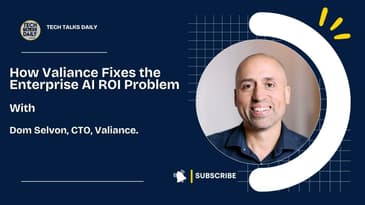
In this episode of Tech Talks Daily, I speak with Dom Selvon, CTO and value partner at Valiance, about enterprise AI ROI, outcome-based consulting, build versus buy decisions, proprietary data, ontologies, and governance.
Valiance is an AI-native consultancy that charges against client outcomes rather than hours worked. Dom explains why his “value partner” title is deliberate. The company begins by identifying the financial or operational result a client wants and connects its own compensation with achieving that result.
Dom argues that many AI initiatives begin without a clear definition of success. The pressure to adopt AI is real, but companies frequently select technology before agreeing on the business problem, desired outcome, or measurement.
He identifies three recurring mistakes. The first is framing the project around AI rather than the business need. The second is failing to establish a metric and baseline before work begins. The third is using a consulting model that rewards billable time without connecting payment to the client’s result.
We also discuss how generative AI is changing traditional build versus buy decisions. Companies historically bought software because custom development was slow, expensive, and difficult to maintain. Coding agents can now reduce the time and cost required to create software for specific internal needs.
Dom does not believe SaaS will simply disappear. However, vendors selling convenience, workflow wrappers, or integration glue face new competition from customers who can create similar capabilities themselves. He argues that stronger SaaS positions will depend on assets a model cannot easily regenerate, including proprietary data, networks, regulatory standing, and deep workflow adoption.
This leads to a wider discussion about competitive advantage. When companies have access to similar models, generated code begins to converge. Dom believes lasting differentiation comes from company data, institutional knowledge, connected systems, employee experience, and the semantic context surrounding that information.
Dom explains why ontologies matter to enterprise AI. Raw data tells an agent what is stored in a particular field. An ontology describes the customers, orders, contracts, payments, relationships, and business rules represented by that data. This context allows people and agents to reason about information in a way that reflects how the company actually works.
Governance also needs to be designed from the beginning. Dom argues that security, permissions, accountability, and compliance allow successful pilots to expand without forcing the business to rebuild everything later.
How can leaders tell when AI is genuinely being adopted? Dom offers a surprisingly simple signal: people stop talking about AI. The technology becomes part of ordinary Monday morning work, and employees focus on completing the task rather than explaining the tool.
Has your company defined the business result, measurement, proprietary context, and governance required to turn AI enthusiasm into operational value? Listen to the episode and share your thoughts with me.