
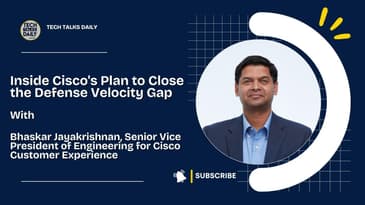
At Cisco Live, I sat down with Bhaskar Jayakrishnan, Senior Vice President of Engineering for Cisco Customer Experience, to discuss a reality facing technology leaders everywhere: attackers are increasingly operating at machine speed while many organizations are still relying on processes designed for a very different era.
Our conversation explores what Cisco describes as the defense velocity gap and why traditional approaches to patching, remediation, and risk management are becoming harder to sustain as environments grow more complex. Bhaskar explains how organizations are shifting from reactive security practices toward more continuous approaches that focus on visibility, resilience, and operational readiness.
We also discuss one of the biggest long-term challenges facing the industry: quantum computing. While many organizations still view quantum threats as a future problem, Bhaskar explains why preparations need to begin now, particularly when it comes to crypto agility and the risks associated with "harvest now, decrypt later" attacks.
Another major theme throughout our discussion is AI. Bhaskar shares lessons learned from Cisco's own experience deploying AI across a workforce of more than 20,000 employees and explains why successful adoption often depends less on the technology itself and more on data quality, workflow design, and organizational trust.
Along the way, we explore resilience, modernization, automation, and what it takes to prepare an organization for a future where both opportunities and threats are arriving faster than ever before.
If you're trying to understand how cybersecurity, AI, and quantum computing are reshaping the responsibilities of today's technology leaders, this conversation offers practical insights from someone helping organizations tackle those challenges every day.
Are today's security and operational models ready for a world moving at machine speed, or is it time for a completely different approach?