
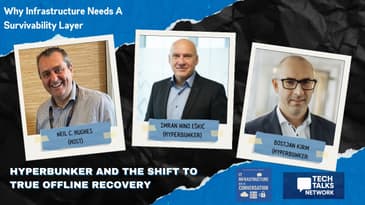
For years, infrastructure has been designed around availability, scale, and performance. Recovery was treated as a process that would work when needed. But as attackers have grown more patient and methodical, they now target recovery paths first, quietly mapping environments and neutralising backup systems long before an incident becomes visible to the business. That shift forces a new architectural question for infrastructure leaders. Where is the layer that remains reachable when everything connected has been taken down?
We explore why so many environments that claim to be air-gapped or immutable still rely on credentials, control planes, and automation, and how those dependencies create hidden single points of failure. Imran and Boštjan explain how HyperBUNKER introduces a physically isolated survivability layer into modern infrastructure, using a hardware-enforced, one-way ingestion process and a double air-gap design that removes the network from the vault entirely. No IP address, no inbound ports, and no authentication surface to attack.
This leads to a wider conversation about infrastructure governance, cyber insurance, and regulatory pressure. Insurers are increasingly focused on whether a final, untouchable copy of critical data exists, because the largest financial losses now come from failed recovery rather than the initial breach. That reality is pushing offline recovery out of the basement and into board-level architecture discussions.
We also tackle the practical challenge every organisation faces. If only a small percentage of data can be placed in a fully isolated vault, how do you decide what keeps the business alive? That decision, as we discuss, cannot sit with IT alone. It requires operational and executive alignment around what the company must have to restart after a catastrophic event.
This episode reframes resilience as an infrastructure design principle rather than a security feature. It asks where a survivability layer should sit alongside cloud platforms, backup software, and existing controls, and why the future of Infrastructure as a Service may depend as much on guaranteed recovery as it does on uptime.
If your architecture assumes that recovery will always be there when you need it, this conversation may change how you think about your entire stack.