
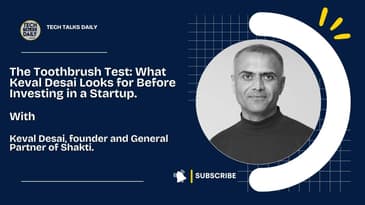
In this episode of Tech Talks Daily, I speak with Keval Desai, founder and General Partner of Shakti, an early-stage venture capital firm investing in AI and space technology companies from inception. Drawing on his experience backing companies including Canva, The RealReal, and Gatik, Keval shares how he evaluates founders before the rest of the market recognizes their potential and why the venture capital industry needs to confront some uncomfortable truths about startup funding and successful exits.
Keval introduces Shakti's "toothbrush" investment philosophy, an idea he first encountered through Larry Page at Google. The principle is simple: can a product or service become something used frequently by millions or even billions of people? He explains why this question helps investors distinguish impressive technology from businesses capable of creating lasting value, particularly at a time when thousands of AI startups are competing for capital and attention.
But identifying a large market is only part of the equation. Keval shares three characteristics he has observed in exceptional founders. They can describe a future that others cannot yet see, attract talented people before they have money or resources, and execute at a speed that continually surprises those around them. His stories from meeting Canva co-founder Melanie Perkins and The RealReal founder Julie Wainwright offer a rare look at what investors can learn from founders at the earliest stages of company building.
We also discuss Keval's thesis that AI is taking the economy into a new Imagination Era. As AI becomes increasingly capable of handling specialized tasks such as coding, analysis, and production, he believes human value will move toward imagination, judgment, taste, and the ability to combine technologies into products and services people actually want. For founders, employees, and business leaders, this raises important questions about education, careers, and what it means to build a company as access to technical capabilities becomes dramatically cheaper.
Keval also compares the arrival of open-source AI models such as DeepSeek to the role Linux played in the development of the commercial internet. He explains why falling inference costs could lower barriers to building AI companies and create opportunities for a new generation of startups, while also examining what this could mean for today's dominant AI companies and the industry's economics.
The conversation then turns to one of the biggest problems facing venture capital. The number of startups receiving funding has grown dramatically, yet the number of technology companies reaching public markets has remained relatively static. Keval explains why venture capital can scale dollars but cannot simply manufacture more category leaders, and why founders need to decide early whether venture capital is actually the right source of funding for the business they want to build.
We also examine the commercial opportunities emerging from space technology. Keval believes the SpaceX IPO could play a similar role for space commerce to Amazon's IPO for e-commerce, by demonstrating viable business models and encouraging entrepreneurs to build new companies in communications, energy, manufacturing, infrastructure, robotics, and services beyond Earth.
Finally, Keval offers an optimistic counterargument to fears that AI will leave younger workers without meaningful careers. He explains why he believes Gen Z's status as the first AI-native generation could become an advantage, why technical careers are changing rather than disappearing, and why the ability to apply AI to problems across healthcare, manufacturing, agriculture, finance, and other industries could create opportunities far beyond Silicon Valley.
This conversation offers founders a practical framework for evaluating ideas, choosing investors, understanding venture economics, and building companies in the age of AI. It also provides investors and technology leaders with a broader perspective on open-source AI, space commerce, the future of work, and where the next generation of category-defining companies could come from.