
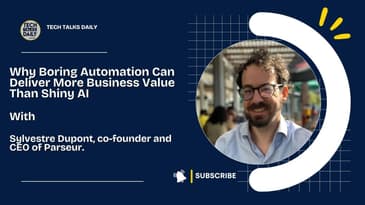
In this episode of Tech Talks Daily, I speak with Sylvestre Dupont, co-founder and CEO of Parseur, about why successful AI adoption begins with making business data usable, why traditional automation can often outperform more sophisticated AI systems, and how he built a profitable global technology company with six employees across six countries without venture capital funding.
Sylvestre introduces the concept of data liquidity, the ability to move information from the documents and systems where it is trapped into the applications, workflows, and AI systems that can put it to work. Companies may have years of valuable operational data, but if that information remains buried inside what Sylvestre calls “digital concrete,” even the most advanced AI models will struggle to produce useful results.
The conversation examines why structured data extraction has become increasingly important as companies invest in AI agents, copilots, and automated workflows. Sylvestre explains that better models alone cannot compensate for incomplete, inaccessible, or poorly structured information. Before businesses can expect AI to automate complex processes or support better decisions, they need reliable ways to collect, structure, and move data between systems.
We also challenge the assumption that every business problem now requires an AI solution. Sylvestre explains why AI should be treated as one tool among many and why deterministic automation remains the better option for repetitive processes where accuracy, consistency, and explainability matter. Parseur itself combines AI-powered document processing with template-based extraction and traditional workflow automation, using each approach where it performs best.
Drawing on Parseur’s experience processing more than 100 million documents annually, Sylvestre describes the different stages companies move through as they mature their automation strategies. Some begin by manually uploading documents and downloading extracted data. Others automate document ingestion and connect information directly to accounting platforms, CRM systems, and other business applications. The most advanced companies add exception handling and human review processes for situations where automation cannot reliably complete the task.
Data privacy and security are another major part of the discussion. Sylvestre shares the questions technology leaders should ask before sending sensitive company information to AI-powered platforms, including where data is stored and processed, whether customer information is used to train AI models, how deletion requests are handled, and whether vendors genuinely understand the regulations and security standards they claim to follow.
For founders and bootstrapped entrepreneurs, Sylvestre also shares an alternative perspective on building technology companies. Parseur has remained profitable, globally distributed, and customer-funded rather than pursuing the venture capital model of rapid expansion. Sylvestre explains why he prefers customers to determine the company’s priorities, how asynchronous communication supports a team operating across multiple time zones, and why building a sustainable business can offer founders greater control over product decisions and company culture.
This conversation offers practical lessons for technology leaders deciding where AI belongs in their operations, operations teams trying to reduce repetitive manual work, and founders questioning whether venture capital is the only route to building a successful global software company.
The message throughout the episode is simple: AI can be extremely useful, but companies still need reliable data, appropriate technology choices, strong privacy practices, and well-designed business processes. Sometimes the smartest technology strategy begins by solving the boring problems first.