
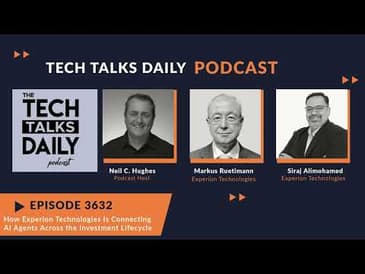
In this episode, I speak with Markus Ruetimann, a member of the Experion Technologies Advisory Board and former Global Chief Operating Officer with more than three decades of experience in institutional asset management, alongside Siraj Alimohamed, Global Head of Data and AI at Experion Technologies.
We begin with a simple question. What does an asset manager actually do with our pensions, savings, and investments every day? Markus takes us through the investment process, from research and stock selection to portfolio construction, trading, settlement, performance analysis, and regulatory reporting. Along the way, we examine where time, money, and expertise are being lost.
Siraj then explains composable AI through one of the clearest analogies I have heard. Think of building with Lego bricks rather than creating every solution from scratch. Companies can create reusable AI agents for research, risk monitoring, compliance, portfolio analysis, trade execution, and reporting, all operating on a shared data and governance foundation.
We discuss how this model can change the economics of AI adoption. Siraj shares examples of AI reading hundreds of broker reports in seconds, freeing hundreds of analyst hours, reducing portfolio review cycles from days to hours, improving trade execution quality, identifying settlement risks before trades fail, and accelerating regulatory reporting.
The conversation also tackles one of the most common reasons companies delay AI projects: “our data isn’t ready.” Siraj argues that waiting for perfect data can become an excuse for inaction. His advice is to identify two or three measurable use cases, prove their value within weeks, and use those results to build confidence and secure further investment.
But technology is only part of the story. Markus explains why AI adoption in asset management is also a cultural and organizational challenge. Companies must decide which processes to automate, which to support with AI, and where human judgment must remain firmly in control.
The message from both guests is refreshingly practical. Start small, start with a real business problem, connect AI systems through a common data foundation, and give skilled people more time to make better decisions.
Can composable AI help asset managers respond faster, reduce costs, improve investor returns, and make better use of human expertise, or will legacy systems and cultural resistance continue to slow progress? Listen to the conversation and share your thoughts.